



Published by GFXToolz AI | Last updated: March 2026
Keyword research tutorial — this is the complete step-by-step guide every SEO beginner needs. Keyword research is the difference between writing a blog post 10 people read and one 10,000 people find.
This tutorial walks through the entire process step by step. We’ll use free tools where possible and show you how to access premium tools like SEMrush and Ahrefs without paying ₹10,000+/month. By the end, you’ll know how to find keywords your audience is actually searching for, evaluate whether you can realistically rank for them, and organise them into a content plan you can execute.
This keyword research tutorial covers every step from seed keywords to content calendar
What is keyword research (and why it matters)
“How to find keywords” is really just one question in disguise: what do people type into Google when they’re looking for something you offer?
Keyword research is the process of answering that question systematically. Instead of guessing, you look it up and build your content around what the data shows.
Here’s why it matters: according to Ahrefs’ crawl data, 90% of web pages get zero organic traffic from Google. The most common reason isn’t bad writing or weak technical SEO. It’s targeting keywords nobody searches for, or targeting keywords so competitive that a new site has no realistic path to ranking. Keyword research catches both of these before you spend time writing the wrong thing.
A concrete Indian example: a freelancer starting a digital marketing blog could write posts targeting “digital marketing” — 150,000+ monthly searches, top results from HubSpot, Neil Patel, Forbes. They will not rank. Or they could target “digital marketing tips for small businesses in India” — same topic, far lower competition, specific audience, actually rankable. The effort to write both posts is roughly equal. The traffic outcome is not.
That’s the entire case for keyword research in one example.
The 3 types of keywords you need to know
Understanding keyword types is the foundation of any keyword research tutorial.
Before jumping into the step-by-step process, you need to understand three categories of keywords and which ones you should actually target.
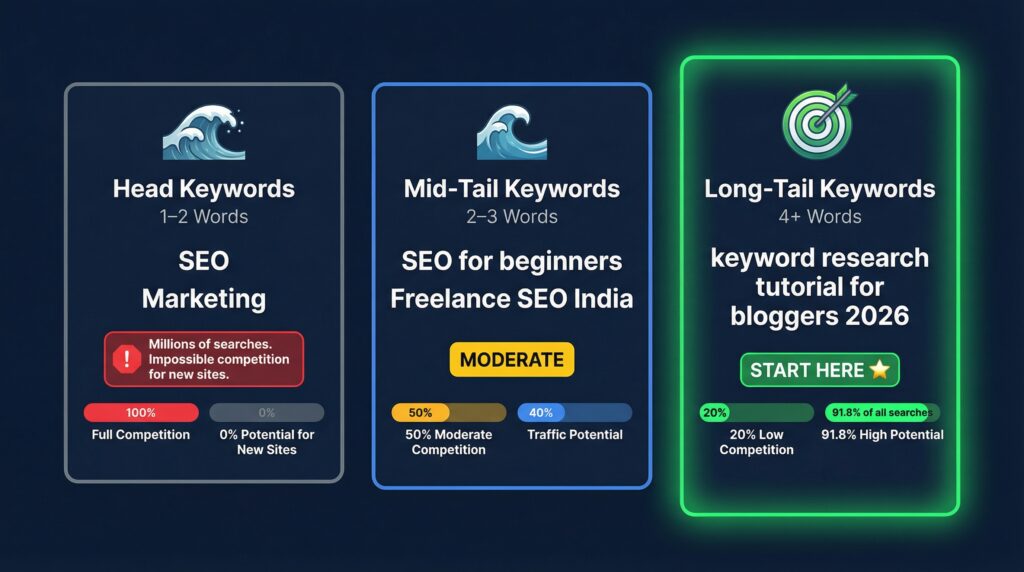
Head keywords (1–2 words)
Examples: “SEO,” “keyword research,” “digital marketing,” “freelancing.”
Short, broad terms with massive search volume and brutal competition. “SEO” gets millions of searches per month. The top results are Moz, Google, HubSpot, and Wikipedia. A new site targeting this keyword isn’t competing — it’s invisible. Save these for later, much later.
Mid-tail keywords (2–3 words)
Examples: “keyword research tools,” “SEO for beginners,” “freelance SEO India.”
Moderate search volume, moderate competition. Reasonable targets once your site has built some credibility — around 20–30 published posts and a few backlinks. Not a starting point.
Long-tail keywords (4+ words)
Examples: “how to do keyword research for free,” “best SEO tools for Indian freelancers,” “keyword research tutorial for bloggers 2026.”
Lower individual search volume, but 91.8% of all Google searches are long-tail, according to Ahrefs research. Lower competition, clearer intent, higher conversion rates — because the person searching knows exactly what they want.
For an Indian SEO context: “best group buy seo tools India” is a long-tail keyword with clear commercial intent and much lower competition than “seo tools.” A blogger targeting this has a realistic path to page one. Targeting “seo tools” does not.
This is where you start. The broader terms come later, once the site has actual authority behind it.
Understanding search intent (what people actually want)
Search intent is the most skipped concept in any keyword research tutorial for beginners
Ranking for a keyword is only half the job. The other half is understanding what the person searching actually wants — and giving them exactly that.
Google has gotten good at matching content to intent. If your content doesn’t match, Google won’t rank it regardless of how well-optimised it is. Most beginner guides skip this entirely.
Four types of search intent:
Informational: The person wants to learn something. “How to do keyword research.” They want a guide or tutorial. If you build a product page targeting this keyword, it won’t rank — the format doesn’t match what the searcher needs.
Navigational: The person wants to reach a specific place. “GFXToolz login,” “Ahrefs dashboard.” They already know where they’re going.
Commercial: The person is comparing options before deciding. “Best group buy seo tools 2026,” “Ahrefs vs SEMrush comparison.” They want comparison articles and review posts.
Transactional: The person is ready to buy or sign up. “Buy SEMrush group buy,” “GFXToolz pricing.” They want pricing pages and sign-up flows.
How to identify intent quickly: Google the keyword. Look at the first 10 results. Tutorials and guides? Informational. Product pages and pricing tables? Transactional. Reviews and comparisons? Commercial. Match your content format to what Google is already ranking. If all 10 results are beginner guides and you want to rank with a sales page, you won’t.
Step-by-step keyword research process (7 steps)
Follow these steps in order for any new website, blog, or client project.
Step 1: start with seed keywords
Seed keywords are Step 1 of this keyword research tutorial — don’t skip them.
A seed keyword is a broad term that describes your niche or business. These are starting points — don’t overthink them.
- Graphic design services: “graphic design,” “logo design,” “social media graphics,” “brand identity design”
- Travel blog about India: “budget travel India,” “Rajasthan itinerary,” “Goa beaches,” “hill stations near Mumbai”
- SEO freelancer: “SEO,” “keyword research,” “backlink building,” “on-page SEO”
Write 10–15 seeds in five minutes. Every keyword you’ll eventually rank for starts from one of these.
Step 2: expand with free tools
Free tools in this keyword research tutorial give you ideas without spending anything.
Google Autocomplete: Start typing your seed keyword and stop before pressing Enter. The dropdown suggestions are real searches. “Keyword research” becomes “keyword research tutorial,” “keyword research for beginners,” “keyword research tools free India.” Each suggestion is a potential target.
People Also Ask: After searching your seed keyword, look at the PAA box on the results page. Each question is a real search query, and these are particularly good for informational content ideas.
Related Searches: Scroll to the bottom of Google results. The eight related searches shown there are queries Google associates with your seed keyword. Add the relevant ones to your list.
Google Keyword Planner: Free with a Google account. Enter seed keywords and get related ideas with approximate search volume ranges. The range format (1K–10K instead of exact numbers) is a real limitation, but it’s useful for identifying which keywords are worth researching further.
Google Trends: Check whether interest in your keyword is growing or declining. Particularly useful for seasonal Indian keywords — “Diwali marketing tips” spikes in October, “New Year email campaigns” spikes in December. Useful for timing content.
Hindi Autocomplete tip: Google Autocomplete works in Hindi. If your audience searches in Hindi or Hinglish, type your seed in Hindi and capture suggestions most English-only guides completely miss. For regional Indian niches, this is a real competitive edge.
Step 3: use premium tools without paying full price
Premium tools in this keyword research tutorial are accessible from ₹423/month via GFXToolz
Free tools give you keyword ideas. They don’t reliably show you keyword difficulty — whether a keyword is realistically rankable for your site. For that, you need SEMrush or Ahrefs.
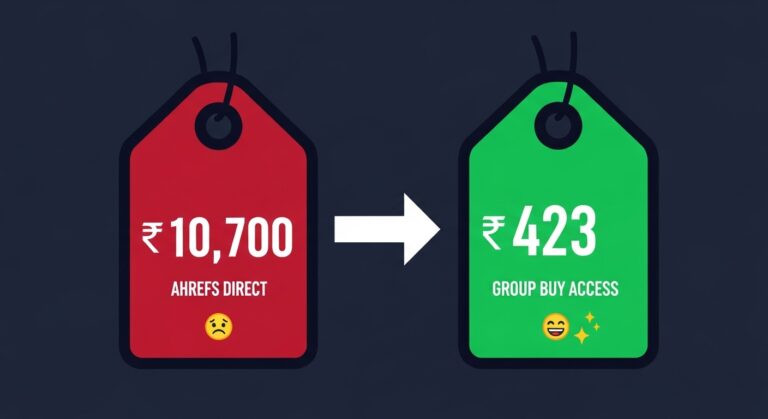
SEMrush costs ₹11,600/month. Ahrefs costs ₹10,700/month. For a freelancer or beginner blogger, that’s not realistic.
Group buy platforms solve this directly. GFXToolz gives you access to the same SEMrush Keyword Magic Tool and Ahrefs Keywords Explorer starting at ₹423/month (Basic plan, 100+ tools) or free on the trial tier. Same data, same features, fraction of the cost.
Workflow in SEMrush via GFXToolz:
- Open SEMrush Keyword Magic Tool
- Enter your seed keyword
- Filter Keyword Difficulty under 30 (keywords a new site can realistically rank for)
- Sort by Search Volume descending
- Export the top 50 results
- Repeat for each seed keyword
In Ahrefs Keywords Explorer:
- Enter your seed keyword
- Check the Keyword Difficulty score
- Look at “Parent Topic” — sometimes the parent keyword has higher volume and lower competition than your seed
- Use “Having same terms” and “Questions” filters for long-tail variations
According to Ahrefs’ crawl data, 90% of web pages get zero organic traffic from Google
If you’re using free tools only for now, apply the same filtering logic to Google Keyword Planner results and cross-reference with Autocomplete to estimate relative competition.
Step 4: analyse the competition
Competition analysis separates a basic keyword research tutorial from an advanced one.
Before committing to a keyword, check who you’d be competing with. Google the keyword. Look at the first five results:
- Are these established sites (Wikipedia, Times of India, HubSpot) or smaller niche sites?
- Is the content comprehensive and high-quality, or thin?
- Could you create something more detailed and useful than what’s ranking?
With Ahrefs or SEMrush access: check the Domain Rating or Domain Authority of sites in positions 1–10. If all of them are DR 60+ and yours is DR 5, you’re targeting the wrong keyword at the wrong time. Look for keywords where at least 2–3 results come from sites with DR under 40.
A practical benchmark for Indian SEO beginners: if the results are all small Indian blogs and freelancer websites rather than major publications, you have a realistic shot.
Step 5: evaluate intent, volume, and difficulty
Evaluating intent, volume and difficulty together is the core skill this keyword research tutorial teaches.
For every keyword on your shortlist, check three things:
Intent: Does this keyword match the content you want to create? If you want to write a tutorial and the top 10 results are product pages, the intent doesn’t match. Skip it or adjust the format.
Volume: Is anyone actually searching for this? A keyword with 10 monthly searches isn’t worth a 2,000-word post unless it’s extremely high-value commercially. Target the 100–5,000 monthly searches range for most beginner content.
Difficulty: Can you realistically rank? For a new site, target keywords with a difficulty score below 30. For a site with some authority, up to 50 is workable.
What this looks like in practice:
| Keyword | Monthly searches | KD score | Intent | Worth targeting? |
|---|---|---|---|---|
| keyword research | 110,000 | 82 | Informational | No — too competitive |
| keyword research tutorial | 2,900 | 41 | Informational | Maybe — if some authority |
| keyword research for beginners India | 880 | 28 | Informational | Yes — strong fit |
| how to find keywords for free | 590 | 24 | Informational | Yes — good long-tail |
| best keyword research tools India | 390 | 31 | Commercial | Yes — review format |
The sweet spot: clear intent that matches your content + 100–5,000 monthly searches + KD under 30. When all three align, you have a target worth writing.
Step 6: group keywords into clusters
Keyword clustering is where most keyword research tutorial guides stop — but it matters most.
This step prevents one of the most common beginner mistakes: creating a separate post for every keyword variation and splitting ranking potential across dozens of thin pages.
Related keywords belong on the same page.
For this article, the following keywords are all being targeted together: “keyword research tutorial,” “how to do keyword research,” “keyword research for beginners,” “keyword research guide 2026,” “how to find keywords,” “SEO keyword research.” One comprehensive page covering all of them outperforms six separate thin pages.
Build topic clusters:
- Pillar page: targets the main, higher-volume keyword with a comprehensive long-form guide
- Supporting posts: target specific sub-topics or long-tail variations, link back to the pillar
Example cluster for an SEO blog:
| Post | Keyword |
|---|---|
| Pillar | “Complete SEO guide for beginners” |
| Support | “How to do keyword research” |
| Support | “How to write SEO-optimized content” |
| Support | “How to build backlinks for free” |
| Support | “Technical SEO checklist for new websites” |
Each supporting post links to the pillar. The pillar links back. Google sees coherent topic authority rather than scattered content.
Step 7: build your content calendar
Building a content calendar completes this keyword research tutorial process
You have your keyword clusters. Now prioritise them by three factors:
Business value: Will this keyword attract potential clients or customers, or just casual readers? “GFXToolz pricing” has high business value. “What is SEO” builds awareness but drives fewer direct leads.
Difficulty: Start with the easiest wins. Lowest KD, clearest intent, most specific audience. Build authority before targeting harder keywords.
Content format: Match format to intent. Tutorials and guides for informational keywords. Comparison posts for commercial keywords. Landing pages for transactional keywords.
Plan 8–12 posts for the next three months. Assign one primary keyword and 2–4 secondary keywords per post. Track rankings monthly in Google Search Console — it’s free and shows exactly which queries are driving impressions and clicks to each page.
5 Keyword Research Tutorial Mistakes Beginners Make
These 5 mistakes come up in every beginner keyword research tutorial discussion.
1. Targeting high-volume head keywords. You won’t rank for “SEO” or “keyword research” as a new site. Not in year one. Possibly not ever. Start with long-tail, build authority, expand from there.
2. Ignoring search intent. A product page targeting an informational keyword will not rank, regardless of how well it’s written. Match format to what Google is already showing for that query.
3. Skipping difficulty data. Google Keyword Planner doesn’t show keyword difficulty. Without KD data, you might spend a month writing a post for a keyword where you have no realistic path to ranking. Ahrefs and SEMrush via group buy at ₹249–₹423/month solves this affordably.
4. Creating a separate post for every keyword variation. “Keyword research tutorial,” “keyword research guide,” and “keyword research for beginners” are not three posts. They’re one post. Cluster them.
5. Doing keyword research once. Search behaviour changes. New competitors enter. Algorithm updates redistribute traffic. Review your keyword strategy quarterly. Check Google Search Console monthly for new ranking opportunities you didn’t plan for.
Keyword Research Tutorial: Free vs Paid Tools Compared what you actually need
| Tool | Cost | What it does | Key limitation |
|---|---|---|---|
| Google Keyword Planner | Free | Volume ranges, keyword ideas | No difficulty score, ranges not exact |
| Google Trends | Free | Trend direction, seasonal patterns | No volume data |
| Google Autocomplete | Free | Keyword idea generation | No data, ideas only |
| Keyword Surfer (extension) | Free | Volume shown in Google results | Limited accuracy |
| Ubersuggest free | Free | 3 searches/day, basic data | Very restricted |
| Ahrefs | ₹10,700/month | Complete data, best backlink index | Expensive for beginners |
| SEMrush | ₹11,600/month | Complete data, strong keyword database | Expensive for beginners |
| Mangools/KWFinder | ₹2,420/month | Beginner-friendly UI, solid data | Fewer features than top two |
| GFXToolz Basic | ₹423/month | SEMrush + Ahrefs + 100 more tools | Shared access, occasional downtime |
| NoxTools | ₹249/month | SEMrush + 50 tools | No AI, no refund |
| SEOToolsAdda | ₹149/month | Basic Ahrefs/SEMrush access | Smaller library |
Honest recommendation: use free Google tools for your first month while you learn the process. Once you’re doing keyword research for real client projects, accurate difficulty data from SEMrush or Ahrefs makes a genuine difference in targeting decisions. Group buy is the most practical way for Indian beginners to access these tools without a ₹10,000+/month commitment.
Keyword research in the AI search era (2026 update)
A keyword research guide for 2026 has to address what’s changed in the last 12 months. AI is increasingly answering search queries directly.
According to SEMrush data, 58.5% of searches now result in zero clicks — the answer appears in Google’s AI Overview or a featured snippet and the user never visits a site. ChatGPT, Perplexity, and Google’s AI Mode handle simple factual queries entirely within their interfaces.
What this means for finding keywords in 2026:
Target depth over breadth. AI gives surface-level answers. A 4,000-word guide with worked examples, data tables, and nuanced specifics gives users something they can’t get from a three-paragraph AI summary. Long-form, comprehensive content is more defensible now than it was two years ago.
Prioritise experience-based content. “I tested 10 group buy SEO platforms and here’s what I found” is something AI cannot replicate — it requires first-hand experience. Keyword research should increasingly point you toward case studies, personal tests, before/after results, original data.
Optimise to be cited by AI. When ChatGPT or Perplexity answers a question, they often cite sources. Well-structured, factually accurate, authoritative content gets cited. A brand mention inside an AI answer that never produces a click is still a brand mention — and it happens more often than most SEO writers currently account for.
None of the fundamentals have changed. Seed keywords, expansion, difficulty analysis, intent matching, clustering — all of it still applies. What’s changed is that content quality requirements have risen, and you need to factor in zero-click searches when estimating how much traffic a keyword will actually send.
FAQ
How do I start keyword research as a complete beginner?
Write 10–15 seed keywords describing your niche or business. Expand them using Google Autocomplete, People Also Ask, and Related Searches. Use Google Keyword Planner to check approximate search volumes. Focus on long-tail keywords (4+ words) with lower competition. For difficulty data, access SEMrush or Ahrefs through a group buy platform like GFXToolz starting at ₹423/month — or test with their free tier first.This keyword research tutorial starts with seed keywords and free Google tools
What are the best free keyword research tools in 2026?
Google Keyword Planner (volume ranges), Google Trends (seasonal patterns), Google Autocomplete (keyword ideas), Keyword
Surfer extension (volumes shown in search results), Ubersuggest free tier (3 searches/day), and Google Search Console (keywords your site already ranks for). These cover idea generation but don’t provide difficulty scores, which matters when evaluating competition.
How many keywords should I target per blog post?
One primary keyword and 2–4 secondary keywords. Group related variations into a single piece rather than splitting them across multiple thin posts. This tutorial targets “keyword research tutorial” as the primary keyword alongside “how to find keywords,” “keyword research for beginners,” “keyword research guide 2026,” and “SEO keyword research” — all addressed within the same content.
What is a good keyword difficulty score for beginners?
Target keywords with a difficulty score below 30 (on Ahrefs or SEMrush’s 0–100 scale) when your site is new. As domain authority grows through content and backlinks, you can push toward 30–50. Above 50 is generally not worth targeting until your site has real backlink authority behind it.
Can I do keyword research without paying for expensive tools?
Yes, with limitations. Free tools give you keyword ideas and approximate volume ranges but don’t show difficulty, making competition assessment unreliable. For accurate data, you need SEMrush or Ahrefs. The most practical path for Indian users: a group buy platform. GFXToolz at ₹423/month for 100+ tools including full SEMrush and Ahrefs access, or NoxTools at ₹249/month for 50 tools — both significantly cheaper than direct subscriptions.This keyword research tutorial recommends GFXToolz at ₹423/month for full SEMrush and Ahrefs access.
How often should I update my keyword research?
Review your strategy quarterly. Check Google Search Console monthly — you’ll often find keywords your pages already rank for that you didn’t specifically target, which reveals content expansion opportunities. After any major algorithm update, recheck your top-performing posts to confirm keyword relevance hasn’t shifted.The final step of this keyword research tutorial is reviewing your strategy quarterly
The bottom line
This keyword research tutorial gives you a complete 7-step process to execute today.
Keyword research is a seven-step process: brainstorm seeds, expand with free tools, go premium for difficulty data, check competition, evaluate intent against volume and difficulty, cluster related keywords, build a content calendar.
This keyword research tutorial is most useful when you execute it with real keywords from your own niche. Run through Steps 1 and 2 with your first five seed keywords today, using free tools. Doing it once, even imperfectly, teaches you more than reading about it does.
When you’re ready for accurate difficulty data — which speeds up targeting decisions more than any other single upgrade — SEMrush and Ahrefs via GFXToolz are available from ₹423/month, with a free tier at ₹0 to test first.
The tools matter less than the process. A beginner following this guide with Google Keyword Planner will outperform someone with a full Ahrefs subscription who doesn’t know what to look for.
Also read:
- Best Affordable SEO Tools Under ₹500/Month in India
- Why Indian Freelancers Are Switching to GFXToolz in 2026
- Best Group Buy SEO Tools in 2026: Top 10 Providers Ranked

Leave a Comment