

Published by GFXToolz AI | Last updated: April 10, 2026
April 8, 2026. Google’s March core update finished rolling out. Your keyword rankings shifted. Some pages climbed. Some dropped. This page documents every confirmed Google algorithm update in 2026 — what changed, who was affected, and what to do about it.
Google makes hundreds of changes per year. Most go unannounced. The confirmed ones cause panic. Bloggers and store owners check their rankings, see a drop, and can’t tell whether it’s temporary rollout volatility or something they need to actually respond to — and the two situations call for very different actions.
This live tracker documents every confirmed google algorithm update 2026 within 48 hours.
Google Algorithm Update 2026 Timeline (Live)
Last updated: April 10, 2026. Source: Google Search Status Dashboard (status.search.google.com). Only confirmed updates are listed — unconfirmed volatility is noted in context but not included here.
| Date | Update name | Type | Duration | Severity | Status |
|---|---|---|---|---|---|
| Feb 5–27 | February 2026 Discover Core Update | Core (Discover) | 22 days | Moderate | COMPLETE |
| Mar 24–25 | March 2026 Spam Update | Spam | Under 24 hours | Low–Moderate | COMPLETE |
| Mar 27–Apr 8 | March 2026 Core Update | Core (Broad) | 12 days | Moderate | COMPLETE |
| TBD | Next confirmed update | TBD | TBD | TBD | Pending |
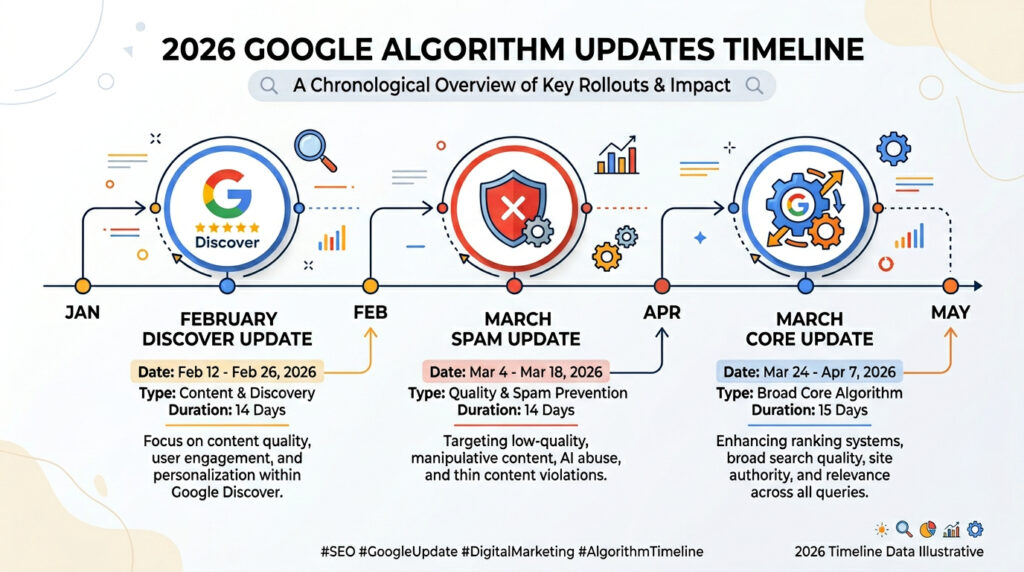
The google algorithm update 2026 timeline shows three confirmed changes already in Q1.
February 2026 Google Algorithm Update: Discover Core Update
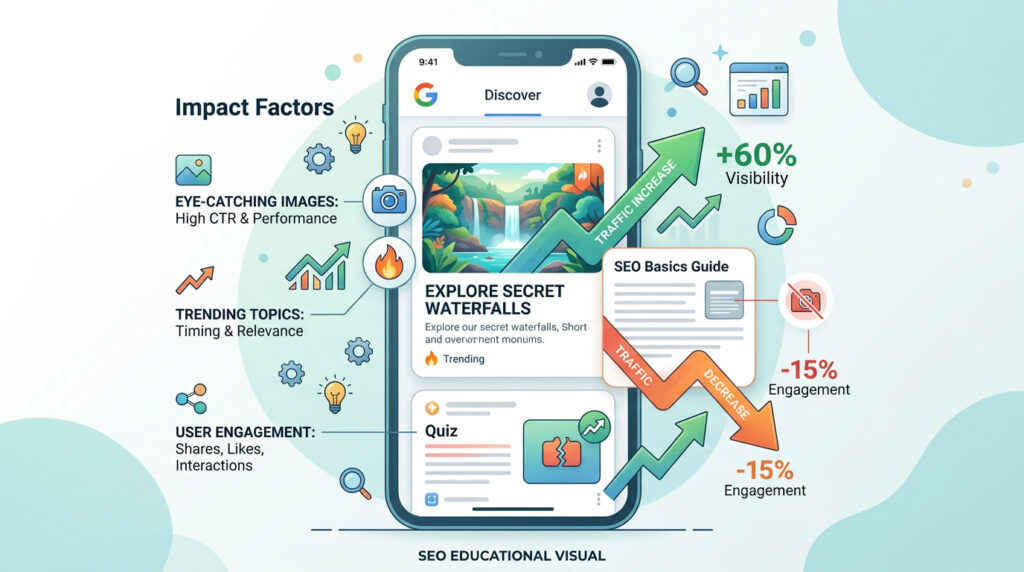
Dates: February 5–27, 2026 (22 days) Type: Core update — Discover-specific
The February google algorithm update 2026 was the first Discover-specific core update.
This was the first time Google officially labelled a core update as Discover-only. All previous core updates had been broad. This one touched only content surfaced in Google Discover feeds on mobile.
What changed: Discover runs on different signals than regular search — it’s personalisation-based, meaning Google pushes content to users who haven’t searched for it. The update recalibrated how Google weighs visual quality, topical authority, and content recency for those recommendations.
This google algorithm update 2026 only affected Google Discover — not regular search.
Who was affected: Publishers who rely heavily on Discover traffic saw the most movement. News sites, viral content producers, and blogs covering trending topics consistently were most impacted. Sites that occasionally spiked in Discover from a viral piece may have lost that unpredictability — replaced by more stable but lower Discover visibility.
What to do: Check Google Search Console → Discover tab specifically. This is a separate report from the main Search Results data. Look for pages that lost impressions and clicks between February 5 and 27. If your organic search traffic was unaffected but Discover dropped in that window, this update is the cause.
To recover: add original images to your key posts (Discover strongly prefers unique visuals over stock photos), add clear author attribution with expertise signals, and keep topical consistency across recent posts.
Use Semrush via GFXToolz to identify which posts were hit by this google algorithm update 2026.
GFXToolz workflow for Discover recovery: Open Semrush (via GFXToolz at ₹423/month) and identify which content types had the strongest historical Discover performance. Then use Nano Banana Pro in AI Studio to generate unique featured images for those top candidates. Google Discover is noticeably more likely to feature content with original visuals it hasn’t already indexed across thousands of other sites.
March 2026 Google Algorithm Update: Spam Update
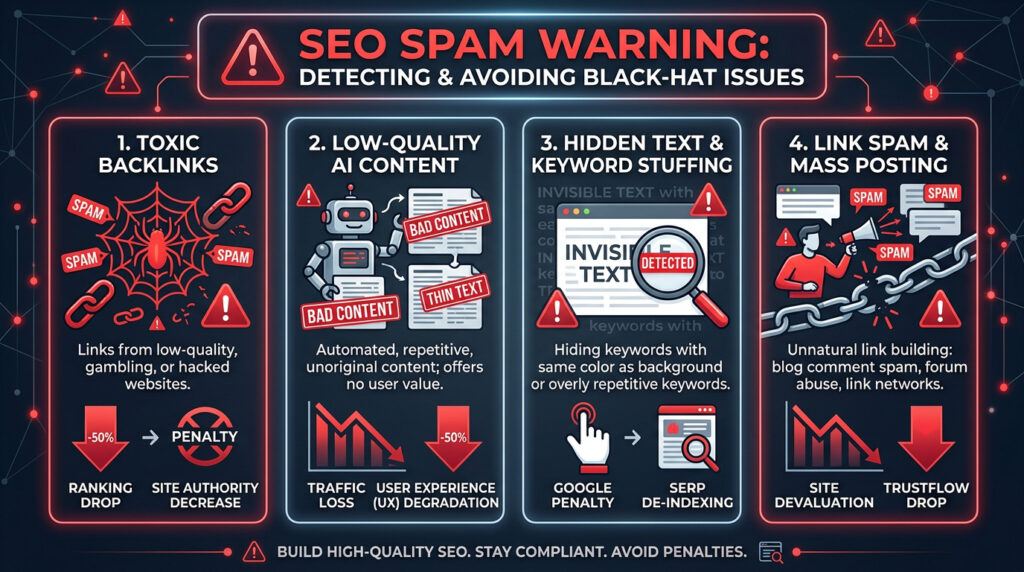
Dates: March 24–25, 2026 (under 24 hours) Type: Spam update
The March spam google algorithm update 2026 completed in under 24 hours.
One of the fastest confirmed updates in recent memory. Under 24 hours suggests this was a targeted classifier update rather than a broad index recrawl.
What changed: Improved automated spam detection across all languages and regions. The update went after manipulative practices Google has been targeting more aggressively since 2024:
- Link spam: Unnatural link patterns, paid links without nofollow, link exchange networks, low-quality directories built for SEO rather than users
- Scaled AI-generated content: AI content published at volume without meaningful human editing or unique perspective. The target here is thin mass-produced content — not responsibly-produced AI-assisted writing
- Cloaking: Showing different content to search engines versus users
- Hidden text and links: Content visible to crawlers but hidden from users through CSS
This google algorithm update 2026 targeted AI content at volume and link spam networks.
Who was affected: Sites with aggressive link-building schemes saw sharp drops. Blogs that published large volumes of unedited AI content over the previous 6–12 months were particularly exposed. Because the rollout was under 24 hours, sites saw sudden drops rather than the gradual shifts typical of core updates.
What to do: If your drops happened specifically on March 24–25 — not the days before or after — open Google Search Console immediately and check for manual actions. Spam updates can trigger manual reviews alongside the algorithmic changes.
Use Ahrefs (via GFXToolz) to audit your backlink profile. Look for referring domains with Domain Rating under 10, high link velocity from new domains, and anchor text patterns that are unnaturally keyword-heavy. If you hired an SEO provider in 2024–2025, find out what link-building methods they used.
For backlink analysis, see The Complete Guide to Backlink Analysis for Beginners.
Use Ahrefs via GFXToolz to audit backlinks after any spam google algorithm update 2026.
March 2026 Google Algorithm Update: Broad Core Update
Dates: March 27–April 8, 2026 (12 days) Type: Broad core update — first of 2026
The March broad google algorithm update 2026 is the biggest ranking event of Q1.
Rolled out just 48 hours after the spam update completed.
Google’s statement: “A regular update designed to better surface relevant, satisfying content for searchers from all types of sites.” No companion blog post, no specific guidance — standard for broad core updates.
What changed: Broad core updates don’t target specific practices. They reassess which pages best satisfy each search query relative to all competing pages currently indexed. A core update doesn’t penalise sites; it re-evaluates which pages deserve to rank based on what’s currently available.
Tracking tools (Semrush Sensor, Mozcast, Rank Risk Index) reported moderate volatility throughout rollout. Less dramatic than the March 2025 core update, which was among the most volatile in recent history.
This google algorithm update 2026 continued rewarding E-E-A-T signals and original content.
Who was affected: Early analysis following the April 8 completion date suggests:
- Sites with consistent E-E-A-T signals (documented author expertise, original research, first-hand experience) showed stability or gains
- Sites relying on thin but keyword-optimised content saw mixed results
- Local business sites and smaller niche blogs saw less movement than major content publishers
- AI-assisted content that was genuinely edited, fact-checked, and enhanced with human expertise was largely unaffected
The pattern from 2025 continues: Google rewards content that demonstrates real experience with the topic, not just coverage of the keywords.
Sites with strong author expertise held rankings through this google algorithm update 2026.
What to do: Don’t make sudden changes while a rollout is active — it interferes with your ability to measure actual impact. The rollout completed April 8, so analysis can start now.
Open Semrush Position Tracking (via GFXToolz) and compare keyword positions on March 26 (day before the update began) versus April 9–10 (post-completion). Filter for keywords that moved 5+ positions in either direction.
For pages that dropped: check whether competitor pages now outranking you are more comprehensive, more current, or demonstrate stronger author expertise. Core update drops are almost always a content quality gap, not a technical issue.
For rank tracking, see How to Track Keyword Rankings Without Paying ₹10,000/Month.
Compare position tracking data before and after each google algorithm update 2026 in Semrush
What to Do in 48 Hours After Any Google Algorithm Update 2026
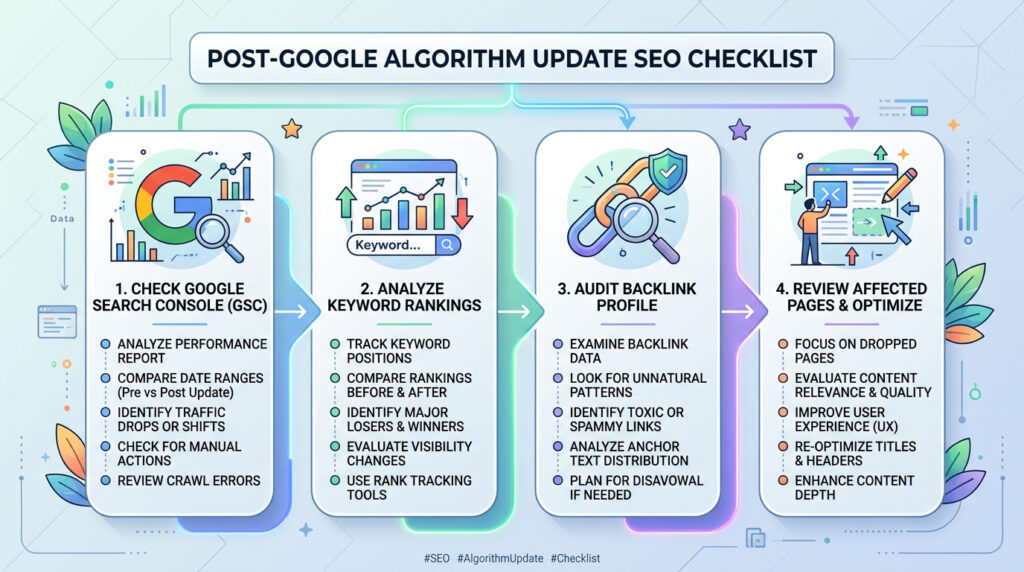
This checklist applies to every google algorithm update 2026 from the first hour.
During rollout — don’t do these: Do not make major content changes. Do not redirect pages. Do not disavow links. Rankings fluctuate throughout rollout and the data is unreliable for decision-making until completion.
Never make major site changes while a google algorithm update 2026 is actively rolling out.
Immediately after confirmation:
- Check the Google Search Status Dashboard (status.search.google.com) for the update type and official date range
- Open Google Search Console. Check the Coverage/Indexing report for new errors. Check the Manual Actions report — spam updates can trigger manual penalties alongside the algorithmic change
- Open Semrush Position Tracking via GFXToolz. Filter for keywords that moved 5+ positions from the day before the update start date to today
- Open Ahrefs via GFXToolz. Check for backlinks gained or lost in the same window — coincidental link changes can create volatility independent of the update
- Determine scope: is the change across your entire site (broad), or limited to specific pages or topic clusters (targeted)?
After rollout completes (usually 1–2 weeks):
- Pages that dropped 5+ positions: compare against current top-ranking pages. Are competitors more comprehensive, more current, or more clearly authoritative?
- Spam update drops: full backlink audit in Ahrefs. Look at domain rating, anchor text, and link velocity
- Core update drops: content quality improvements on affected pages. Not site-wide technical changes
For the full site audit workflow, see How to Run a Complete Website SEO Audit (Step-by-Step).
Types of Google Algorithm Update 2026 Explained
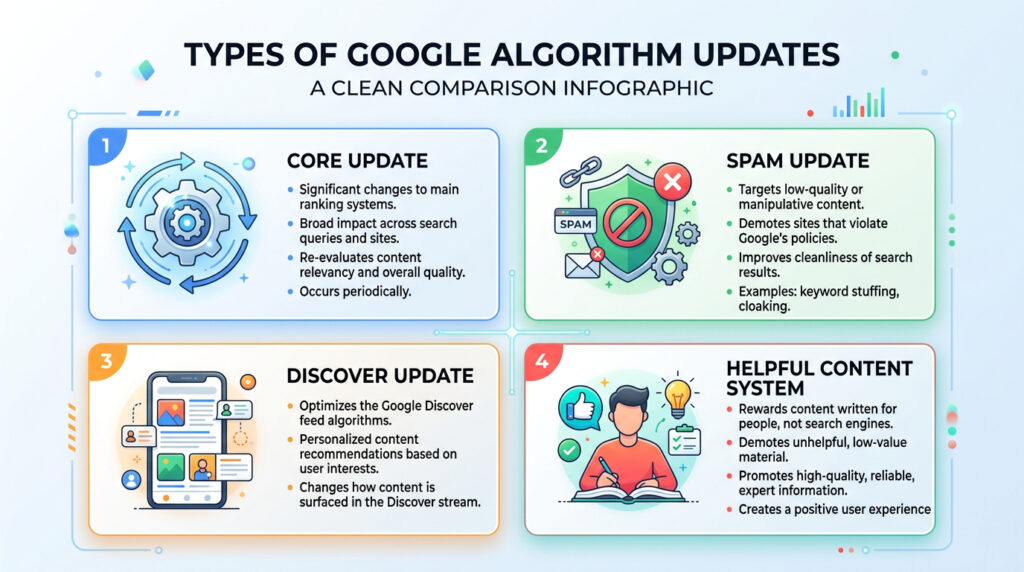
| Update type | What it does | How often |
|---|---|---|
| Core Update | Broad reassessment of content quality across the entire search index. Not targeted at specific sites or practices. Affects rankings based on comparative page quality. | 2–4 times per year. Major ones take 1–2 weeks to roll out. |
| Spam Update | Improves automated spam detection. Targets link spam, cloaking, hidden text, and manipulative content at scale. | 1–3 times per year. Can complete in under 24 hours. |
| Helpful Content System | Evaluates whether content is written for people or for search engines. Integrated into core updates since 2024. No longer a separate update type. | Ongoing — part of core updates. |
| Product Reviews System | Evaluates quality of review content. Rewards firsthand experience and original insights. Integrated into core updates since 2024. | Ongoing — part of core updates. |
| Discover Update | Specifically affects Google Discover feed results on mobile. Evaluates visual quality, topical authority, and content freshness. New as a standalone type in 2026. | New in 2026. |
| Unconfirmed Updates | Ranking changes Google doesn’t officially announce. Detected by tracking tools showing volatility. | Constant. |
Understanding each type of google algorithm update 2026 helps you respond correctly.
How to Monitor Google Algorithm Update 2026 Impact
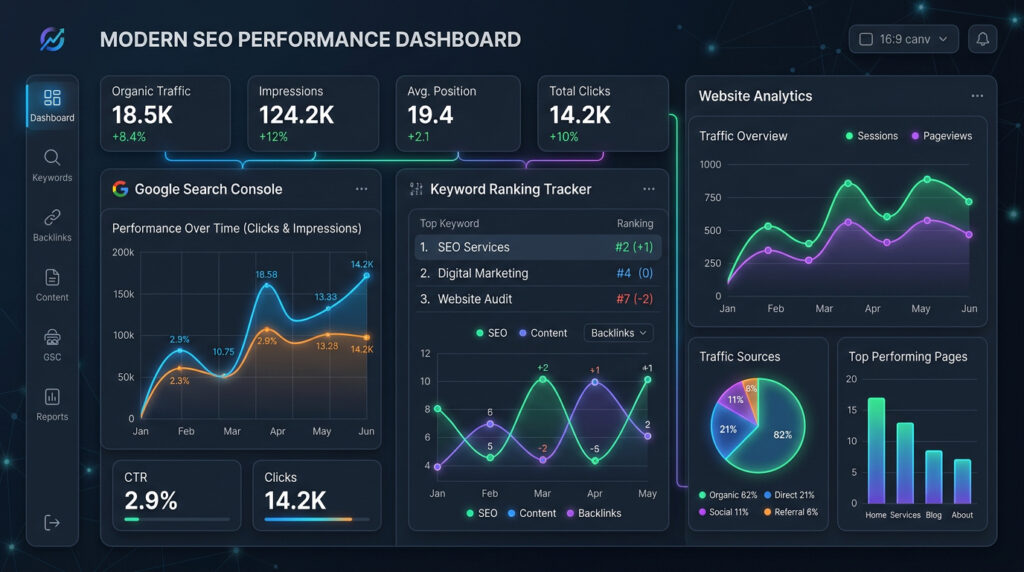
Set up a permanent monitoring system. Ranking shifts should never be a complete surprise.
Google Search Console (free): Check the Performance report weekly. Watch for week-over-week drops in clicks or impressions. During active rollouts, check daily. Filter by page to isolate specific affected content.
Google Search Console is the most reliable free tool to monitor any google algorithm update 2026.
Semrush Position Tracking via GFXToolz: Set up tracking for your top 50 keywords. Semrush flags volatility automatically — you’ll see a high-volatility indicator during significant index changes. Daily during rollouts, weekly during stable periods.
Semrush Position Tracking via GFXToolz shows keyword movement after every google algorithm update 2026
Ahrefs Rank Tracker via GFXToolz: Cross-reference Semrush data. Ahrefs shows your overall ranking distribution — what percentage of your keywords are on page 1 versus page 2 and beyond. Drops in that distribution suggest a site-level issue rather than individual page problems.
Google Search Status Dashboard: status.search.google.com. The only official source for confirmed updates. Third-party tracking tools detect volatility before Google confirms it, but official confirmation sets the date range that matters for analysis.
Search Engine Roundtable: Barry Schwartz at seroundtable.com documents every update with community analysis and impact reports within hours of detection. Useful context during volatile periods.
This page: Updated within 48 hours of every official Google confirmation throughout 2026.
For the Semrush tracking workflow, see Semrush Group Buy 2026: Everything You Need to Know.
2025 updates recap (for context)
| Date | Update | Key pattern |
|---|---|---|
| March 2025 | March 2025 Core Update | Major volatility across all niches. Most discussed update of the year. |
| June 2025 | June 2025 Core Update | Rewarded sites with strong E-E-A-T. Penalised thin AI content at scale. |
| August 2025 | August 2025 Spam Update | Targeted link spam networks and scaled content abuse. |
| November 2025 | November 2025 Core Update | Continued emphasis on original content and topic expertise. |
| December 2025 | December 2025 Core Update | 18-day rollout. Emphasised comparative page quality in updated documentation. |
The 2025 history gives context for every google algorithm update 2026 this year.
Google released 5 confirmed major updates in 2025 and 3 in Q1 2026 alone. AI Overviews add a dimension to visibility that didn’t exist in 2024 — content cited in AI Overviews gets impressions even when organic click-through drops. Every 2026 core update so far has favoured content with demonstrable author expertise, original data, and unique perspectives. Three updates in a row saying the same thing is worth taking seriously.
Three consecutive updates with the same signal shows where the google algorithm update 2026 direction is heading.
FAQ
How often does Google release algorithm updates in 2026?
Google makes thousands of small changes annually, most unconfirmed. Major confirmed updates typically happen 4–8 times per year. Q1 2026 saw 3 confirmed updates — more than previous Q1 periods — which tracks with Google’s accelerating response to AI-generated content flooding the index.
Q1 2026 saw 3 confirmed google algorithm update 2026 releases already.
What should I do if my rankings drop after a Google update?
Wait for the rollout to complete (1–2 weeks) before making major changes. Then: check Google Search Console for manual actions and indexing errors, review keyword movements in Semrush Position Tracking, audit backlinks in Ahrefs for spam update drops, and look at content quality gaps on affected pages for core update drops. The 48-hour checklist above covers the full process. Wait for rollout completion before responding to any google algorithm update 2026 drop.
Where can I check if there’s a Google update happening right now?
Official source: Google Search Status Dashboard at status.search.google.com. For real-time community detection before official confirmation, Search Engine Roundtable publishes within hours of detected volatility. This tracker page is updated within 48 hours of every official confirmation.
Do Google core updates affect all websites equally?
No. Core updates are comparative — they reassess which pages best satisfy each query relative to everything else indexed. Sites with strong E-E-A-T signals, fresh and comprehensive content, and clean technical health tend to hold or gain. Sites with thin, outdated, or mass-produced AI content are consistently more exposed.
What tools do I need to monitor Google algorithm updates?
Three tools cover the essentials: Google Search Console (free, your own site data), Semrush Position Tracking (keyword monitoring), and Ahrefs (backlink health and ranking distribution). GFXToolz Basic at ₹423/month includes Semrush and Ahrefs alongside 100+ other tools. GFXToolz at ₹423/month includes Semrush and Ahrefs for monitoring any google algorithm update 2026.
Current status — April 10, 2026
The March 2026 Core Update completed April 8. No new confirmed updates are rolling out.
Compare current rankings against March 26 baselines. Update pages that dropped significantly. Tracking tools show elevated volatility heading into Q2, so stay on the monitoring routine.
This page updates within 48 hours of the next confirmed announcement.
The latest google algorithm update 2026 completed April 8 — compare rankings against March 26 baseline.
Related resources:
- How to Track Keyword Rankings Without Paying ₹10,000/Month
- How to Run a Complete Website SEO Audit (Step-by-Step)
- Content Gap Analysis: Find Keywords Your Competitors Rank For
Leave a Comment