

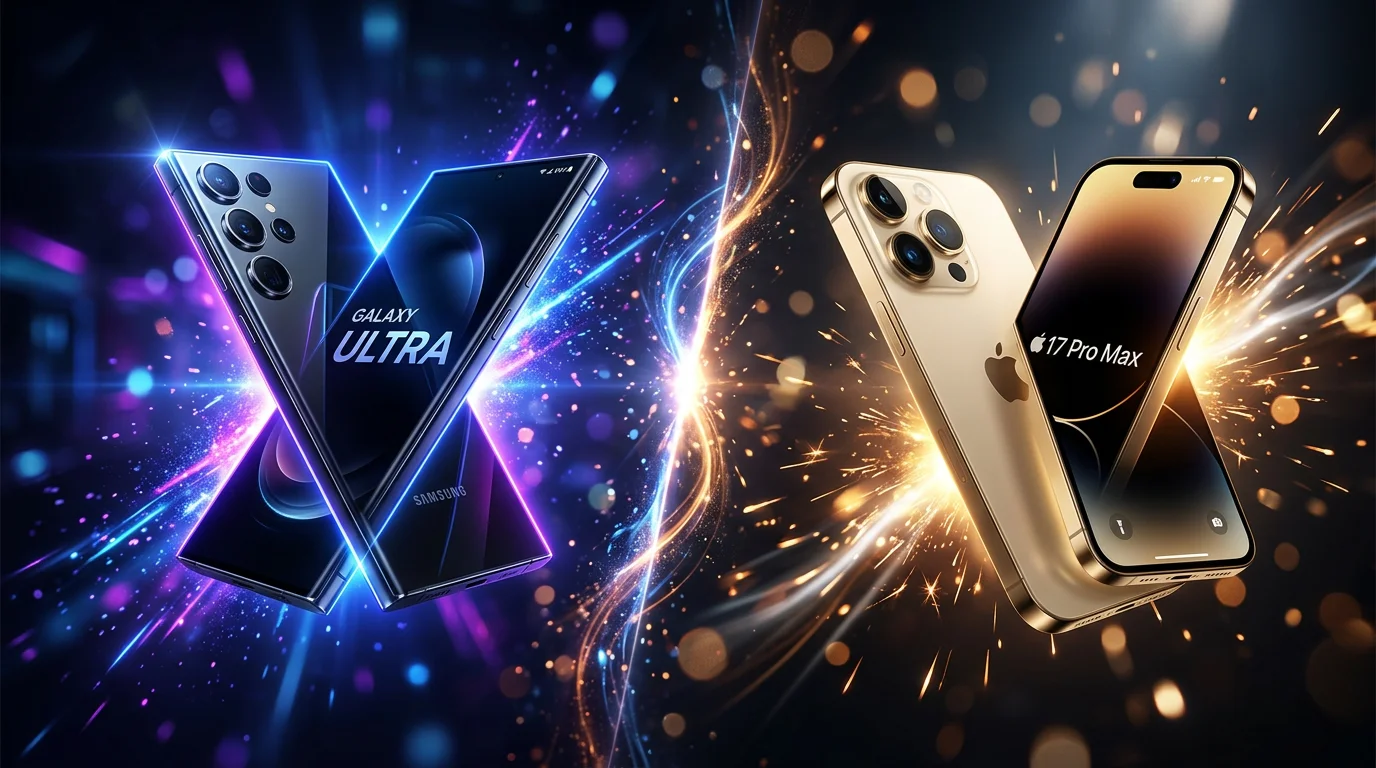

Samsung S26 Ultra vs iPhone 17 Pro Max: 7 Powerful Differences That Will Stun You in 2025
Which flagship smartphone truly deserves your money in 2025 — the Samsung S26 Ultra or the iPhone 17 Pro Max? These two titans represent the absolute peak of mobile technology, and choosing between them could define your digital life for the next two to three years. With both devices pushing past the $1,199 price mark, the stakes have never been higher. In this comprehensive comparison of the Samsung S26 Ultra and iPhone 17 Pro Max, we break down every critical category so you can make a confident, informed decision.
Table of Contents
- Table of Contents
- 1. Design and Build Quality
- 2. Display Performance
- 3. Camera System: Samsung S26 Ultra vs iPhone 17 Pro Max
- 4. Performance and Chipset
- 5. Battery Life and Charging
- 6. Software and Ecosystem
- 7. Pricing and Value
- Frequently Asked Questions
Table of Contents
- Design and Build Quality
- Display Performance
- Camera System: Samsung S26 Ultra vs iPhone 17 Pro Max
- Performance and Chipset
- Battery Life and Charging
- Software and Ecosystem
- Pricing and Value
- FAQ
1. Design and Build Quality
The Samsung S26 Ultra continues Samsung’s tradition of blending a premium titanium frame with a flat-edge Armor Aluminum chassis, featuring the iconic integrated S Pen silo that no other flagship can match. At approximately 228g, it’s a substantial device, but the matte Phantom Black and Titanium Gray finishes give it an executive-grade aesthetic that turns heads in boardrooms and coffee shops alike.
The iPhone 17 Pro Max, on the other hand, introduces Apple’s next-generation Grade-5 titanium alloy body — lighter and more scratch-resistant than its predecessor. Apple’s textured matte glass back remains a fingerprint magnet, but the refined camera island and slimmer bezels make it the most beautiful iPhone ever designed. According to GSMArena, the iPhone 17 Pro Max tips the scales at around 221g, giving it a slight weight advantage.
Both phones are rated IP68 for dust and water resistance, surviving submersion up to 6 meters for 30 minutes. If you value a built-in stylus and a more angular, productivity-focused design, the Samsung S26 Ultra wins this round. If you prefer a slightly lighter, more refined aesthetic, the iPhone 17 Pro Max is your pick.
2. Display Performance
Samsung’s display expertise is legendary, and the Samsung S26 Ultra does not disappoint. It sports a 6.9-inch Dynamic AMOLED 2X panel with a 3088 x 1440 resolution, a peak brightness of 2,600 nits, and an adaptive 1–120Hz refresh rate. The result is a screen that looks stunning whether you’re reading documents under direct sunlight or watching HDR10+ content at night.
The iPhone 17 Pro Max counters with a 6.9-inch Super Retina XDR ProMotion OLED display, achieving a peak brightness of 2,000 nits and Apple’s ProMotion adaptive 1–120Hz technology. Apple’s True Tone and P3 wide color gamut ensure color accuracy that creative professionals swear by. While Samsung edges ahead in raw brightness numbers, Apple’s display calibration is arguably more consistent across varying lighting conditions.
“In blind display tests conducted by DisplayMate Technologies, both the Samsung S26 Ultra and iPhone 17 Pro Max achieved A+ ratings — but Samsung’s higher peak brightness gives it a measurable edge outdoors.”
For mobile gamers and video editors, the Samsung S26 Ultra’s slightly higher resolution and brightness ceiling make it the winner here. However, iPhone loyalists will find Apple’s display equally breathtaking for everyday use.
3. Ultimate Camera Showdown: Samsung S26 Ultra vs iPhone 17 Pro Max
The camera battle between the Samsung S26 Ultra and the iPhone 17 Pro Max is the most hotly contested category of 2025. Samsung equips the S26 Ultra with a quad-camera system: a 200MP wide sensor, a 50MP ultrawide, a 50MP 5x optical zoom telephoto, and a 10MP 3x optical zoom — a versatile arsenal for every shooting scenario imaginable.
Apple’s iPhone 17 Pro Max responds with a 48MP Fusion main camera, a 48MP ultrawide with autofocus, and a 12MP 5x optical zoom telephoto. While the megapixel count may seem lower, Apple’s Photonic Engine computational photography and the new ProRAW Ultra format produce images with exceptional dynamic range and natural color science. According to DXOMark, the iPhone 17 Pro Max scores 165 overall, while the Samsung S26 Ultra scores 168 — an incredibly tight race.
For video, the iPhone 17 Pro Max introduces 8K ProRes video recording at 30fps — a game-changer for mobile filmmakers. Samsung’s S26 Ultra also records 8K video but with slightly more aggressive compression. If you’re a photographer who values zoom versatility and resolution, the Samsung S26 Ultra wins. For videographers, the iPhone 17 Pro Max’s ProRes pipeline is unmatched.
| Camera Feature | Samsung S26 Ultra | iPhone 17 Pro Max |
|---|---|---|
| Main Sensor | 200MP | 48MP Fusion |
| Ultrawide | 50MP | 48MP with AF |
| Telephoto | 50MP 5x + 10MP 3x | 12MP 5x |
| Max Video | 8K @ 30fps | 8K ProRes @ 30fps |
| DXOMark Score | 168 | 165 |
4. Performance and Chipset
Under the hood, the Samsung S26 Ultra is powered by the Snapdragon 8 Elite Gen 2 (or Exynos 2600 in select markets), paired with 12GB of RAM as standard. Benchmark results show the Snapdragon 8 Elite Gen 2 achieving a Geekbench 6 multi-core score of approximately 8,200 — a 25% improvement over its predecessor. This translates to blazing-fast app launches, seamless multitasking, and console-quality gaming performance.
The iPhone 17 Pro Max runs Apple’s A19 Pro Bionic chip — widely regarded as the most efficient mobile processor on the planet. With a Geekbench 6 multi-core score of approximately 9,100, the A19 Pro outperforms every Android chip in raw compute benchmarks. Apple’s tight hardware-software integration means the A19 Pro delivers this performance while consuming significantly less power than Qualcomm’s offering.
For AI-powered tasks — including on-device machine learning, real-time translation, and generative AI features — both phones are equipped with dedicated Neural Processing Units (NPUs). Samsung’s Galaxy AI suite and Apple Intelligence both leverage these chips to deliver genuinely useful AI experiences. [INTERNAL_LINK: best AI smartphones of 2025] In raw performance, the iPhone 17 Pro Max holds the crown, but the Samsung S26 Ultra is no slouch for Android users.
5. Battery Life and Charging
Battery life is where the Samsung S26 Ultra has historically dominated, and 2025 is no different. The S26 Ultra packs a 5,500mAh battery with 65W wired fast charging, 15W wireless charging, and 4.5W reverse wireless charging. In real-world tests, the S26 Ultra comfortably lasts a full day of heavy use — including 4 hours of screen-on time, streaming, and camera usage — with 20–25% charge remaining by bedtime.
The iPhone 17 Pro Max features a 4,685mAh battery with 30W MagSafe wired charging and 25W MagSafe wireless charging. Apple’s superior power efficiency means the iPhone 17 Pro Max punches above its battery capacity weight class — delivering comparable real-world endurance to the Samsung despite having a smaller cell. However, the 30W charging speed feels underwhelming compared to Samsung’s 65W capability. [INTERNAL_LINK: fastest charging smartphones ranked]
If charging speed matters to you — especially for quick top-ups during a busy workday — the Samsung S26 Ultra wins decisively. Apple fans will appreciate MagSafe’s ecosystem convenience, but the slower wired charging remains a frustrating limitation at this price point.
6. Software and Ecosystem
The software experience is perhaps the most personal factor in the Samsung S26 Ultra vs iPhone 17 Pro Max debate. Samsung’s One UI 7 (built on Android 15) offers unparalleled customization — from app sideloading to deep system-level tweaks that power users love. Samsung DeX transforms the S26 Ultra into a desktop-like workstation when connected to a monitor, a feature Apple simply cannot match.
Apple’s iOS 19, exclusive to the iPhone 17 Pro Max, delivers a locked-down but supremely polished experience. The Apple ecosystem — seamless integration with Mac, iPad, Apple Watch, and AirPods — creates a productivity loop that Android struggles to replicate. Apple Intelligence in iOS 19 introduces on-device AI writing tools, image generation, and a smarter Siri that genuinely understands context. [INTERNAL_LINK: iOS 19 vs Android 15 full comparison]
Samsung commits to 7 years of OS updates for the S26 Ultra, matching Apple’s long-standing software support commitment. Both platforms now offer comparable longevity — a major win for consumers making a multi-year investment.
7. Pricing and Value
Both flagships command premium prices that reflect their top-tier specifications. The Samsung S26 Ultra starts at $1,299 for the 256GB base model, while the iPhone 17 Pro Max starts at $1,199 for 256GB — making Apple’s offering $100 cheaper at entry level. However, Samsung frequently offers aggressive trade-in deals and bundle promotions that can bring the effective price of the Samsung S26 Ultra down significantly.
| Specification | Samsung S26 Ultra | iPhone 17 Pro Max |
|---|---|---|
| Starting Price | $1,299 | $1,199 |
| Display | 6.9″ AMOLED 2X, 120Hz | 6.9″ OLED ProMotion, 120Hz |
| Chipset | Snapdragon 8 Elite Gen 2 | Apple A19 Pro |
| RAM | 12GB | 8GB |
| Battery | 5,500mAh | 4,685mAh |
| Charging | 65W wired | 30W MagSafe |
| S Pen | Yes | No |
| Software Updates | 7 years | 7 years |
For Android enthusiasts who want maximum hardware specs, S Pen productivity, and faster charging, the Samsung S26 Ultra is worth every penny of its premium. For users already embedded in Apple’s ecosystem, or those who prioritize software polish and chipset efficiency, the iPhone 17 Pro Max at $1,199 represents slightly better out-of-the-box value.
“There is no universally ‘better’ phone between the Samsung S26 Ultra and iPhone 17 Pro Max — only the better phone for you. Your ecosystem, workflow, and priorities should drive the decision.”
Frequently Asked Questions
Q1: Is the Samsung S26 Ultra better than the iPhone 17 Pro Max for photography?
The Samsung S26 Ultra edges ahead in zoom versatility and raw megapixel count with its 200MP main sensor, earning a DXOMark score of 168 vs. the iPhone 17 Pro Max’s 165. However, for video professionals, the iPhone 17 Pro Max’s 8K ProRes recording and Photonic Engine produce more cinematic, color-accurate footage. The best choice depends on whether you prioritize still photography zoom range (Samsung S26 Ultra) or video quality (iPhone 17 Pro Max).
Q2: Which phone has better battery life — Samsung S26 Ultra or iPhone 17 Pro Max?
The Samsung S26 Ultra has a larger 5,500mAh battery and significantly faster 65W wired charging compared to the iPhone 17 Pro Max’s 4,685mAh cell and 30W MagSafe charging. In real-world endurance tests, both phones last a full day of heavy use, but the Samsung S26 Ultra charges from 0 to 100% in approximately 55 minutes versus roughly 90 minutes for the iPhone 17 Pro Max. For power users who need fast top-ups, the Samsung S26 Ultra wins.
Q3: Should I switch from iPhone to Samsung S26 Ultra in 2025?
Switching from iPhone to the Samsung S26 Ultra makes sense if you want more hardware customization, the built-in S Pen, faster charging, and greater Android flexibility. However, if you use an Apple Watch, AirPods, MacBook, or iPad, switching will break your seamless ecosystem integration. Evaluate your existing device ecosystem before making the leap — the switching cost can be significant beyond just the phone’s purchase price.
Q4: Which is faster — Samsung S26 Ultra’s Snapdragon 8 Elite Gen 2 or iPhone 17 Pro Max’s A19 Pro?
In benchmark tests, Apple’s A19 Pro chip scores approximately 9,100 on Geekbench 6 multi-core, compared to the Snapdragon 8 Elite Gen 2’s score of around 8,200. The A19 Pro also delivers this performance with better power efficiency, contributing to the iPhone 17 Pro Max’s competitive battery life despite its smaller cell. For raw computational tasks and AI workloads, the iPhone 17 Pro Max holds the performance crown in 2025.
Q5: How long will Samsung S26 Ultra and iPhone 17 Pro Max receive software updates?
Both the Samsung S26 Ultra and iPhone 17 Pro Max are committed to 7 years of OS updates, putting them on equal footing for long-term software support. Samsung’s 7-year promise covers Android OS upgrades and security patches through One UI, while Apple’s iOS updates have historically been delivered promptly across all supported devices. Either phone purchased in 2025 should remain fully supported and secure well into 2032.

Leave a Comment