


Published by GFXToolz AI | Last updated: April 2026
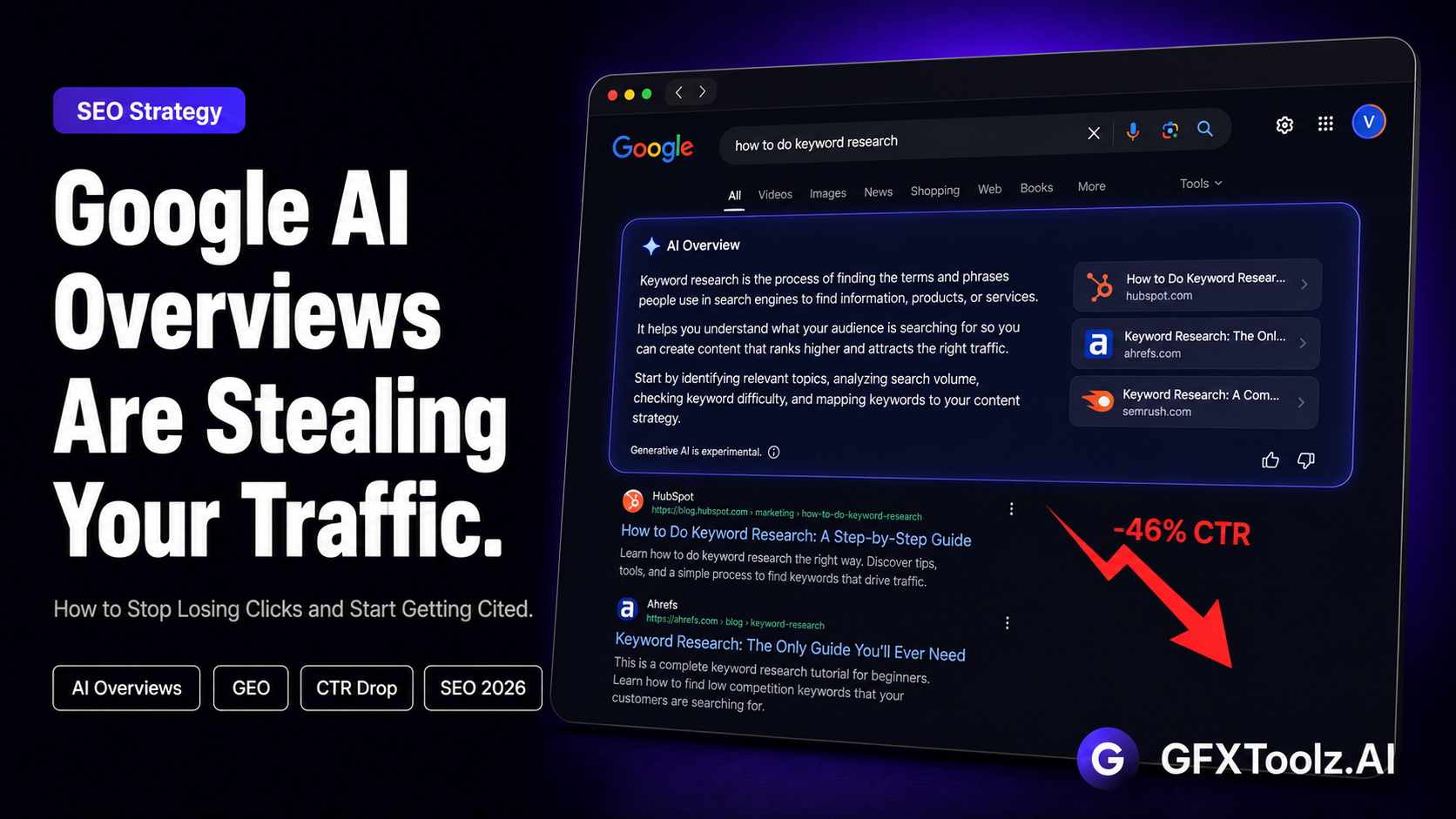
This guide covers Google AI Overviews SEO. You rank #1 for your target keyword. You did everything right: solid content, proper backlinks, good on-page work. Then last month your traffic dropped 35%. Your ranking didn’t move. Google just started answering the query before anyone clicked your link.
This isn’t theory. Thousands of bloggers and store owners noticed it in 2025. It’s happening faster now.
Google’s AI Overviews appear in nearly half of all searches. They sit above every organic result and give users a summary without requiring a single click. That’s not a minor feature update. It’s a structural change in how search works — and if you’re still treating SEO as a ranking game, you’re fighting the wrong battle.
This guide covers what AI Overviews actually are, the real traffic numbers, which content gets cited (and which gets ignored), and a practical checklist for Indian bloggers and store owners who want to stop bleeding traffic and start being the source Google quotes.
What Are Google AI Overviews? SEO Impact Explained
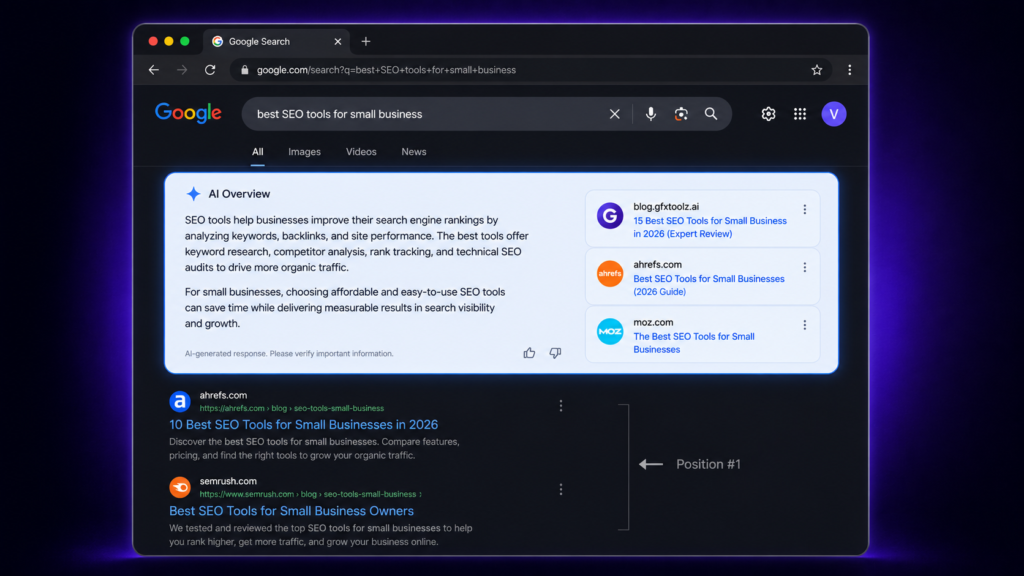
When someone searches “how to do keyword research” or “best SEO tools for small business,” Google reads several web pages, pulls the key information, writes a summary, and shows it at the top with links to the sources it used — above every organic result. That’s an AI Overview.
They launched in the US in May 2024 and went global through 2025. As of March 2026, they appear in roughly 48% of all search queries. A year ago that number was 25%.
If your page gets cited, you still get clicks. If it doesn’t, you’re invisible — even if you rank directly below the AI box at position #1.
Then there’s Google AI Mode, which goes further. It’s a separate tab where Gemini 2.5 handles complex multi-part questions. As of early 2026, 75 million people use it daily. 93% of those sessions end without anyone clicking an organic result.
That number is the point. SEO in 2026 isn’t just about ranking — it’s about being cited.
Google AI Overviews SEO: The Real Traffic Numbers
| Metric | 2025 | 2026 |
|---|---|---|
| Queries triggering AI Overviews | ~25% | ~48% |
| CTR decline for #1 organic result | 15–25% | 34.5–46.7% |
| Informational queries with AI Overviews | ~30% | 70%+ |
| E-commerce queries with AI Overviews | ~29% | ~4% |
| AI Mode daily active users | Not launched | 75 million |
| AI Mode sessions ending without a click | N/A | ~93% |
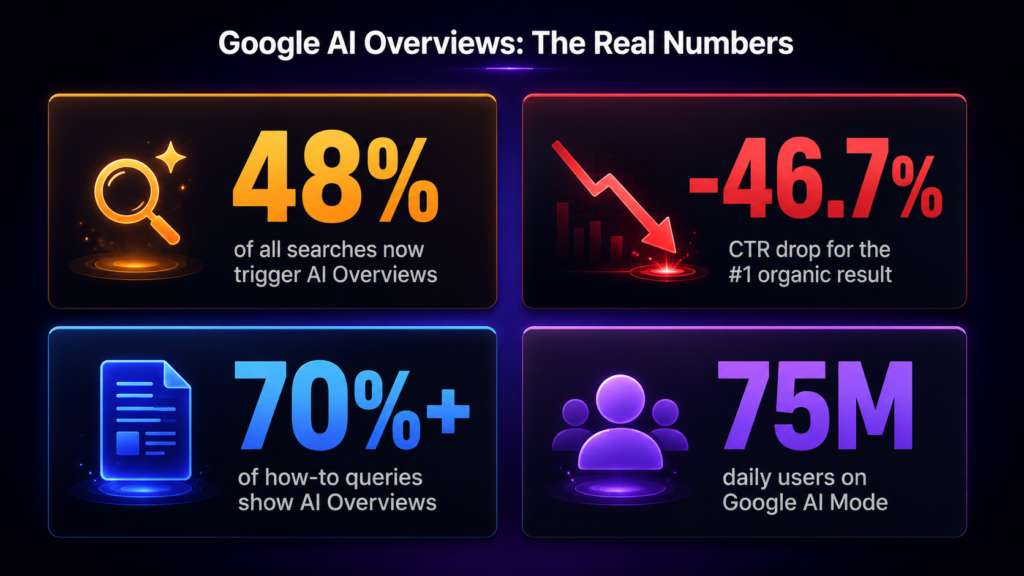
A few things are worth pulling out here.
Informational content is hit hardest. “How to” posts, explainer guides, definition articles — 70% of those queries now trigger an AI Overview. That doesn’t mean abandon the format. It means the strategy changes.
E-commerce product pages are surprisingly safe. Only 4% of product queries trigger an AI Overview. Google knows people need to click to buy. Product SEO still works fine.
The users who do click after seeing an AI Overview are also more qualified. They’ve already read the summary and want more detail. Conversion rates from that traffic tend to run higher than average organic clicks. Losing volume hurts, but what remains often converts better.
What Content Gets Cited in Google AI Overviews (SEO Patterns)
Research from SE Ranking, Surfer SEO, and Ahrefs has identified consistent patterns. These aren’t guesses.
Length. Articles over 2,900 words average 5.1 AI citations. Pages under 800 words average 3.2. Short content gets skipped. Comprehensive content that covers a topic from multiple angles gets pulled into AI summaries repeatedly.
Freshness. Pages updated within the last 3 months average 6 citations per topic. Pages older than that drop to 3.6. If you published a post in 2022 and haven’t touched it, you’re losing citation priority to someone who refreshed theirs last month.
Section structure. Sections between 120 and 180 words per heading get 70% more citations than sections under 50 words. Too short and the AI skips it. Too long and the signal dilutes. Write real, complete sections. One-sentence headers with three lines of padding below them don’t cut it.
Question-based headings. H2s formatted as questions outperform flat topic headings. The AI is built to match questions to answers. Writing your headings as questions makes that matching easier.
Content type breakdown for citations:
- Listicles: 21.9%
- Articles and guides: 16.7%
- Product pages: 13.7%
Citations are also decoupled from rankings. Pages at positions 11–20 regularly get cited if they match the search intent well. You don’t need to rank #1 to appear in an AI Overview.
What doesn’t get cited: generic summaries of what everyone else already said. Unique data, specific numbers, screenshots, and first-hand experience do get cited. The AI is looking for authoritative, non-duplicate information.
Google AI Overviews SEO: 10-Point Optimization Checklist
Go through this for every post you want to optimize — including old ones.
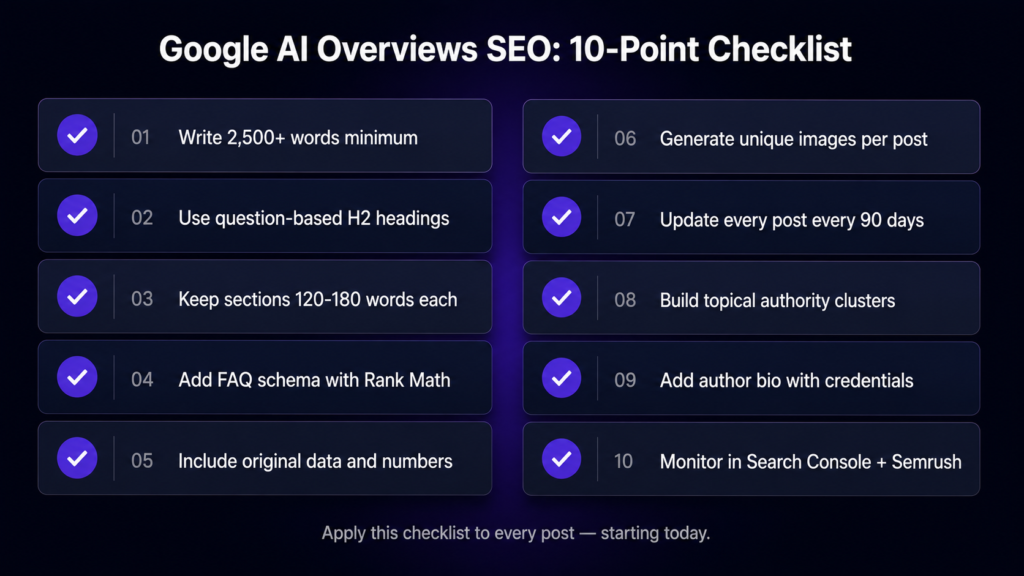
1. Write at least 2,500 words for competitive topics. Not padding. Google’s AI prefers comprehensive coverage because it can pull different sections for different query variations. A 3,000-word post on keyword research can get cited separately for “how to find keywords,” “best free keyword tools,” and “keyword research for beginners.”
2. Use question-based H2 headings. “How do I track my keyword rankings?” instead of “Keyword Tracking.” “What on-page changes actually improve rankings?” instead of “On-Page SEO Tips.” Format headings around how people actually type their queries.
3. Keep each section between 120 and 180 words. Count words between headings. Under 50 is too thin. Over 300 and you’re diluting the signal. Takes editing discipline, worth doing.
4. Add FAQ schema using Rank Math. Add 3–5 questions targeting long-tail variations of your main keyword. Each answer should be 2–3 sentences. FAQ schema helps AI systems identify question-answer pairs and pull them directly into AI Overviews.
5. Include original data, specific numbers, and unique insights. What do you know that others don’t? What tool have you actually tested? What result did you actually see? First-hand experience gets cited more than secondhand summaries.
6. Generate unique images for every post. Unique images signal original content in a way stock photos don’t. Tools like Nano Banana 2 and Flux, available through GFXToolz’s AI Studio, let you generate custom images for each post without stock libraries or copyright headaches.
7. Update every post every 90 days. Calendar reminder. New data, fresh screenshots, updated statistics, replaced outdated examples. Pages updated within 3 months average 67% more citations than untouched ones. You already have the content — just maintain it.
8. Build topical authority through content clusters. Don’t write one post on a topic and move on. Publish 5–10 posts on related sub-topics. Pages that appear across multiple related queries get citation priority because the AI treats them as authoritative on the whole subject, not just one angle of it.
9. Add clear author attribution with credentials. Google’s E-E-A-T signals factor into AI citation decisions. Include an author name, bio, and relevant credentials on every post. A byline like “Written by [name], digital marketer with 5 years of SEO experience” does more than you’d expect.
10. Monitor in Google Search Console and Semrush. In Search Console, look for queries with high impressions but declining CTR — that pattern usually means an AI Overview is intercepting your traffic. In Semrush (via GFXToolz), use the SERP Features filter in Position Tracking to see which keywords are triggering AI Overviews. Those are the pages to prioritize.
Which Content Is Safe? Google AI Overviews SEO Risk by Category
E-commerce product pages are largely fine. Only 4% of product queries trigger AI Overviews, and standard product page SEO with schema markup, rich descriptions, and customer reviews still works. If you run a WooCommerce or Shopify store, this isn’t where your problem is.
Transactional queries (“buy X online,” “X price in India”) rarely trigger AI Overviews. Users with purchase intent still click through.
Comparison and review content has moderate exposure. Users who want a genuine comparison tend to click through for the detail — so if you publish comparison posts, make your tables data-rich and based on actual testing, not specs anyone can find on the product page.
How-to and tutorial guides are the most exposed category, at 70%+ of queries. If your blog runs on “how to” content, that’s a real problem. But generic how-to posts were always thin. Guides with actual depth, first-hand screenshots, and genuine specificity get cited. Write those instead.
Local and navigational queries (“best digital marketing agency in Thane,” “SEO consultant near me”) rarely trigger AI Overviews. Google Business Profile optimization still matters here.
News and time-sensitive content gets summarized, but users want the full story. Publish fast, update often. Freshness gives you citation priority.
Google AI Overviews SEO for Indian Bloggers: What’s Different
AI Overviews are live in India for English-language queries right now. Hindi and regional language queries see lower rates for now, but Google is expanding steadily.
If you run a blog targeting English informational keywords in the digital marketing, e-commerce, or tech niche, you’re already in the affected zone. CTR declines are measurable in Search Console if you know where to look.
If you run an e-commerce store, your product pages are relatively protected. The blog content that supports the store — buying guides, comparison posts, how-to articles — needs the AI citation treatment.
Here’s something most Indian bloggers aren’t paying attention to yet: almost nobody in the local SEO and digital marketing space is actively optimizing for AI citations. The international blogs are doing it. Your local competition mostly isn’t. That’s a real window.
GFXToolz blog posts already follow this format: long-form content, FAQ schema on every post, question-based headings, Nano Banana images, regular updates. Same checklist as above, applied consistently.
For tools: Semrush (available through GFXToolz) is the most practical way to track which keywords are triggering AI Overviews and how your citation visibility changes. Surfer SEO helps you structure content sections properly. Rank Math handles schema. If you’re already using the GFXToolz tool library, none of this costs extra.
It’s not all bad news
Most coverage of this topic is written like a disaster report. That’s partly accurate. But it’s not the whole picture.
Users who click after seeing an AI Overview have already read a summary and decided they want more. That makes them more qualified than someone who clicked because your title looked interesting. Conversion rates from AI-cited traffic tend to run higher.
Being cited repeatedly in AI Overviews also has brand value independent of the click. If your page gets pulled into summaries for the same topic across multiple queries, you’re being positioned as an authority whether or not anyone reads your full article.
And the shift punishes thin content in a way that ranking never fully did. A 300-word post stuffed with keywords could rank. It won’t get cited. Sites publishing AI-generated filler are losing visibility. Sites with real expertise are gaining it. For anyone who actually knows their subject, that’s a better long-term situation.
Tools to Monitor Google AI Overviews SEO Performance
Semrush via GFXToolz is the most practical Google AI Overviews SEO monitoring tool available.
Google Search Console (free): Performance > Search Results. High impressions, declining CTR = AI Overview intercepting your traffic. Note those queries and prioritize the corresponding pages.
Semrush (via GFXToolz, ₹423/month): SERP Features filter in Position Tracking shows which keywords now trigger AI Overviews. Content Audit identifies stale posts that need freshness updates.
Surfer SEO (via GFXToolz): Content Editor shows you the structure of pages currently getting cited for your keywords — heading count, section length, word count. Gives you a concrete benchmark.
Rank Math: FAQ schema and Article schema with proper author markup. Both increase your chances of being cited because they help Google’s AI identify structured question-answer pairs and authorship signals.
Nano Banana 2 + Flux (GFXToolz AI Studio): Unique images per post, at scale, without stock library costs or copyright issues.
FAQ
What is Google AI Overviews SEO and why does it matter in 2026? Google AI Overviews are AI-generated summaries that appear above organic search results and answer queries directly. This reduces organic CTR by 15–46% depending on the query type. The practical implication is that SEO strategy now has to optimize for being cited as a source, not just ranking on page 1.
How often do AI Overviews appear in 2026? As of March 2026, roughly 48% of all search queries. Informational queries trigger them over 70% of the time. E-commerce product queries trigger them only about 4% of the time.
How do I get cited in AI Overviews? Write comprehensive content (2,500 words minimum), use question-based H2 headings, keep sections 120–180 words, add FAQ schema, include original data and unique images, and update every post every 90 days. Pages with topical depth across related queries get cited more often.
Do AI Overviews affect Indian e-commerce stores? Product pages are mostly safe — only 4% of product queries trigger AI Overviews. Standard product page SEO still works. The blog content supporting your store needs AI citation optimization.
What tools help monitor the impact? Google Search Console tracks impressions and CTR patterns. Semrush (via GFXToolz) tracks SERP features at the keyword level. Surfer SEO helps structure content. Rank Math adds FAQ and Article schema.
What to do right now
AI Overviews aren’t going away. The 48% query rate will keep rising. Informational content that doesn’t adapt will keep losing CTR regardless of where it ranks.
Your Google AI Overviews SEO strategy doesn’t need to be complicated.
Pick your best-performing blog post. Add FAQ schema using Rank Math. Update it with fresh data or a new screenshot. Generate a unique image with Nano Banana on GFXToolz. Those three changes take an afternoon and put you ahead of most Indian bloggers who haven’t touched their posts in a year.
The numbers are current: 48% of queries trigger AI Overviews now, 70% of informational searches, and CTR for the #1 organic result is down 34.5–46.7%. Your ranking didn’t drop. Your traffic did. That’s the gap AI citation optimization closes.
Start with one post today — apply the Google AI Overviews SEO checklist above.
Check GFXToolz pricing at gfxtoolz.ai.
Leave a Comment