


Published by GFXToolz AI | Last updated: June 2026
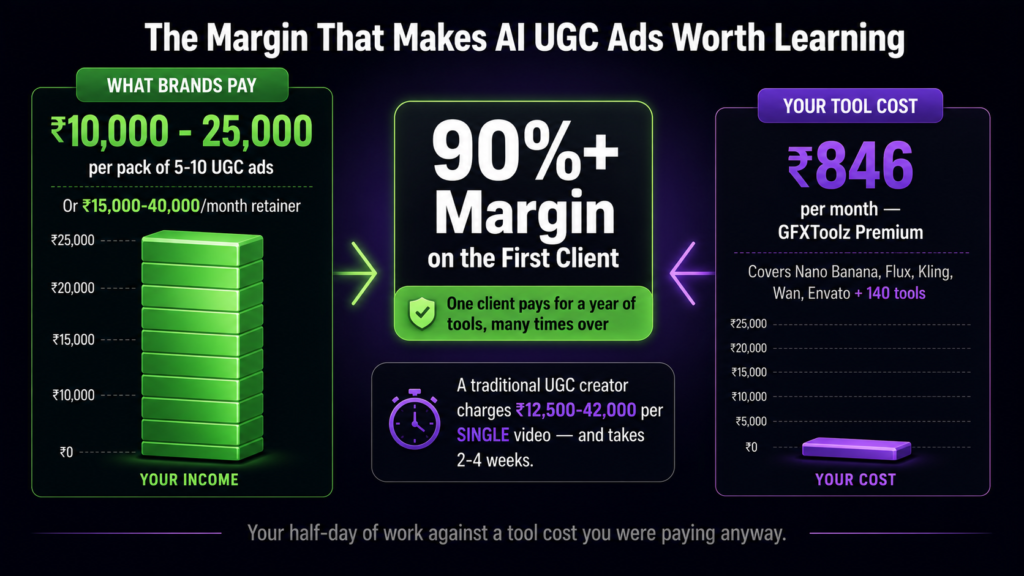
A single UGC creator charges Rs 12,500 to Rs 42,000 per video. A pack of 20 can cost a brand four to twelve lakh rupees and take a month to deliver. In 2026, a freelancer who knows how to make AI UGC ads produces the same kind of content in an afternoon, for a tool cost of a few hundred rupees a month.
Brands are desperate for fresh, native-feeling ad creative, because Meta and TikTok algorithms punish ad fatigue and reward content that looks like a real person made it. The demand for good UGC keeps rising. The supply of human creators cannot keep up with it. That gap between demand and supply is a real opportunity, and most Indian freelancers do not even know the skill exists yet.
This guide shows how to create AI UGC ads with GFXToolz, the exact workflow using Nano Banana Pro, Flux 2, and Kling 2.5, and how to turn it into a service brands pay Rs 10,000 or more for. No expensive avatar subscription required, because you will be using the same underlying AI engines those subscriptions run on.
Before the how-to, it is worth understanding why this window is open right now specifically. UGC as an ad format is not new; brands have wanted authentic-feeling creative for years. What changed in 2026 is the supply side. AI video reached the quality threshold where AI UGC ads are good enough to run as paid ads, and it did so faster than freelancers learned to use it.
That mismatch (huge demand, capable tools, but few people who know the workflow) is the entire opportunity. It will not last. As more freelancers learn this, the rate brands pay will normalise downward, the way it always does once a skill becomes common. The people who learn it while it is still scarce capture the high rates first and build the client relationships that survive the eventual crowding.
What AI UGC Ads Are (And Why Brands Want Them)
A UGC ad is a paid advertisement built from content that looks like a real customer or creator made it. Short video, casual lighting, native phone-camera feel. It is the deliberate opposite of a polished brand shoot with a studio, a crew, and perfect lighting.
The reason UGC converts comes down to how people scroll. A polished, obviously branded ad triggers the “skip reflex” instantly, because viewers have learned to tune out anything that looks like an advertisement. UGC blends into the feed. It looks like the post before it and the post after it, made by a regular person, so it slips past that reflex. The measurable result is higher click-through rates and lower cost-per-click than traditional brand ads, which is exactly what every performance marketer is chasing.
An AI UGC ad recreates that authentic feel using AI. The creator, the voice, the scene, and the pacing are all generated, built from a product photo and a script. Instead of booking a creator, shipping them the product, waiting for filming, and managing revisions over weeks, you generate the whole thing in minutes.
The craft in AI UGC ads is intentional imperfection, and this is the part most people get wrong. The handheld feel, the conversational delivery, the natural and slightly uneven lighting are all on purpose. If you make an AI UGC ad too polished, it stops looking like UGC and starts looking like an ad again, which means it loses the exact advantage that made UGC valuable. The skill is in restraint, not in maximum production quality.
This trips up beginners constantly, because every instinct from traditional content creation pushes toward higher production value. You spend years learning that better lighting, steadier shots, and cleaner audio make content look professional, and then UGC asks you to dial all of that back on purpose.
A creator who cannot resist making everything look polished produces ads that perform like brand ads, which is to say they get skipped. The freelancers who succeed at AI UGC ads internalise one counterintuitive rule early: looking slightly amateur is the professional choice, because it is what converts.
Here is why brands pay real money for this. Meta’s algorithm demands a constant stream of fresh creative to fight ad fatigue, which is what happens when the same ad is shown too many times and stops performing. Some brands run 300 or more creative variations a month to keep their ad accounts fresh. No human UGC operation can produce 300 quality videos a month at a reasonable cost. AI UGC can, and that volume capability is precisely what brands cannot get anywhere else affordably.
The Honest Truth About AI UGC Ad Tools (And Why GFXToolz Does the Same Job)
There are dozens of paid AI UGC platforms in the market right now: Creatify, MakeUGC, Shhots, Invideo, and more. They charge monthly subscriptions, usually billed per creative or per credit, and they market themselves as specialist UGC-generation tools.
Here is what they do not put in their marketing. Almost all of them run the same underlying AI models you can access directly. For video, that means Kling, Wan, Veo, and Seedance. For images, that means Nano Banana or similar engines. The dedicated UGC platform is, in most cases, a convenient wrapper around the same models, with a markup for the convenience.
GFXToolz AI Studio includes those same engines directly. Nano Banana Pro and Flux 2 for the images, Kling 2.5 and Wan 2.2 for the video. Which means you can build the same AI UGC ads from the same underlying technology, without paying for a separate UGC-specific subscription on top of everything else.
The trade-off deserves an honest statement, because this post is about giving you the real picture rather than a one-sided pitch. Dedicated UGC platforms add genuine convenience: pre-built avatar libraries, one-click templates, and guided workflows that hold your hand through the process. GFXToolz gives you the raw models instead, which means more creative control, the ability to work with unlimited products and scenes, and a far lower cost as part of a 146-tool plan rather than a standalone subscription.
So who should use what? If you want zero-effort avatar ads and you are happy paying per video for that simplicity, a dedicated tool may genuinely suit you, and there is no shame in choosing convenience. But if you want creative control, the freedom to make AI UGC ads for unlimited products, and the lowest possible cost, especially if you plan to sell this as a service, learn the GFXToolz workflow below. It takes slightly more effort to learn once, and then it is yours.
Paying a dedicated UGC platform per video is renting a skill. Learning the workflow on the underlying models is owning it. For a freelancer planning to sell AI UGC ads to clients, owning it wins every single time, because your margin is not eaten by a per-video fee on every deliverable.
The GFXToolz AI UGC Ads Workflow (Step by Step)
This is the exact, replicable workflow that the dedicated platforms charge you to abstract away. Five stages, each with the GFXToolz tool that does the job. Learn this once and you can produce AI UGC ads for any product on demand.
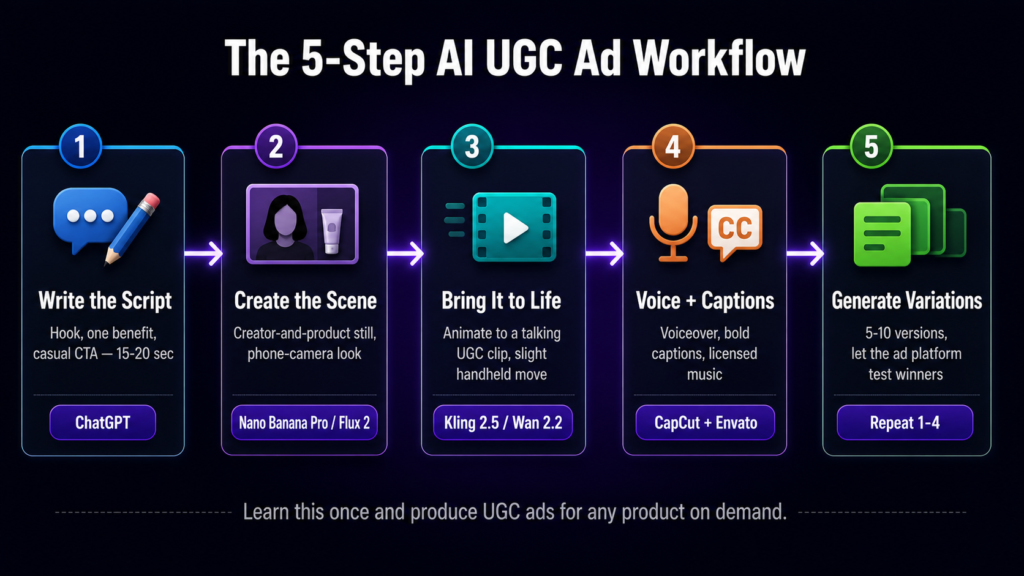
Step 1: Write the Script (The Part That Actually Sells)
The script matters more than the visuals. A beautiful AI video with a weak script does not convert; a simple AI video with a sharp script does. Use the proven UGC formula: a hook in the first 1 to 2 seconds, one clear benefit, and one simple call to action. Keep it 15 to 20 seconds and conversational, the way a real person actually talks, not the way a brand writes.
Use this ChatGPT prompt to draft it:
Write a 20-second UGC ad script for [product]. Start with a scroll-stopping hook about [problem]. Mention ONE benefit. End with a casual CTA. Write it like a real Indian customer talking to a friend, not an ad. No corporate language.
The “talking to a friend” instruction is the key. The moment a script sounds like marketing copy, the ad stops feeling like UGC. Read your script aloud. If it sounds like something you would actually say to a friend who asked about the product, it is right. If it sounds like a billboard, rewrite it.
Step 2: Create the Scene Image (Nano Banana Pro or Flux 2)
Generate the creator-and-product scene as a still image first. Nano Banana Pro excels at realistic people and product-in-hand shots. Flux 2 gives photorealistic studio-grade quality when you need it. Upload your actual product photo so the AI keeps the product accurate rather than inventing a generic version of it.
A working Nano Banana Pro prompt:
A young Indian woman in her 20s holding [product] in a sunlit home setting, casual handheld selfie-style framing, natural lighting, authentic phone-camera look, smiling naturally. Photorealistic, not studio-polished.
Note the deliberate instructions toward imperfection: “handheld selfie-style,” “authentic phone-camera look,” “not studio-polished.” These are doing the real work. Without them, the AI defaults to clean, professional framing, which is exactly the polished look that kills the performance of AI UGC ads.
Step 3: Bring It to Life (Kling 2.5 or Wan 2.2)
Animate the still scene into a talking, moving UGC clip. Kling 2.5 gives the most natural human motion, which matters for a believable talking creator. Wan 2.2 is faster and cheaper when you need high-volume variations. Add a slight handheld camera movement to keep the clip feeling real rather than locked-down and professional.
A working Kling 2.5 prompt:
The woman holds up [product] toward the camera and gestures naturally as if explaining it, slight handheld camera movement, casual home background, natural daylight, authentic UGC style, 15 seconds.
The “slight handheld camera movement” is another intentional-imperfection cue. A perfectly stable shot reads as professional. A small, natural wobble reads as a real person holding a phone, which is what you want.
Step 4: Add Voice, Captions, and Polish
Voiceover brings the script to life. Use an AI voice tool for speed, or record your own voice for the most authentic feel, especially if you can match the conversational tone of the script from Step 1. A real human voice often outperforms a synthetic one for UGC specifically, because small natural imperfections in delivery add to the authenticity.
Captions are non-negotiable. Most people watch video on mute, so your message has to land visually. Add bold, readable captions. Free tools like CapCut auto-caption in seconds, and the captions themselves become part of the visual hook.
Music and B-roll fill the gaps and lift the energy. Pull commercially licensed audio and filler clips from Envato Elements, included on GFXToolz, so you are never worried about copyright strikes on a client’s ad account. A few seconds of relevant B-roll between the talking segments keeps the pacing alive.
Step 5: Generate Variations and Test
This is where the whole advantage of AI UGC ads pays off. The entire point is volume. Regenerate the scene with different creators, different settings, different hooks, and different formats. Produce 5 to 10 variations of the same core ad, then let the ad platform’s own optimisation find the winner across them. You are not trying to guess the best version. You are giving the algorithm options and letting the data decide.
The highest-converting format to try first is the before-after video, which both Meta and TikTok algorithms tend to favour. Also test testimonial-style, unboxing-style, and straight product-demo formats. Different products and audiences respond to different formats, and the only way to know which works is to ship several and watch the numbers.
The Money Part: Sell AI UGC Ads as a Freelance Service
Here is where the skill becomes income. The numbers make the case on their own:
| Item | Amount (INR) | Note |
|---|---|---|
| What brands pay for a UGC ad pack | Rs 10,000–25,000 | 5–10 video variations, a common starter package |
| Traditional UGC creator (per video) | Rs 12,500–42,000 | Plus 2–4 week delivery and revisions |
| Your tool cost (GFXToolz Premium) | Rs 846/month | Covers Nano Banana Pro, Flux 2, Kling, Wan, Envato + 140 more |
| Your time per pack | Half a day | Once you know the workflow |
| Margin on the first client | 90%+ | One client pays for a year of tools many times over |
Look at the gap between what brands pay and what it costs you to deliver. A starter pack at Rs 10,000 to Rs 25,000 against a monthly tool cost of Rs 846 means your first client covers your tools for a year, several times over. After that, the tool cost is essentially noise against your revenue.
Who actually buys AI UGC ads: Shopify and dropshipping stores that live or die on ad creative, D2C brands fighting for feed attention, app makers needing install ads, local businesses running Meta and Instagram ads, and agencies that need creative volume their in-house teams cannot produce. The buyer pool is large and most of them are currently underserved.
The pitch that lands: “Fresh UGC ad creative every week, no creators to book, delivered in days not weeks.” Brands fighting ad fatigue hear that and say yes quickly, because you are solving their most painful and most recurring problem. They do not need to be educated on why they need it. They already feel the pain of stale creative.
The smart structure is recurring revenue, not one-off packs. Sell a monthly creative retainer in the Rs 15,000 to Rs 40,000 per month range for ongoing variations. Because ad fatigue is a permanent, recurring problem, your clients always need more creative. A retainer turns a one-time sale into stable monthly income, which is what makes freelancing sustainable rather than a constant hunt for the next project.
Start with one local brand or one Shopify store in your existing network. You do not need a big launch. One delivered pack becomes your portfolio, your portfolio gets you the second client, and the second client gets you the referral to the third. The first delivery is the hardest and the most important.
To make the economics concrete, walk through a realistic first month. You approach a Shopify store owner in your city who sells skincare and is already running Meta ads. You offer a starter pack of 8 AI UGC ads for Rs 15,000, delivered in four days.
You spend one afternoon running the five-step workflow: three different AI creators, three scene settings, and a mix of before-after, testimonial, and demo formats. Your hard cost is your Rs 846 monthly GFXToolz plan, which you were paying anyway, plus a few hours of your time.
The store owner runs the pack, two of the eight variations outperform their existing creative, and they ask for a fresh batch next month. You convert them to a Rs 20,000 monthly retainer. That single client now pays your tool cost more than twenty times over every month, and you have a portfolio piece to win the next one. Nothing in that sequence requires a camera, a studio, or a creator booking.
This is the single highest-margin skill on the GFXToolz platform right now. The demand is real, the supply of people who can do it is thin, and your cost to deliver is part of a Rs 846 plan you may already be paying for. I would not sit on this gap for long, because skills with this profile do not stay uncrowded forever.
Stay Compliant and Ethical with AI UGC Ads (The Rules That Keep Your Ads Live)
This section protects you, your clients, and your reputation, so treat it as part of the skill rather than an afterthought. AI UGC done dishonestly gets ad accounts banned, and a banned client account is a lost client and a damaged reputation.
Disclose AI content. Meta and TikTok both require disclosure for synthetic media, and they provide AI-content labels for exactly this purpose. Use them. Hiding that content is AI-generated risks account bans for both you and your client, and the disclosure costs you nothing in performance.
No fake testimonials presented as real. An AI avatar saying “I used this for 6 months and it changed my life” as if it were a genuine customer is both a compliance violation and a trust violation. Frame AI UGC ads as illustrative content, a representation of how the product works, not as a real person’s sworn experience. The difference matters legally and ethically.
No misleading claims. The AI persona can be expressive and enthusiastic, but every product claim must be true and within ad policy. This is especially strict for finance, health, and supplement products, where false claims carry real legal and platform consequences. The AI does not get you a pass on truth-in-advertising rules.
Tell your clients. Brands need to know the content is AI-generated so they can disclose it correctly on their end too. Being upfront here protects both of you and builds the kind of trust that turns a one-time client into a long-term retainer. A client who finds out later that you hid it will not stay a client.
The freelancers who treat AI UGC ads ethically, with proper disclosure and honest claims, will still be in business in 2027. The ones faking real testimonials and hiding the AI will get their clients’ ad accounts banned and take their own reputation down with them. The honest path is also the durable one here, which is a rare and convenient alignment.
FAQ
What are AI UGC ads?
AI UGC ads are user-generated-content-style advertisements created with AI rather than filmed by a real creator. They recreate the casual, native, phone-camera feel that makes UGC convert (handheld framing, conversational delivery, natural lighting) but are generated from a product photo and a script in minutes. Brands use them on Meta, TikTok, and YouTube Shorts because they get higher click-through and lower cost-per-click than polished brand ads.
How do I create AI UGC ads with GFXToolz?
Follow a five-step workflow: write a 15 to 20 second script (hook, one benefit, CTA), generate the creator-and-product scene with Nano Banana Pro or Flux 2, animate it with Kling 2.5 or Wan 2.2, add voice and captions, then produce 5 to 10 variations to test. All these tools sit in the GFXToolz AI Studio, so you build the ads directly instead of paying a dedicated UGC platform per video.
How much can I earn making AI UGC ads in India?
Brands typically pay Rs 10,000 to Rs 25,000 for a pack of 5 to 10 AI UGC ads, while a traditional creator charges Rs 12,500 to Rs 42,000 for a single video. Your tool cost through GFXToolz is Rs 846 per month for everything, so margins exceed 90% from the first client. A monthly creative retainer of Rs 15,000 to Rs 40,000 per client turns it into stable recurring income.
Are AI UGC ads allowed on Meta and TikTok?
Yes, as long as you follow each platform’s ad policies. You must disclose AI-generated content using their labels, avoid misleading claims, and never present a fabricated AI persona as a real customer testimonial. Some categories like financial services and health carry extra restrictions. Used honestly and disclosed properly, AI UGC ads run cleanly on both platforms.
Do I need to pay for a UGC tool like Creatify or MakeUGC?
Not necessarily. Most dedicated AI UGC platforms run the same underlying models (Kling, Wan, Veo, and Seedance for video, Nano Banana for images) that GFXToolz already includes. Dedicated tools add convenience like avatar libraries and one-click templates, but GFXToolz gives you the raw models, more creative control, and a far lower cost as part of a 146-tool plan from Rs 846 per month.
The Skill to Learn This Year
AI UGC ads are the rare combination of high brand demand, thin supply, and low production cost. With GFXToolz you can build them using the same Kling, Wan, Nano Banana Pro, and Flux 2 engines the paid platforms run on, then sell the result as a high-margin freelance service that brands genuinely need and will pay recurring money for.
Pick one product, write a 20-second script using the prompt above, and run it through the five-step workflow this week. You will have your first AI UGC ad, and the start of a portfolio, by tonight. The first one is the hardest and it is still just an afternoon of work.
Brands pay Rs 10,000 or more for a UGC pack. Your tool cost is part of Rs 846 a month. That margin, on a skill the market is hungry for and few people have learned yet, is why AI UGC ads are the skill to learn in 2026.
Leave a Comment