


Published by GFXToolz AI | Last updated: June 2026
In 2026, a channel with zero subscribers can outperform one with a million on a single video. YouTube’s algorithm stopped caring about how big you already are and started caring about whether viewers are actually satisfied with what they watch. For a new Indian creator with no audience and no budget, that is the best news in years.
The catch is that millions of videos get uploaded every day, and most never gain any traction. Usually not because the content is bad, but because the creator ignored how the system actually works in 2026: retention over clicks, a Shorts-to-long-form funnel, and thumbnails that earn the click before anyone sees the content. Most new creators also assume growth requires expensive cameras and paid software. It does not, and believing it does keeps people from starting.
This guide shows how to grow a YouTube channel in 2026 step by step, tuned for Indian creators specifically: how the new algorithm works, the Shorts funnel that surfaces small channels, thumbnails that convert, the affordable AI tools that speed up production, the AI-disclosure rules you must not break, and an honest timeline for when results actually arrive.
How the YouTube Algorithm Actually Works in 2026
Understanding the algorithm is not about gaming it. It is about understanding what it measures, so you can stop guessing and make videos that satisfy the signals it actually reads.
Three signals decide your reach. Click-Through Rate (CTR): do people click your thumbnail when they see it? Watch Time and Retention: once they click, do they keep watching? And Satisfaction: did they get genuine value, measured through behaviours like likes, returns to your channel, and survey responses? Every video lives or dies on these three, in that rough order.
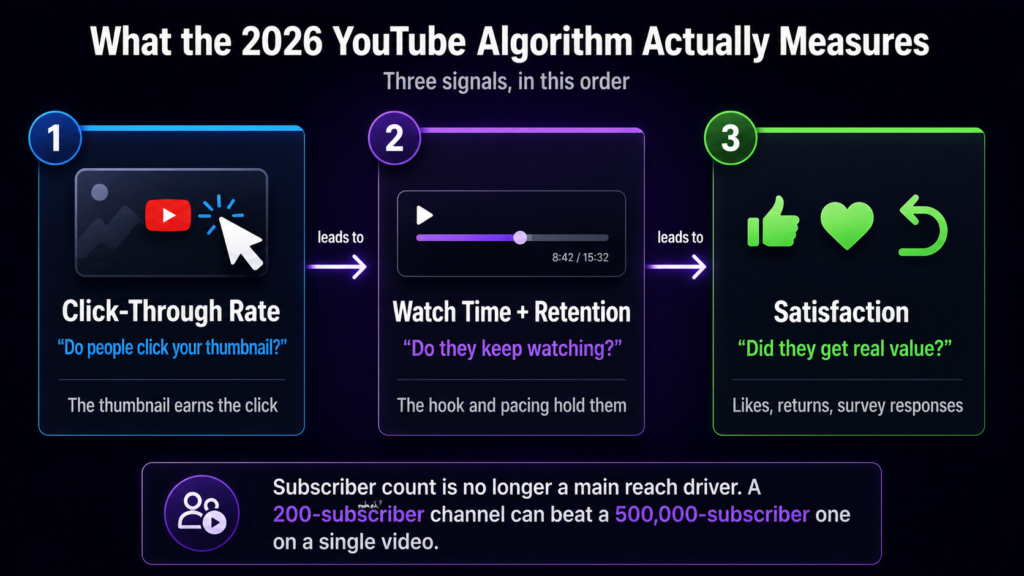
The single biggest change is that subscriber count is no longer a main reach driver. YouTube judges each video on the viewer behaviour it generates, not on the size of the channel that posted it. This is why a 200-subscriber channel can land a video on a million feeds while a 500,000-subscriber channel posts something that reaches almost no one. The system is asking “is this video good?” not “is this channel big?”
This creates a real new-creator advantage when you want to grow a YouTube channel from scratch. YouTube tests every new video by showing it to a small initial audience first. If that test audience clicks well and watches to a high percentage, the algorithm expands the video’s reach through suggested feeds and the Shorts feed. Strong early engagement is what unlocks distribution. A zero-subscriber channel genuinely gets a real shot at every upload, which was not true a few years ago.
Gemini AI now powers a large part of YouTube’s recommendation system. The “Peak Points” feature identifies the most-engaging moments inside videos, and the “Ask” tool lets viewers ask questions about a video’s content. Content that creates clear engagement peaks (moments where viewers lean in, rewatch, or react) gets pushed harder, because the system can identify and reward those peaks directly.
The mindset shift that ties all of this together: stop trying to please an algorithm and start making a video that a real person watches to the end. The 2026 algorithm is built specifically to reward exactly that, which means the old tricks (keyword-stuffed tags, clickbait that does not deliver, padding length for watch time) now actively work against you.
The single best question you can ask before publishing in 2026 is the simplest one: would I watch this to the end? If the honest answer is no, no amount of SEO or tags will save it. Every step that follows in this guide exists to help you answer yes to that question more often.
Step 1 to Grow a YouTube Channel: Pick a Micro-Niche You Can Make 100 Videos In
Narrow beats broad for a small channel, every time. A micro-niche targets a precise audience that the algorithm can confidently recommend you to, because it can clearly understand who your content is for. A channel about “tech” is too broad for the algorithm to place. A channel about “budget Android phones for Indian students” is something it can recommend with confidence to exactly the right people.
Here is the test for whether your niche is the right size: can you make 100 or more videos in it without running out of ideas? If you cannot picture 100 videos, the niche is too narrow and you will stall. If you can picture 1,000, it is probably too broad to build a clear identity. Narrow until you hit a topic where 100-plus videos feel natural, and that is your micro-niche.
The fastest-growing niches in 2026 are worth knowing, because they combine search demand with strong ad rates. AI and tech leads with around 340% year-over-year search growth and CPMs in the $8 to $20 range. Finance, productivity, education, and gaming round out the high-growth, high-value categories. None of these is a guarantee, but starting in a growing niche means the tide is moving with you.
The India angle is the one most global advice on how to grow a YouTube channel misses entirely. Hindi and regional-language content faces far less competition than English content fighting against creators worldwide. A focused Hindi channel in a strong niche can grow faster than an English channel in the same niche, simply because there are fewer creators competing for the same viewers. If you are comfortable creating in Hindi, Tamil, Telugu, Bengali, or another Indian language, that is a structural advantage, not a limitation.
Whatever niche you pick, every video must solve a problem or deliver a clear emotion. Before you make a video, answer this in one sentence: what is in it for the viewer? If you cannot answer it cleanly, the video does not have a clear enough reason to exist, and viewers will feel that vagueness and leave.
Step 2 to Grow a YouTube Channel: Master the Click
The thumbnail is the single biggest growth lever you control. Around 90% of top-performing videos use custom thumbnails, not auto-generated frames. A great thumbnail is a promise that earns the click, and if no one clicks, nothing else about the video matters, because the algorithm never gets the engagement data it needs to expand reach.
The 2026 thumbnail rules are simple and consistent across successful channels. Use 3 to 4 words of big, clean text that is readable on a phone screen. Show a face with real, clear emotion, because human faces and genuine expressions draw the eye. Use high contrast so the thumbnail pops in a crowded feed. Keep one clear subject and zero clutter. A thumbnail trying to say five things says nothing. A thumbnail saying one thing loudly gets clicked.
The title works with the thumbnail, not separately from it. The formula that holds up: Topic + Promise + Curiosity, kept under 60 characters so it does not truncate. The title and thumbnail together must deliver one clear, single promise. If the thumbnail says one thing and the title says another, the viewer gets confused and scrolls past.
Producing great thumbnails used to require a designer or hours in Photoshop. Now it does not. Generate emotional faces and custom backgrounds with Nano Banana Pro in the GFXToolz AI Studio, then compose the layout and add your text in Canva Pro, also on GFXToolz. The two tools together replace a freelance designer for thumbnail production, and you can iterate in minutes instead of waiting on a brief.
Then test what works. vidIQ, available on GFXToolz, shows thumbnail performance data so you can see which thumbnails actually earn clicks and iterate based on real numbers rather than guesswork. The best thumbnail creators are not the most artistic. They are the ones who test most and learn fastest.
I have watched genuinely good videos die because of a cluttered thumbnail, and mediocre ones blow up on a clean one. If you have one hour to spend on a video after filming, spend it on the thumbnail, not the intro. The thumbnail decides whether the intro is ever seen at all.
Step 3 to Grow a YouTube Channel: Build the Shorts-to-Long-Form Funnel
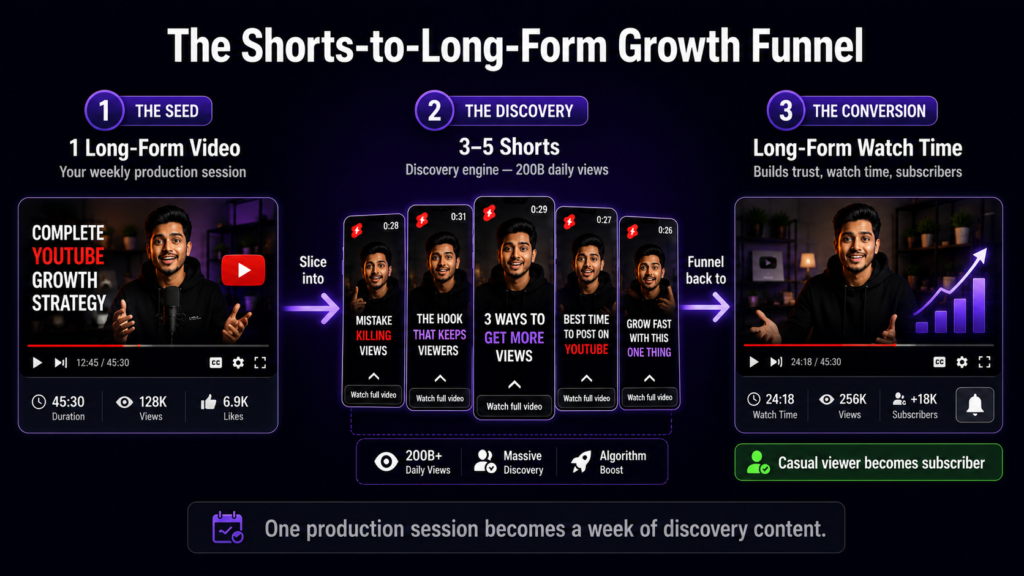
The proven model for small-creator growth in 2026 is a funnel: Shorts for discovery, long-form for trust and watch time. Shorts get 200 billion daily views and surface new creators faster than any other format on the platform. Long-form videos build the deeper watch time and audience relationship that turn a viewer into a subscriber. You need both, working together.
The most efficient way to run this funnel is to turn one long video into 3 to 5 Shorts. You already filmed the content. Slicing the strongest moments into vertical Shorts gives you a week of discovery content from a single production session. Each Short ends with a soft call to action: “watch the full video for the rest.” This is the bridge that moves short-form discovery into long-form retention, converting a casual Shorts viewer into someone who watches your 10-minute video and subscribes.
Content clustering matters for Shorts. Instead of posting random unrelated clips, post a series of related Shorts within your micro-niche. This teaches the algorithm exactly who your audience is, so it shows your Shorts to increasingly well-matched viewers. Five Shorts on the same sub-topic train the system far better than five Shorts on five different topics.
Shorts can now run up to 90 seconds for many creators, which gives you room for a real hook, genuine value, and a clean CTA rather than just a quick clip. But the first 1 to 2 seconds still decide everything. A Short that does not hook instantly gets swiped away before it can deliver, so open with the most attention-grabbing moment, not a slow build.
On cadence, aim for 1 to 2 long-form videos and 3 to 5 Shorts per week. Consistency signals to the algorithm that you are an active, reliable channel during the critical testing phase when it is deciding how much to trust and promote you. Sporadic posting resets that trust repeatedly. Steady posting compounds it.
Step 4 to Grow a YouTube Channel: Win Retention
If CTR gets the click, retention is what turns that click into reach. It is the metric that decides whether the algorithm expands a video or quietly buries it, and most of your improvement effort should go here.
Hook in the first 10 seconds. State the payoff immediately, before anything else. Most viewers who leave a video leave within the first 30 seconds, and the first 10 are where you either earn their attention or lose it. Skip the long intro, the channel branding animation, and the “hey guys welcome back” preamble. Open with the reason they should stay.
Create Peak Points deliberately. Because the Gemini-powered algorithm rewards moments of high engagement, build them on purpose. Use pattern interrupts (a sudden change in pace, location, or visual), B-roll to illustrate points, and visual variety to hold attention through the middle stretch where most videos lose viewers. A talking head on a static background for 12 minutes loses retention no matter how good the words are.
For most niches, the ideal long-form length is 8 to 15 minutes, but only if every single minute earns its place. Long videos win on total watch time, which the algorithm values, but padded videos lose on retention percentage, which it values more. A tight 8-minute video beats a bloated 15-minute one. Never add length for its own sake.
End with a soft teaser pointing to your next video. This increases session time, the total time a viewer spends on YouTube after watching you, which the algorithm rewards heavily because it means you sent the viewer deeper into the platform rather than away from it.
For production help on retention, add cinematic B-roll with Kling 2.5 and quick filler clips with Wan 2.2, both in the GFXToolz AI Studio. These break up talking-head segments and add the visual variety that holds attention, without needing a film crew, a second camera, or stock footage licensing. A solo creator can now produce the kind of visual variety that used to require a production team.
Step 5 to Grow a YouTube Channel: Use YouTube SEO So Videos Get Found
Retention and CTR drive the algorithmic push, but SEO brings the steady, consistent traffic that compounds over time, especially valuable for a new channel with no audience yet.
Start with video keyword research. Find what your audience actually searches for using vidIQ or TubeBuddy, both on GFXToolz. Search-based videos (the ones answering a query people type into YouTube) bring consistent traffic for months, because they get discovered through search long after you publish them. For a new channel, search traffic is more reliable than hoping for a viral moment.
Optimise the three on-page elements. Put your keyword in the title naturally. Write an in-depth description, which most creators waste with one lazy line, when it is a real ranking and context signal. Use 5 to 8 relevant tags: your main keyword, close variations, and a couple of broad category terms. None of these is a magic switch, but together they tell YouTube and search engines what your video is about.
YouTube is now an AI-search signal too. Google AI Overviews, ChatGPT, and Perplexity all cite video content in their answers. An optimised video can get surfaced well beyond YouTube itself, appearing as a cited source when someone asks an AI assistant about your topic. This is a growing source of discovery that most creators are not optimising for yet.
Add chapters and accurate captions to every long-form video. Chapters improve retention by letting viewers navigate to what they want. Captions improve accessibility and, increasingly, help AI systems understand and cite your video content. Both are quick to add and both pay off in discovery and watch time.
The Affordable Tool Stack to Grow a YouTube Channel (With INR Costs)
Here is the full production stack, priced for an Indian creator on a budget:
| Job | Tool | Cost |
|---|---|---|
| Video + keyword SEO | vidIQ / TubeBuddy | Free tiers work; full features on GFXToolz from Rs 550/mo |
| Thumbnails | Nano Banana Pro + Canva Pro | On GFXToolz Premium Rs 846/mo (faces, backgrounds, text, templates) |
| B-roll + intros | Kling 2.5 + Wan 2.2 | On GFXToolz AI Studio; cinematic clips without a camera |
| Scripting + ideas | ChatGPT | Free tier handles hooks, outlines, titles, descriptions |
| Editing + captions | CapCut / Descript | Free tiers; AI captions and clipping |
| Music + SFX | Envato Elements | On GFXToolz Premium; commercially licensed audio |
The honest picture: you do not need expensive gear to start. A decent phone, clear audio (a basic clip-on mic matters more than the camera), and good lighting will beat a fancy camera pointed at boring content every time. The only paid layer genuinely worth it early is the production stack for thumbnails, B-roll, SEO, and music. GFXToolz covers most of that from Rs 423 to Rs 846 per month, instead of paying separate subscriptions for vidIQ, Canva Pro, an AI video tool, and a music library individually, which would run several times the cost.
For the full plan breakdown, see the GFXToolz pricing guide (Post #28).
The AI Honesty Rule (Don’t Get Caught in the Slop Crackdown)
This section could save your channel, so do not skip it. YouTube tightened its AI rules significantly in 2026. You must now disclose deepfakes, cloned voices, and synthetic recreations of real people. Enforcement against reused, low-quality, and compilation content increased sharply, and channels are being penalised for it.
CEO Neal Mohan explicitly named preventing “AI slop” as a platform priority. Channels mass-producing faceless AI content (auto-generated scripts read by cloned voices over stock footage, churned out at volume) are being actively suppressed. The era where you could spin up a faceless channel and flood it with AI-generated videos for easy ad revenue is closing fast.
The safe rule is simple: use AI to assist your production, not to replace human value. AI for B-roll, thumbnails, scripts, editing help, and keyword research is fine and smart. AI to mass-produce content with no genuine human input is what gets flagged. And disclose synthetic media honestly when you use it, because getting caught hiding it is far more damaging than the disclosure ever would be.
Here is why this rule actually protects you rather than holding you back. Original, human-led content with AI assistance is exactly what the satisfaction-first algorithm rewards. Slop fails on retention because viewers can feel its emptiness and leave, and then it gets flagged on top of that. The creators following the honesty rule are aligned with both the algorithm and the policy. The ones gaming it are fighting both at once.
AI is the best production assistant a solo Indian creator has ever had. But the channels treating it as a slop machine are about to learn an expensive lesson. Use it to make your real videos better, not to fake a hundred fake ones. The first approach compounds into a real channel. The second ends in suppression or a strike.
How Long Does It Take to Grow a YouTube Channel? (The Honest Timeline)
No one can promise you virality, and anyone who does is selling something. But the timeline for honest, consistent effort is knowable, and knowing it is what stops you from quitting right before it works.
Real momentum usually arrives after 20 to 50 published videos. This is the exact range where most people quit, frustrated by slow early numbers, right before the algorithm has gathered enough data to start pushing them. The single biggest predictor of channel growth is not talent or budget. It is not quitting at video 25.
For the broader timeline: noticeable growth typically comes after 3 to 6 months of consistent uploads using the Shorts-plus-long-form model. Sustainable success, the point where the channel has real momentum and a reliable audience, usually takes 6 to 12 months. These are ranges, not promises, and they assume consistent quality and consistent posting.
A monetization reality check for India specifically: ad revenue through the YouTube Partner Program is slow to start and CPMs vary widely by niche and audience. Affiliate income, brand sponsorships, and your own digital products usually earn more, earlier, than ad revenue does. Diversify your income from day one rather than waiting for the ad money, which for many Indian creators is the smallest revenue stream for a long time.
Track your progress weekly in YouTube Studio: retention, CTR, and impressions are the three numbers that matter most. Use the Ask Studio AI tool to understand why a specific video performed the way it did and what to fix on the next one. Treat each video as data for the next, not as a pass-or-fail verdict.
The honest bottom line: nobody can promise virality, and you should distrust anyone who does. What you fully control is consistency, retention, and click-through. Do those three things well for 6 months and the algorithm will do its part, because in 2026 it is built to.
FAQ
How long does it take to grow a YouTube channel in 2026?
Most creators see real momentum after 20 to 50 videos, noticeable growth in 3 to 6 months, and sustainable success in 6 to 12 months with consistent uploads. Growth is faster when you combine Shorts for discovery with long-form videos for watch time. The biggest reason channels fail is quitting at 20 to 30 videos, right before the algorithm has gathered enough data to push them.
Do I need expensive equipment to grow a YouTube channel?
No. Clear audio, good lighting, and valuable content matter far more than an expensive camera. A decent phone is enough to start. The only worthwhile paid layer early is a production stack for thumbnails, B-roll, and SEO, and tools like vidIQ, Nano Banana Pro, Kling, and Canva are available affordably through GFXToolz from Rs 423 to Rs 846 per month rather than as separate subscriptions.
Are YouTube Shorts necessary to grow a YouTube channel in 2026?
Not mandatory, but highly recommended. Shorts get 200 billion daily views and are YouTube’s fastest discovery engine for new creators. The proven model is a funnel: use Shorts to get discovered, then guide viewers to long-form videos that build trust and watch time. Turning one long video into 3 to 5 Shorts is the most efficient way to run this without doubling your workload.
Can AI tools help grow a YouTube channel?
Yes, when used to assist rather than replace you. AI tools speed up scripting (ChatGPT), thumbnails (Nano Banana Pro and Canva), B-roll (Kling and Wan), and keyword research (vidIQ). But YouTube is cracking down on AI slop in 2026 and requires disclosure of synthetic media, so use AI to improve real, human-led content rather than to mass-produce faceless videos that get suppressed.
How do small YouTube channels get discovered in 2026?
YouTube now tests every new video with a small audience first, so even a channel with zero subscribers gets a genuine chance. If your video earns strong click-through and retention in that initial test, the algorithm expands its reach through suggested feeds and the Shorts feed. Focus on a tight micro-niche, a clean thumbnail, and a strong hook in the first 10 seconds to pass that test.
Treat It Like a System, Not a Lottery
To grow a YouTube channel in 2026 comes down to the satisfaction-first algorithm and how you feed it: a tight micro-niche the algorithm can place you in, thumbnails that earn the click, a Shorts-to-long-form funnel that turns discovery into watch time, and retention that signals real value. None of it is luck. All of it is a system you can run.
Pick your micro-niche this week and publish your first video with a clean thumbnail and a 10-second hook. Then turn that one video into three Shorts. Repeat the cycle for 90 days, tracking retention and CTR each week, and adjust based on what the numbers tell you.
YouTube tests every new video with a small audience first, so a zero-subscriber channel can still break out on any upload. Consistency across 20 to 50 videos is the single thing that separates the creators who grow a YouTube channel from the ones who quit just before it would have worked.

Leave a Comment