


Published by GFXToolz AI | Last updated: July 2026
India’s digital economy crossed Rs 52 lakh crore in 2025. Somewhere inside that number is your share, if you pick a real method and stick with it past the point where most people quit.
The internet is full of “earn Rs 1 lakh a month from your phone” promises. Almost all of them are lying, and many are outright scams built to take a deposit and vanish. The real methods are less flashy. They need a skill, a few affordable tools, and consistency for about 90 days before the money starts to compound. That is the honest version, and it is the one that actually works.
This is a straight guide to how to make money online in India in 2026. Ten real methods, with realistic INR earnings, how long each one takes to pay, the exact tools you need (most cost between Rs 0 and Rs 846 a month), and the scams to avoid. No hype and no course to buy at the end. Each method links to a detailed how-to guide if you want to go deeper on the one you choose.
The Honest Truth Before You Make Money Online in India
Before any method, you need the real numbers and the real rules, because getting these wrong is why most people fail before they begin.
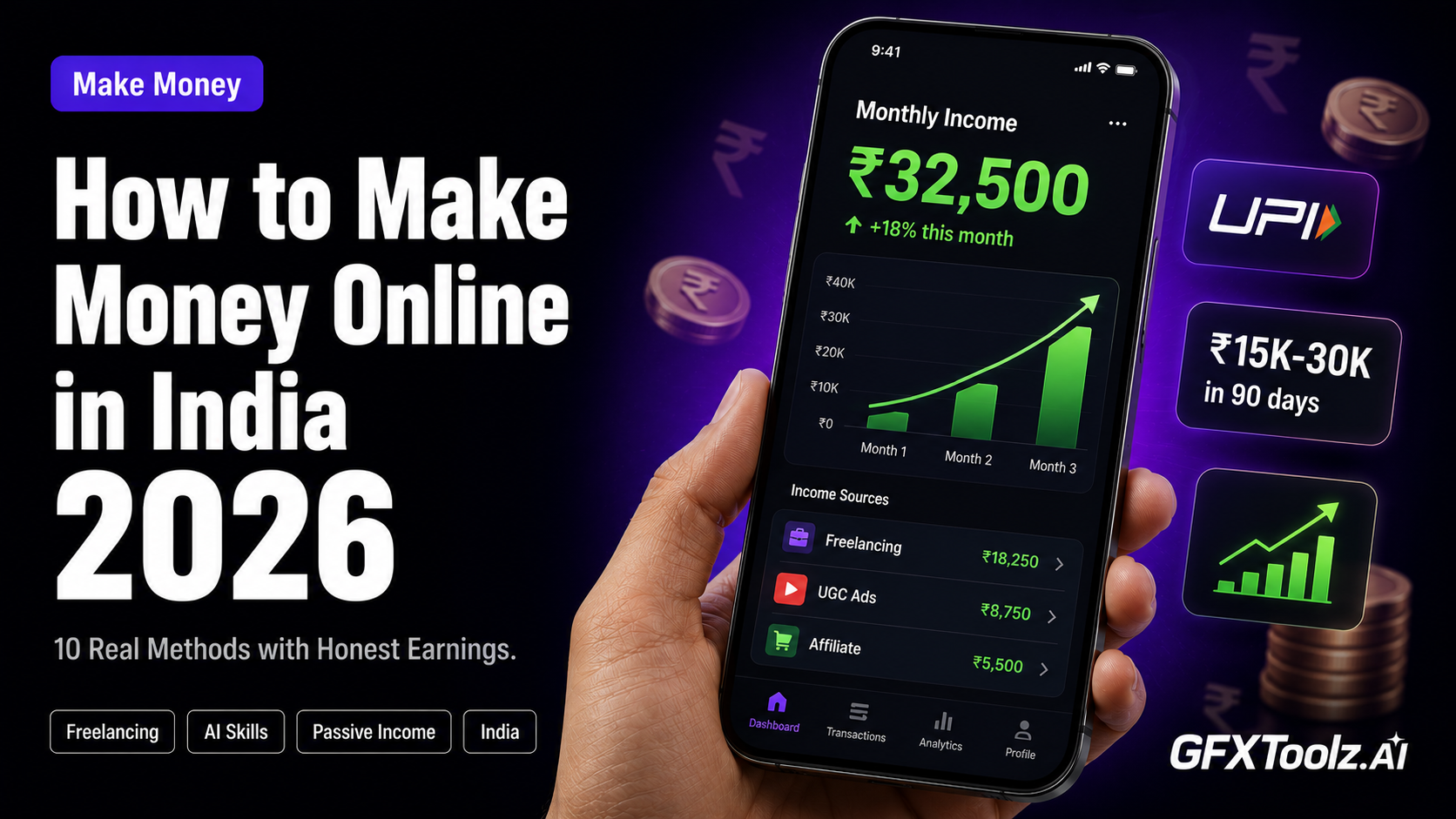
Realistic earnings look like this. With consistent effort, beginners reach Rs 15,000 to Rs 30,000 per month within about three months. The faster-start methods can bring Rs 5,000 to Rs 20,000 in the first month. Nobody makes lakhs in week one, and anyone telling you otherwise is selling something. These numbers are modest at the start and that is exactly why they are believable.
Income compounds after 90 days. This is the single most important thing to understand about online earning. The first two months feel slow and discouraging, and then things accelerate as your skills sharpen, your reviews accumulate, and referrals start arriving. Most people quit in Month 2, right before the compounding kicks in. Consistency is the single biggest predictor of who earns and who does not. Not talent, not luck, not the specific method. Consistency.
Skill-based beats task-based, every time. Surveys, micro-tasks, and “watch ads for money” apps cap out around Rs 8,000 to Rs 10,000 a month no matter how many hours you pour in, because you are selling low-value time with a hard ceiling. One real skill (writing, design, video, SEO) has no ceiling. A skilled freelancer can go from Rs 15,000 to Rs 1,00,000 a month with the same number of working hours, just at higher rates. Always choose the path that lets your rate grow.
Memorise the scam rule: no legitimate way to make money online in India ever charges you an upfront fee. Telegram “like and earn” groups, paid “data entry” jobs, and deposit-first apps are traps, without exception. If a platform wants money from you before you have earned anything, walk away. This one rule filters out the overwhelming majority of online scams targeting Indians.
And be honest about tax from day one. Report your online income, file your ITR, and register for GST if your turnover crosses Rs 20 lakh. Treating your online work as a real business from the start saves you serious pain later, and it is what separates a sustainable income from a problem waiting to happen.
The uncomfortable truth is that online income is not passive and not instant. It is a real skill traded for real money. The good news underneath that: the skills are free to learn, mostly on YouTube, and the tools are cheap. The only genuinely scarce input is your patience.
One more piece of context worth holding onto. India’s online earning opportunity is not evenly understood, which is itself the advantage. Internet access reached the vast majority of the country by 2026, UPI made receiving payments frictionless, and international clients increasingly hire Indian freelancers directly.
But most people around you still think “making money online” means surveys and scams, because that is what the ads promise. The gap between what is actually possible (skilled, legitimate, well-paid remote work) and what most people believe is possible (get-rich-quick apps) is exactly the space where the informed and consistent win. You are not competing against everyone with a smartphone. You are competing against the small fraction who picked a real skill and stuck with it, which is a far smaller and beatable group.
Quick Cash vs Build an Asset (Pick Your Path)
There are two fundamentally different ways to make money online in India, and understanding the difference decides which method you should start with.
Quick cash methods trade your time for money and pay fast. Freelancing, tutoring, virtual assistance, and AI UGC ads all fall here. You do work, you get paid, usually within days to a few weeks. The income is reliable and starts quickly, but it stops when you stop working, because you are selling hours.
Asset-building methods pay little or nothing for the first three to six months, then compound and can eventually earn while you sleep. Blogging, YouTube, and digital products are the main asset plays. A blog post you write today can earn ad and affiliate income for years. A YouTube video keeps getting views long after you publish it. The catch is the long unpaid runway at the start, which is why most people abandon assets before they mature.
The smart 2026 play is to run both, in the right order. Start with a quick-cash method to fund your life and cover your tools. Then use a portion of that time to build one asset alongside it. The quick cash keeps you going; the asset compounds into something bigger over time. What you should not do is try to build five things at once, which spreads your effort so thin that nothing reaches the threshold where it starts working.
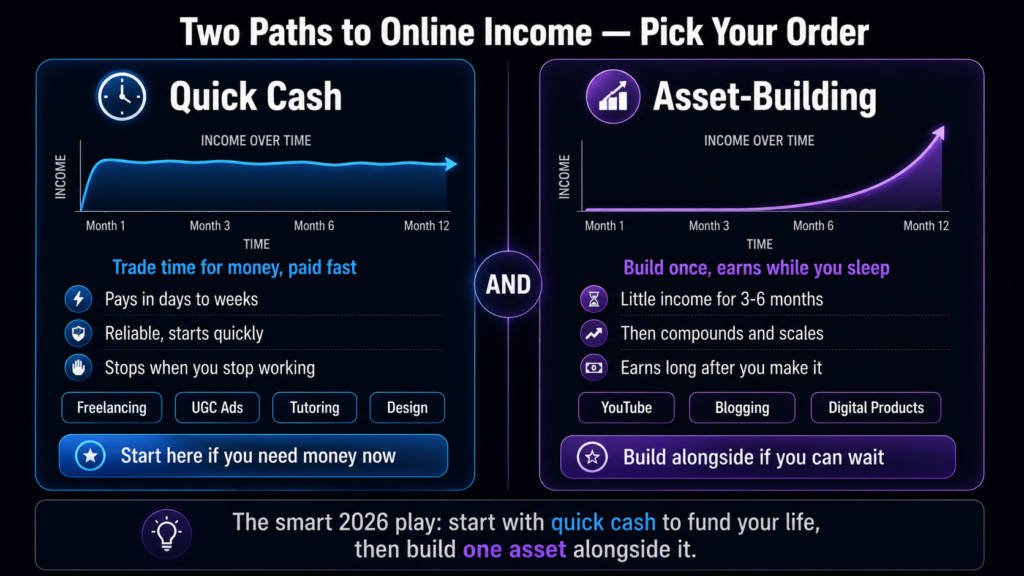
Choose based on your situation honestly. If you need money this month, start with a service (quick cash). If you can afford to invest three to six months before meaningful income, build an asset alongside your service work. Most people who succeed online do both, and they do them in that sequence: cash first to survive, asset second to scale.
The 10 Real Ways to Make Money Online in India (With Honest Earnings and Tools)
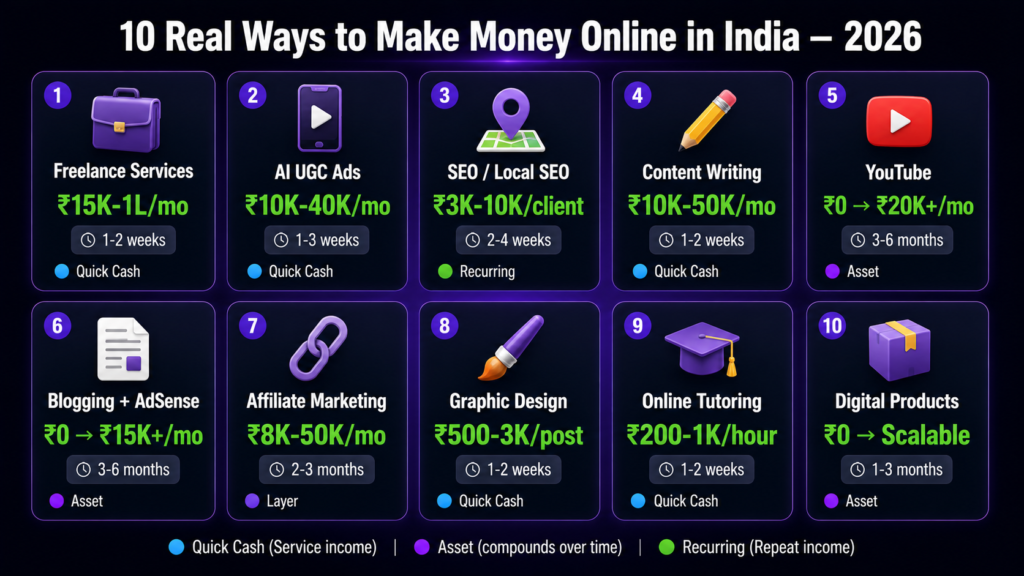
Here is the full picture at a glance, then a breakdown of each:
| Method | Realistic Income | First Income | Type |
|---|---|---|---|
| Freelance services | Rs 15,000-1,00,000/mo | 1-2 weeks | Quick cash, skill-based |
| AI UGC ads | Rs 10,000-40,000/mo | 1-3 weeks | Quick cash, high-margin |
| SEO / local SEO services | Rs 3,000-10,000/client/mo | 2-4 weeks | Recurring retainer |
| Content writing | Rs 10,000-50,000/mo | 1-2 weeks | Quick cash, skill-based |
| YouTube | Rs 0 then Rs 20,000+/mo | 3-6 months | Asset-building |
| Blogging + AdSense/affiliate | Rs 0 then Rs 15,000+/mo | 3-6 months | Asset-building |
| Affiliate marketing | Rs 8,000-50,000/mo | 2-3 months | Layer on content |
| Graphic / social design | Rs 500-3,000/post | 1-2 weeks | Quick cash, skill-based |
| Online tutoring | Rs 200-1,000/hour | 1-2 weeks | Quick cash, skill-based |
| Digital products | Rs 0 then scalable | 1-3 months | Asset-building |
1. Freelance Services (Writing, Design, Video, Marketing)
This is the fastest way to make money online in India. If you have any marketable skill, someone will pay for it on Upwork, Fiverr, or Truelancer. Indian freelancers charge less than US and UK rates, but they win on volume and on the arbitrage of serving international clients who pay in dollars for work priced against Indian costs.
The path is straightforward: pick your strongest skill, set up a profile with a few portfolio samples, price slightly below market to win your first reviews, then raise rates as your reputation builds. Your first client can arrive within one to two weeks of setting up properly.
To make it concrete, here is how a first month often looks. Say you can write. You set up a Fiverr profile offering blog posts, create three sample posts as portfolio pieces, and price your first gigs at Rs 500 for a 700-word article, deliberately below market to attract early buyers.
You land two orders in week two, deliver them well, and earn your first two five-star reviews. Those reviews let you raise to Rs 800 in week three, and by the end of the month you have five reviews and a rate of Rs 1,200. The Rs 500 starting price was never the real business. It was the cost of buying your first reviews, which are the actual asset that lets your rate climb. This same review-first sequence works for design, video, and marketing gigs equally well.
Tools: Canva Pro and Envato for design, Grammarly for writing, the AI Studio for video, Semrush for marketing work. All of these sit on GFXToolz from Rs 423 to Rs 846 per month, so the entire skill-delivery toolkit is one subscription rather than five.
2. AI UGC Ads (The High-Margin 2026 Skill)
Brands pay Rs 10,000 or more for a pack of UGC-style ad videos, the casual, native-looking creative that performs well on Meta and Instagram. With AI, you produce those videos in an afternoon at near-zero cost. The demand is high, the supply of people who can do it is thin, and the margin is enormous. This is one of the best-timed opportunities on this entire list.
Tools: Nano Banana Pro, Flux 2, Kling 2.5, and Wan 2.2, all in the GFXToolz AI Studio. Your only real cost is Rs 846 per month for everything, against client packs that start at Rs 10,000.
3. SEO and Local SEO Services (Recurring Income)
Every restaurant, clinic, coaching centre, and shop needs to rank on Google, and most of them do it badly or not at all. Local SEO is a recurring retainer service at Rs 3,000 to Rs 10,000 per client per month, and it is largely protected from the AI search disruption hitting other content types, because local queries still need real business results.
The recurring structure is what makes this powerful. Five retainer clients at Rs 6,000 each is a stable Rs 30,000 a month, and local clients tend to stay for a long time because they can see the calls coming in.
Tools: Semrush and Ahrefs for research, on GFXToolz from Rs 423 per month. Google Business Profile, the core of local SEO, is completely free.
4. Content Writing
Content writing pays fast and scales with skill. Beginners start around Rs 1 per word; skilled SEO writers charge Rs 3 or more per word for optimised, ranking-focused content. AI and SEO tools multiply both your output and your rates, because they let you deliver research-backed, optimised content faster than a writer working manually.
The jump from Rs 1 to Rs 3 per word is not about writing better prose. It is about delivering SEO-optimised content with keyword research and structure built in, which is a different and more valuable deliverable.
Tools: ChatGPT, Grammarly, and Surfer SEO, all available through GFXToolz, form the content-writing stack that justifies premium rates.
5. YouTube
YouTube is a slower asset play, but India is the largest creator market in the world and the platform rewards consistency heavily. The 2026 algorithm judges each video on viewer satisfaction rather than channel size, so even a new creator with zero subscribers gets a real shot at every upload.
Expect to earn nothing for the first three to six months, then see income build from ads, sponsorships, and affiliate links as your channel matures. Diversify beyond ad revenue early, because Indian YouTube CPMs are modest and sponsorships usually pay more, sooner.
Tools: vidIQ for keyword research and the AI Studio for thumbnails and B-roll, both on GFXToolz.
6. Blogging Plus AdSense and Affiliate
Blogging is the classic asset play, and it pairs naturally with affiliate marketing. You build a site around a topic, publish helpful content that ranks on Google, and earn from ad revenue and affiliate commissions. It pays nothing for three to six months, then compounds into a durable income stream that keeps earning from content you wrote long ago.
The honest 2026 rule for blogging: only recommend tools and products you actually use, with real screenshots and genuine experience. Google’s systems and readers both reward authentic, experience-backed content and punish thin affiliate pages, so authenticity is not just ethical, it is what ranks.
Tools: WordPress with Rank Math for the site, Semrush for keyword research, all covered in a single GFXToolz plan.
7. Affiliate Marketing
Affiliate marketing is best understood as a layer you add on top of content, not a standalone method. You recommend products through your blog, YouTube channel, or social presence, and earn a commission on sales made through your links. Income typically starts arriving two to three months in, once you have enough content driving traffic, and ranges widely from Rs 8,000 to Rs 50,000 a month depending on your niche and audience size.
The niches with the highest affiliate value are finance, software, and web hosting, where single commissions can be substantial. The key is genuine recommendations, because trust is what converts an affiliate link.
8. Graphic and Social Media Design
Design work pays fast and there is constant demand from small businesses and creators who need social media graphics, thumbnails, logos, and marketing materials. Rates run from Rs 500 to Rs 3,000 per post or asset, and a designer serving a few regular clients on monthly packages builds reliable income quickly.
AI tools have lowered the barrier dramatically. You no longer need years of Photoshop skill to produce professional graphics, which means this is accessible to more people than it used to be.
Tools: Canva Pro and Envato Elements for templates and assets, Nano Banana Pro and Flux 2 for custom AI visuals, all in one GFXToolz plan.
9. Online Tutoring
If you know a subject well, someone will pay you to teach it. Online tutoring pays Rs 200 to Rs 1,000 per hour depending on the subject and level, and demand is strong across academic subjects, competitive exam prep, languages, and skills like coding or music. You can start on tutoring platforms or find students directly, and the first income arrives within one to two weeks.
Tutoring scales into higher-value formats over time: one-to-one sessions become group classes, and group classes become recorded courses, which crosses over into the digital-products method below.
10. Digital Products
Digital products are the ultimate asset play: create once, sell many times. Ebooks, templates, courses, presets, Notion templates, and design assets all fall here. The income takes one to three months to start as you build the product and your audience, then scales without a proportional increase in your effort, because selling the hundredth copy costs the same as selling the first.
The smart approach is to build a digital product from a skill you already sell as a service. A freelance designer packages their templates. A tutor records their best lessons. A writer turns their expertise into an ebook. The service teaches you what people will pay for; the product scales it.
Here is that progression in one example. A freelance designer spends six months making social media templates for clients at Rs 1,500 each. Along the way, she notices that half her clients want the same kind of Instagram carousel templates.
So she packages 30 of her best carousel designs into a template pack and sells it on Gumroad for Rs 799. The pack took a weekend to assemble from work she had already done, and now it sells while she sleeps, to buyers she never has to talk to. Her service work taught her exactly what the market wanted and gave her the raw material for free. That is the asset play at its cleanest: the service funds your life and reveals the product, and the product scales beyond the hours you can personally work.
Tools: the design and content tools in your GFXToolz plan cover production; the selling happens on platforms like Gumroad, Topmate, or your own site.
The Tools You Actually Need to Make Money Online in India (And What They Cost)
Here is the honest tool truth that cuts through the noise: most ways to make money online in India need between Rs 0 and Rs 846 per month of tools. The skill is free to learn on YouTube. The tools are cheap. Only consistency is scarce, and no tool can buy you that.
The free layer is genuinely capable. ChatGPT’s free tier for writing and thinking, Google Business Profile for local SEO, Google Search Console for tracking, CapCut for video editing, and WordPress for blogging. You can start several of these methods at exactly Rs 0, prove they work for you, and only then spend anything.
The paid layer that pays for itself is a single affordable bundle. GFXToolz from Rs 423 per month gives you Semrush, Ahrefs, Canva Pro, Envato Elements, Grammarly, and the full AI Studio. Those are the tools behind freelancing, SEO services, UGC ads, content writing, and design, which is five of the ten methods on this list covered by one subscription.
The math settles the question of whether it is worth it. One freelance client or one UGC pack, at Rs 10,000 or more, covers a full year of tools many times over. The tool cost is never the barrier to earning online. It is a rounding error against even a single client, which means “I can’t afford the tools” is almost never the real reason someone does not start.
People spend months looking for the “best” way to make money online in India and skip the boring truth: pick one, get the Rs 500 of tools it needs, and do it every day for 90 days. That single approach beats every course you could buy, and it costs a fraction as much.
How to Avoid Scams When You Make Money Online in India
Scams take more money from aspiring earners in India than most people realise, and they are getting more sophisticated. These five rules will keep you safe.
Never pay to earn. No legitimate opportunity charges a registration fee, a security deposit, or a “training fee” before you start earning. This single rule filters out around 90% of all online scams. A real client or platform pays you; you never pay them for the privilege of working.
Ignore “like and earn” and Telegram task groups. The ones promising Rs 5,000 a day for liking videos or completing simple tasks follow a predictable pattern: they pay small amounts at first to build trust, then ask for a deposit for “premium tasks,” then disappear with your money. Thousands of Indians have been trapped in exactly this scheme. The early small payments are the bait, not proof it is real.
Distrust urgency and guarantees. “Guaranteed returns” and “limited seats, join now before it closes” are pressure tactics designed to stop you from thinking clearly. Real income has no guarantees, and real opportunities do not evaporate if you take a day to research them. Urgency is a manipulation tool, not a feature of legitimate work.
Check reviews before signing up. Google Play reviews, Trustpilot, and MouthShut reveal most scams if you look. Search the platform’s name plus the word “scam” and read what comes up. If you cannot find honest, independent reviews of a platform anywhere, treat that absence as a warning and walk away.
If it sounds too easy, it is. A real way to make money online in India requires a skill and consistency. Anything promising money for no skill and no effort is selling you a dream first and a deposit second. The fantasy of effortless passive income is the hook that every scam is built on, precisely because it is what people want to hear.
Your First 90 Days (The Plan That Actually Works)
Ninety days is the timeline where consistency turns into income. Here is exactly how to spend them.
Week 1: Pick ONE method. Choose the single method that best matches your existing skills and how urgently you need money. If you need cash soon, pick a quick-cash service. If you can wait, you can start an asset. Do not start five things. One focused income stream beats five half-built ones every time, because each method needs your full attention to reach the threshold where it works.
Weeks 2 to 4: Learn, set up, and deliver. Learn the core skill free on YouTube, where every one of these methods has hundreds of quality tutorials. Set up your freelance profile, channel, or blog. Get the one or two affordable tools the method needs. Then deliver your first small job or publish your first post. The goal of this month is not income. It is getting your first real deliverable into the world.
Month 2: This is where most people quit. Do not. The numbers are still small, the progress feels slow, and the temptation to switch methods or give up entirely peaks right here. Push through it. Keep delivering, improve your pricing and quality every two weeks, and collect reviews or subscribers. The compounding has not started yet, but it is close, and the people who quit now are quitting one month before it would have worked.
Month 3: Income starts compounding. This is where the reviews, the referrals, and the improved skills start multiplying your results. Raise your rates, actively ask satisfied clients for referrals, and reinvest a little of your time into building a longer-term asset alongside your quick-cash method. What felt like pushing a boulder uphill in Month 2 starts rolling on its own in Month 3.
Ninety days of boring consistency on one method will out-earn three years of jumping between shiny new ideas. The people who win online are rarely the most talented. They are the ones who did not quit in Month 2.
FAQ
How can I make money online in India without investment?
The best zero-investment methods are freelancing, content writing, online tutoring, and affiliate marketing, all of which are free to join on platforms like Upwork, Fiverr, and Amazon Associates. You trade a skill for money using just a smartphone or laptop and an internet connection. Free tools like ChatGPT, Canva’s free tier, and Google Business Profile let you start several methods at zero cost. Never pay any platform an upfront fee to begin.
How much can a beginner realistically earn online in India?
With consistent effort, beginners typically earn Rs 15,000 to Rs 30,000 per month within about three months. Fast-start methods like freelancing and content writing can bring Rs 5,000 to Rs 20,000 in the first month, while asset-based methods like blogging and YouTube take three to six months to earn meaningfully but compound over time. Anyone promising Rs 1 lakh in your first month is not being honest with you.
Which method pays the fastest to make money online in India?
Freelancing, content writing, virtual assistance, and online tutoring pay the fastest, often within one to two weeks, because they are skill-based services where you get paid on delivery. High-margin newer skills like AI UGC ads also pay quickly, within one to three weeks, because brands need fresh creative constantly. Blogging and YouTube pay slowly at first but compound significantly over time.
What tools do I need to start making money online in India?
Most methods need very little. Free tools like ChatGPT, Canva’s free tier, WordPress, and Google Business Profile can start you at zero cost. As you grow, an affordable bundle like GFXToolz (from Rs 423 per month) gives you Semrush, Ahrefs, Canva Pro, Envato, Grammarly, and AI tools, the software behind freelancing, SEO services, UGC ads, and content. One client typically covers a full year of tools.
How do I avoid scams when I make money online in India?
Follow one rule above all others: never pay money to earn money. No legitimate opportunity charges a registration fee, deposit, or training fee. Avoid Telegram “like and earn” groups, paid “data entry” jobs, and anything promising guaranteed returns or using urgency to rush your decision. Check reviews on Google Play, Trustpilot, or MouthShut before joining any platform, and if it sounds too easy, it is a scam.
Pick One and Start This Week
Learning to make money online in India in 2026 is real, legal, and achievable, but it is a skill traded for money, not a lottery ticket. Pick one method that fits your situation, get the few affordable tools it needs, avoid every pay-to-earn scam, and stay consistent through Month 2 when most people quit. That is the whole formula, and it is boring precisely because it works.
Choose one method from the ten above today. Open its detailed guide, learn the skill this week, and deliver your first job or publish your first post within 30 days. Then do it again, and again, for 90 days.
Beginners reach Rs 15,000 to Rs 30,000 a month in about 90 days with consistency. The tools cost between Rs 0 and Rs 846 a month. The only thing standing between you and that number is not quitting in Month 2.

Leave a Comment