

Published by GFXToolz AI | Last updated: July 2026
India will have around 900 million internet users in 2026, and almost every business behind that number needs someone who can run ads, rank on Google, and build a brand online. From a Surat clothing brand to a Bengaluru startup, the demand is the same. Digital marketing jobs grew 30% in the last two years, and the supply of genuinely skilled people is still thin. That imbalance is the opportunity.
The problem is not a lack of information. It is too much of it, most of it built to sell you a course. Beginners drown in dozens of sub-fields, buy training they never apply, jump between SEO and ads and social media without finishing anything, and quit before a single skill starts paying. The confusion is manufactured, because confused beginners buy more courses.
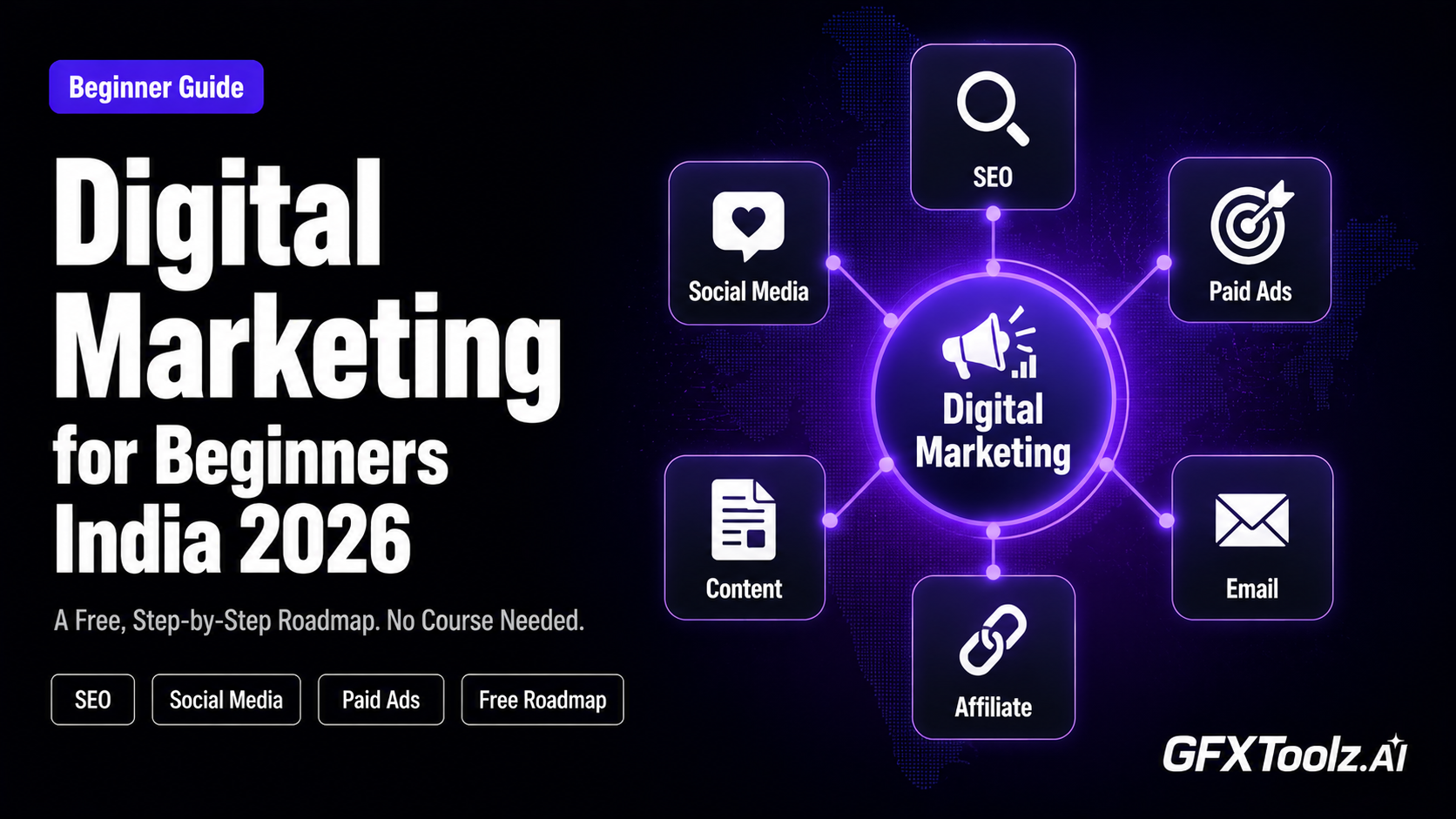
This is a free, honest roadmap for digital marketing for beginners in India in 2026. What it actually is, the core channels, the exact skills and tools you need (most cost nothing to start), a week-by-week 30-day action plan, realistic earnings across every path, and how to land your first client, without buying a single course. Each channel links to a detailed how-to if you want to go deeper on the one you choose.
What Digital Marketing Actually Is (In Plain Language)
Strip away the jargon and digital marketing is simple: promoting a product, service, or brand using online channels (search engines, social media, email, websites, and apps) to attract people, engage them, and convert them into customers. That is the whole field. Everything else is a specialisation within it.
The reason it beats traditional marketing comes down to three things. It is measurable: you can see exactly how many people saw your ad, clicked it, and bought. It is targeted: you can show your message to precisely the people most likely to care, by age, location, interest, or behaviour. And it is cheap to start: you can launch a campaign with a few hundred rupees, track every rupee of return, and adjust in real time. A newspaper ad gives you none of that. A Meta ad gives you all of it.
The shift underway in 2026 is worth understanding early, because it shapes what a beginner in digital marketing should learn. The field is now less about pushing ads at people and more about personalisation, genuinely useful content, and showing up where both AI systems and humans look for answers. As AI Overviews and AI-powered search change how people find information, the marketers who win are the ones creating content worth citing, not the ones shouting the loudest.
This matters for a beginner because it changes what “good” looks like. A few years ago, you could rank a thin, keyword-stuffed page and run interruptive ads and make money. In 2026, Google’s systems and AI search engines actively suppress that kind of low-value work, while rewarding content that genuinely helps and creative that people actually want to watch.
That is good news if you are starting now, because it means the skills you build (creating real value, understanding your audience, using AI to produce better work faster) are the durable ones, not tricks that stop working after the next algorithm update. You are learning the version of marketing that is being rewarded, not the version that is being phased out.
Who should learn this? Business owners who want to grow without hiring an agency. Students and job seekers, since entry-level roles pay Rs 2.5 to 6 LPA and the field is hungry for people. And anyone who wants to freelance or earn online independently. Crucially, no degree is required. This is one of the few well-paid fields where what you can demonstrate matters far more than what you studied.
The Core Channels of Digital Marketing for Beginners in India
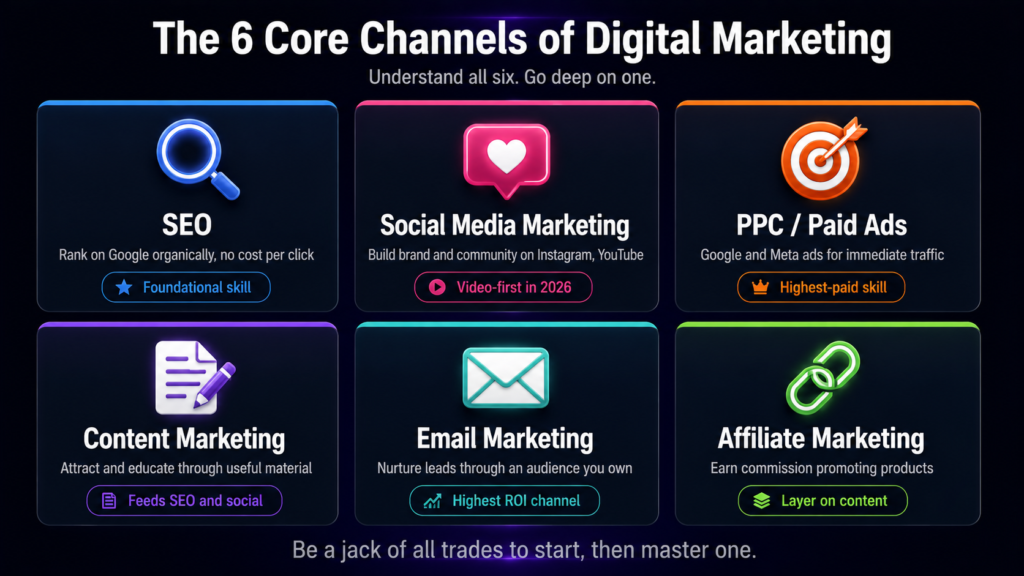
Digital marketing is not one skill. It is a set of connected channels, and understanding what each does helps you choose where to start. You do not need to master all of these. You need to understand all of them and go deep on one.
1. SEO (Search Engine Optimisation)
SEO is the practice of getting websites and content to rank on Google so people find you organically, without paying for each click. It is the foundational skill every marketer benefits from, because it underpins content, informs social, and even improves paid ads. In 2026, SEO has expanded to include AI-search optimisation (AEO), as AI Overviews and AI Mode change how people search and what gets surfaced. A marketer who understands SEO understands how the entire web organises attention.
To picture it in practice: a Jaipur bakery that ranks first for “best chocolate cake in Jaipur” gets a steady stream of customers every month without paying for a single click, while a competitor paying for Google Ads stops getting traffic the moment their ad budget runs out. That difference (owned organic visibility versus rented paid visibility) is why SEO is the skill marketers return to again and again. It compounds. Work you do today keeps paying months and years later.
2. Social Media Marketing
This is building a brand and community on Instagram, LinkedIn, YouTube, and Facebook. It covers content creation, community management, and understanding how each platform’s algorithm decides what to show. Video is the dominant format in 2026 across every platform, so comfort with short-form video is close to mandatory here. Social media is where brands become recognisable and where a lot of Indian small businesses most obviously need help, since most have a page and no strategy.
3. PPC / Paid Ads (Google and Meta)
Pay-per-click advertising runs paid campaigns for immediate traffic and leads, in contrast to SEO’s slower organic build. Google Ads dominates in India and is one of the highest-paid marketing skills you can develop, because businesses will pay well for someone who can turn ad spend into profit reliably. Meta ads across Instagram and Facebook are where UGC-style creative wins, and where a lot of D2C and e-commerce growth happens. Paid ads is a skill that pays quickly because the results are directly measurable in rupees.
4. Content Marketing
Content marketing attracts and educates an audience through blogs, videos, guides, and other genuinely useful material. Rather than interrupting people with ads, it earns their attention by helping them. It is the engine that feeds SEO and social, because both need content to work, and it builds the kind of trust that converts over time.
5. Email Marketing
Email marketing nurtures leads into customers through direct, owned communication. It remains one of the highest-return channels in all of marketing, because an email list is an audience you own rather than rent from a platform. When social algorithms change or ad costs rise, your email list is unaffected. This is an underrated skill that quietly outperforms flashier channels.
6. Affiliate Marketing
Affiliate marketing earns commission by promoting other companies’ products through your content and links. It is best understood as a layer you add on top of content or social, not a standalone method, because it needs an audience to work. A blogger or YouTuber with genuine reach can add affiliate income to what they already do, turning existing content into a revenue stream.
The Skills You Need in Digital Marketing (And the Ones That Pay Most)
Knowing the channels is one thing. Knowing which skills to build, and in which order, is what actually determines your income.
The foundational skills every beginner needs, regardless of specialisation: keyword research, basic SEO, content writing, social media fundamentals, and the ability to read analytics through Google Analytics and Search Console. These are the literacy of digital marketing. You cannot specialise well without them, because every specialisation depends on understanding what your audience searches for and whether what you are doing is working.
The highest-paying specialisations in 2026 are worth knowing so you can aim toward one. Performance marketing (running Google and Meta Ads profitably), SEO, marketing automation, and AI optimisation are where the money concentrates. Specialists in these areas earn Rs 50,000 to Rs 1,50,000 or more per month, because they produce measurable revenue and are genuinely hard to replace. The generalist who does a bit of everything earns far less than the specialist who does one thing exceptionally.
The AI edge separates 2026 marketers from those still working like it is 2022. Knowing how to use AI tools (ChatGPT for ideas and content briefs, AI image and video tools for creative production) gives you a real, visible advantage over marketers who do not. AI is now part of every marketer’s daily work, and the ones who use it deliver more output at higher quality in less time. This is not optional knowledge anymore. It is baseline competence.
The one rule that governs your whole first year: be a jack of all trades to start, then master one. Understand all six channels at a basic level, then pick a single one and get genuinely, deeply good at it. “Master of one” is where the big money lives. The generalist competes with everyone; the specialist competes with few.
The beginners who struggle are the ones learning SEO on Monday, ads on Tuesday, and email on Wednesday, and mastering none of them. Pick one channel, get genuinely good at it, and add the rest later once you have income and confidence. Depth beats breadth decisively for your first year, and the people who ignore this advice are the ones still “learning” a year later with nothing to show.
The Beginner Tool Stack for Digital Marketing (Free to Start, Affordable to Grow)
Here is the tool reality that the course sellers do not want you to know: you can learn and practise every core skill in digital marketing for free.
| Job | Free Tool (Start Here) | Grow To (GFXToolz) |
|---|---|---|
| Keyword + SEO research | Google Trends, Search Console | Semrush / Ahrefs (from Rs 423/mo) |
| Design + graphics | Canva free tier | Canva Pro + Envato (Premium Rs 846/mo) |
| Content + ideas | ChatGPT free tier | + Grammarly + Surfer SEO |
| Analytics | Google Analytics 4 (free) | Stays free, layer on tool data |
| Image + video creative | Canva, CapCut (free) | Nano Banana Pro, Flux 2, Kling (AI Studio) |
| Certifications | Google Digital Garage, HubSpot, Meta Blueprint (all free) | Free forever, do these first |
The honest tool truth: you can learn every core skill of digital marketing at Rs 0. The free certifications from Google, HubSpot, and Meta plus free tools like Canva, ChatGPT, and Google Analytics are genuinely enough to start and even to land your first clients. The paid layer becomes worth it only when client work or your own growth demands more power. GFXToolz from Rs 423 per month gives you Semrush, Ahrefs, Canva Pro, Envato, and the AI Studio, which are the tools behind professional SEO, content, and creative work, but you do not need them on day one.
Do not spend Rs 50,000 on a course to learn what Google and HubSpot teach for free. Spend that money on nothing at first, then on a Rs 423 tool subscription once you have a paying client to justify it. The course industry sells urgency and the fear of missing out. The skill itself just needs free learning and consistent practice. The single most common expensive mistake beginners make is buying a premium course before trying the free path that teaches the exact same fundamentals.
Your 30-Day Digital Marketing Action Plan
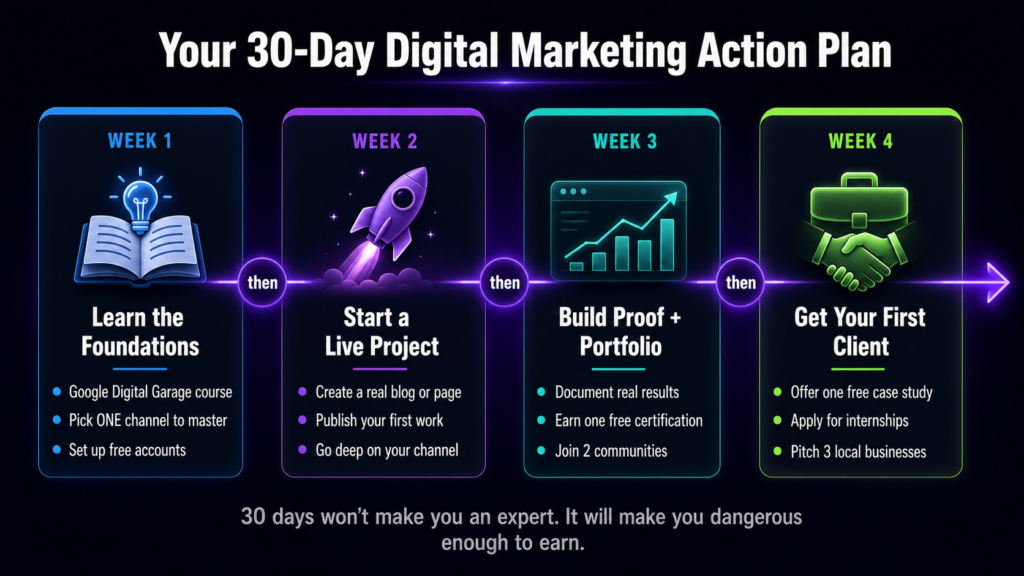
Most guides tell you what to learn and leave you to figure out how to actually start. Here is the concrete week-by-week plan that turns learning into earning.
Week 1: Learn the Foundations
Complete the free Google Digital Garage “Fundamentals of Digital Marketing” course. It is about 40 hours total, so do the core modules first rather than trying to finish everything at once. This single free course covers more genuine fundamentals than most paid programs.
Read through the six channels in this guide and pick ONE to go deep on, based on what you actually enjoy. Enjoyment matters more than beginners think, because you will do far more of the work if the channel interests you. If writing energises you, lean toward SEO and content. If you like visuals and video, lean toward social. If you like numbers and immediate results, lean toward paid ads.
Set up your free accounts this week: Canva, ChatGPT, Google Analytics, and a proper LinkedIn profile. The LinkedIn profile matters because it is where a surprising number of first opportunities come from.
Week 2: Start a Live Project
Create a real asset in your chosen niche: a blog, an Instagram page, or a practice website. This is not busywork. It is your live demonstration, the thing you will point clients and employers to instead of a certificate. A live project you can show beats any amount of theory you can describe.
Apply what you learned immediately. Publish your first SEO-optimised blog post, or your first week of planned social content, or your first small practice ad campaign. The point of week two is to move from consuming information to producing work, which is the transition most people never make.
Go deep on your chosen channel using detailed guides. Whether you picked SEO, social, content, or ads, this is the week you move past fundamentals into the specifics of your specialisation.
Week 3: Build Proof and Portfolio
Keep publishing, and this week start documenting results: traffic numbers, reach, click-through rates, engagement. Screenshot everything. These screenshots become your portfolio, and a portfolio of real results is what converts a prospect into a paying client. “I grew this page from 0 to 500 followers in three weeks” with a screenshot is worth more than any credential.
Earn one free certification this week, either HubSpot Content Marketing or Meta Blueprint, to add credibility alongside your live results. Certifications do not replace a portfolio, but they complement it, especially for job applications.
Join two LinkedIn or WhatsApp marketing communities and comment usefully in them. Do not spam or pitch. Contribute genuinely. Many first clients and job leads come from communities rather than job portals, because people hire people they have seen being helpful.
Week 4: Get Your First Opportunity
Offer to manage one local business’s Instagram or SEO for free or at a low rate, specifically to build a documented case study. A real result for a real business, even an unpaid one, is the strongest possible portfolio piece and often converts into a paid engagement once they see the value.
Apply for internships on Internshala and LinkedIn. Entry-level digital marketing internships pay Rs 5,000 to Rs 15,000 per month plus a certificate, and they give you structured experience and a reference. For someone with no track record, an internship is a fast on-ramp.
Pitch three small businesses in your own network. Most Indian shops, restaurants, and local services now have an Instagram page and no idea how to grow it. That gap is precisely your opportunity. You do not need to cold-pitch strangers. You need to notice which businesses you already know are marketing badly, and offer to help.
Thirty days will not make you an expert, but it will make you dangerous enough to earn. The people still “preparing to start” after six months are the ones who never opened a live project in week one. The plan works because it forces you to produce and pitch, not just study.
Here is how a realistic version of this month plays out. A college student in Indore picks social media marketing in week one, finishes the core Google Digital Garage modules, and starts an Instagram page for a niche she cares about in week two.
By week three she has grown it to a few hundred engaged followers and has the screenshots to prove the growth. In week four she walks into a local cafe she already visits, shows the owner her page results on her phone, and offers to run their Instagram for Rs 4,000 a month. The owner, who has 200 followers and no idea what to post, says yes.
That single Rs 4,000 client is not the goal. It is the proof. It becomes the case study that wins her a Rs 8,000 client the next month, and the reference that gets her a freelance interview after that. The entire chain started with one live project and one in-person pitch to a business she already knew.
How Much Can You Earn in Digital Marketing (Job vs Freelance vs Business)
The income potential varies widely by the path you choose, so here are honest ranges across every route:
| Path | Income (INR) | Note |
|---|---|---|
| Fresher job | Rs 2.5-6 LPA (Rs 15-25K/mo) | Entry roles; grows fast with a specialisation |
| Specialist (2-4 yrs) | Rs 50,000-1,50,000+/mo | SEO, performance marketing, automation |
| Freelancer | Rs 80,000-1,50,000/mo | From 3-4 international clients paying in USD/GBP |
| Own business / agency | Uncapped | Manage multiple clients; hire and scale |
| Side income (beginner) | Rs 10,000-30,000/mo | Manage 1-2 local businesses’ social/SEO |
The freelance path deserves special attention for Indians, because it is where the numbers get genuinely large. With international clients paying in dollars or pounds, even a mid-level freelance SEO or ads specialist earns Rs 80,000 to Rs 1,50,000 per month from just three or four clients. A US client happily pays $500 to $800 a month for SEO work that the freelancer prices against Indian living costs. This currency arbitrage is why so many skilled Indian marketers now choose freelancing over a salaried role, and it is entirely achievable within a year of focused skill-building.
The progression most successful marketers follow: start with a job or a side income to build skills and confidence, move to freelancing as your portfolio and rates grow, and eventually build your own agency if you want to scale beyond your own hours. Each stage funds the learning for the next. You do not have to pick your final destination on day one.
Beginner Mistakes in Digital Marketing That Waste Months
Avoiding these five mistakes will save you more time than any productivity tip, because each one quietly costs beginners months of progress.
Trying to learn everything at once. Studying SEO, ads, social, and email simultaneously gives you surface knowledge in all four and real skill in none. You end up able to talk about marketing but not do any of it well enough to get paid. Pick one channel and go deep before adding a second.
Watching courses without building anything. This is the most common and most expensive mistake by far. Endless course consumption feels like progress but produces nothing you can show or sell. Start a live project in week one, even if it is imperfect and even if you feel unready. You learn ten times faster by doing than by watching.
Chasing certificates over skills. Certifications help at the margin, especially for jobs, but employers and clients pay for demonstrated results and a real portfolio, not a wall of badges. A candidate with one certificate and three documented case studies beats a candidate with ten certificates and no live work, every time.
Expecting quick results and quitting early. Growth is slow for the first few weeks and then compounds. This pattern catches people out constantly. The person who quits in month two, frustrated by slow early numbers, never sees the month-three acceleration that would have proven the whole thing works. Consistency through the slow start is the entire game.
Buying an expensive course before trying the free path. Google, HubSpot, and Meta teach the fundamentals for free, and their certifications carry real weight. Spend money on tools once you are earning, not on courses before you start. The Rs 50,000 you might spend on a course is better kept in your pocket until a paying client justifies a Rs 423 tool subscription.
FAQ
Can I learn digital marketing for free in India?
Yes, completely. Free certifications from Google Digital Garage, HubSpot Academy, and Meta Blueprint teach the fundamentals thoroughly, and free tools like Canva, ChatGPT, Google Analytics, and Search Console are enough to start practising. You can learn every core skill and even land your first clients at zero cost. Only upgrade to paid tools like GFXToolz (from Rs 423 per month) once client work needs the extra power that Semrush, Ahrefs, and the AI Studio provide.
How long does it take to learn digital marketing?
Three months of focused, consistent learning is genuinely enough to become job-ready or client-ready. You can grasp the basics in two to three months, but real skill comes from applying them on a live project rather than just watching courses. Pick one channel to master first instead of trying to learn everything, and you will progress far faster than someone spreading their attention across all six.
Do I need a degree to start a digital marketing career in India?
No. Digital marketing is one of the few fields where employers and clients value your portfolio and demonstrated results over your degree. Many successful Indian marketers are entirely self-taught with no formal marketing education. Free Google, HubSpot, and Meta certifications plus a portfolio of real project results matter far more to a hiring manager or client than a marksheet does.
How much can a beginner in digital marketing earn in India?
Fresher jobs start at Rs 2.5 to 6 LPA, roughly Rs 15,000 to 25,000 per month, and specialists with two to four years of experience earn Rs 50,000 to Rs 1,50,000 or more per month. Freelancers with a few international clients earn Rs 80,000 to Rs 1,50,000 per month. Even as a beginner side hustle, managing one or two local businesses’ marketing can bring Rs 10,000 to 30,000 per month.
What is the best digital marketing skill to learn first in 2026?
SEO is the best foundation because it underpins content, social, and even paid ads, and it now includes AI-search optimisation as AI Overviews and AI Mode change how people search. After SEO, the highest-paying specialisations are performance marketing (Google and Meta Ads), marketing automation, and AI optimisation. Master one of these deeply rather than learning several at a surface level.
Start Today, Not Someday
Digital marketing for beginners in India is a rare kind of skill: it can give you a job, a freelance income, or a way to grow your own business, and you can learn the whole thing for free. Pick one channel, learn it by working on a live project, use the free tools until client work justifies paid ones, avoid the course trap, and stay consistent past the point where most people quit.
Start today. Complete the free Google Digital Garage fundamentals course this week, pick the one channel that interests you most, and open a live project. Follow the 30-day plan above and pitch your first client before the month is out.
India will have 900 million internet users in 2026 and a wide gap between what businesses need and the skilled marketers available to serve them. That gap is your opportunity, and it costs nothing but consistency to claim it.
Leave a Comment