


Published by GFXToolz AI | Last updated: June 2026
Google processes 8.5 billion searches a day. Position 1 in those results is the most valuable free real estate on the internet. And in 2026, the rules for getting there changed more in the past 18 months than in the previous five years combined.
AI Overviews now answer roughly 60% of searches before users ever see organic results. E-E-A-T filters generic content out of contention. And most advice on how to rank on Google 2026 is either outdated, written for US audiences with Rs 20,000 per month tool budgets, or pure theory with no actual weekly process attached.
This guide covers how to rank on Google 2026 step by step: the ranking factors that actually carry weight now, the AI Overviews citation playbook, and the exact weekly workflow we run on this blog. It also includes the affordable tool path for Indian bloggers, because professional SEO should not require an agency budget.
How to Rank on Google 2026: What Actually Changed
Google still uses 200+ ranking signals, but the weight distribution has shifted. In 2026, four clusters carry most of the load: search intent match, E-E-A-T, behavioral signals, and AI Overview citation-worthiness.
The fundamental change is how Google evaluates content. The systems now assess how well a page solves the searcher’s actual problem, not whether the right keywords appear at the right density. A page can contain the keyword 15 times and lose to a page that contains it 4 times but answers the question better. This was partially true in 2023. It is decisively true now.
AI Overviews changed the click economics entirely. When an AI-generated summary answers the query above your listing, appearing as a cited source inside that summary matters as much as your organic position below it. A page ranked #4 that gets cited in the Overview can receive more qualified traffic than the #1 result that does not.
Behavioral signals are now confirmed factors rather than speculation. Dwell time, scroll depth, and pogo-sticking (when a user clicks your result, bounces back to search, and clicks a competitor) all feed back into rankings. Content that holds attention ranks. Content that gets abandoned slides.
And here is what died: keyword stuffing, thin content published at scale, random backlink building from low-quality directories, and exact-match domains as a strategy. Sites still running these playbooks are not stagnating. They are actively losing visibility.
The biggest mental shift in how to rank on Google 2026: you are not optimizing pages for a crawler anymore. You are building a body of work that an AI system can trust enough to cite. That changes everything downstream, from keyword selection to content structure to how often you update.
How to Rank on Google 2026 Step 1: Find Keywords You Can Actually Win
Most new bloggers fail at step one. They target “best SEO tools” or “digital marketing tips” and wonder why nothing ranks after six months. Those head terms are owned by sites with years of authority. A new blog competing for them in 2026 is wasting effort.
Start with low-competition long-tail keywords: phrases of 4 or more words with clear, specific intent. “Keyword research” is unwinnable for a new site. “Free keyword research tools for Hindi blogs” is winnable in weeks.
The filtering process is mechanical once you have proper tools. In Semrush or Ahrefs (both available on GFXToolz from Rs 423 per month), filter your keyword lists by: keyword difficulty under 30, monthly volume between 100 and 1,000, and a clear intent you can identify from reading the keyword alone. That filter set surfaces the keywords where a well-executed post from a newer site has a genuine shot.
Indian bloggers have an additional advantage most guides ignore: vernacular keywords. Over 68% of Indian internet users prefer content in their native language, and Hindi, Tamil, Telugu, and Bengali keywords carry a fraction of the competition that English equivalents do. A Hindi post on a topic with decent search volume can rank in weeks where the English version would take months. If your audience overlaps with native-language searchers, this is the most underpriced opportunity in Indian SEO right now.
Before writing anything, run the intent check. Google the keyword yourself and look at the top 5 results. If they are all e-commerce category pages and you are planning a blog post, the intent does not match and you will not rank regardless of quality. If they are all listicles and you are planning a tutorial, same problem. Match the dominant content type or pick another keyword.
Finally, build a cluster, not a list. Pick one core topic you want to be known for and map 10 to 15 related keywords around it. Then plan posts for each. Topical authority, where Google sees your site as a genuine resource on a subject rather than a site with one lucky post, is the ranking currency of 2026. Random keywords produce random results. Clusters compound.
How to Rank on Google 2026 Step 2: Create Content Google’s AI Wants to Cite
This is where E-E-A-T and AI Overviews stop being abstract concepts and become a concrete checklist.
Answer the query in the first 200 words. AI Overviews pull from content that resolves the query immediately and then elaborates. The old structure (long preamble, context, history, then the answer in paragraph nine) is dead. State the answer, then earn the depth. Readers and AI systems both reward this.
Add first-hand experience markers. Screenshots of your own process. Real numbers from your own projects. “When we did this on this blog” phrasing. Google’s systems in 2026 are measurably better at distinguishing content written from experience versus content generated from other content. The first Experience in E-E-A-T is not decorative. It is the hardest signal to fake and the strongest one to have.
Structure for machine parsing. Descriptive H2 and H3 headings that say what the section contains. FAQ blocks with schema markup. Comparison tables for any “versus” or “best” content. Numbered steps for any process. Clean structure is not just readability. It is what makes your content extractable when an AI system assembles an answer.
One author, real bio, linked credentials on every post. Anonymous content is at a structural disadvantage in 2026. An author page with a name, photo, experience summary, and links to profiles costs an hour to set up and applies trust signals to every post on the site.
Meet the depth standard. Cover the topic comprehensively or do not bother. Twenty excellent pages beat two hundred mediocre ones, and that is not a slogan. It is how cluster authority actually accumulates. Thin posts dilute the very signal you are trying to build.
Here is the AI Overview citation checklist, the concrete version most guides never provide:
- Answer the exact query in 2 to 3 sentences within the first 200 words.
- Add FAQ schema with 3 to 5 question variations of the main query.
- Include at least one original data point, example, or screenshot per major section.
- Use comparison tables for any “vs” or “best” content.
- Keep one idea per paragraph. AI extraction favours clean, separable structure.
Run every post against those five points before publishing. They take minutes to verify and they are the difference between content that gets summarized away and content that gets cited.
How to Rank on Google 2026 Step 3: Nail On-Page SEO
On-page SEO has not been replaced by AI-era ranking. It has become the entry requirement. Getting it wrong disqualifies you. Getting it right qualifies you to compete on the factors above.
Title tag: primary keyword plus year plus a benefit, under 60 characters. “How to Rank on Google 2026: Complete Guide for Beginners” works. A clever title that omits the keyword does not.
URL slug: the exact keyword phrase, nothing else. /how-to-rank-on-google-2026, not /my-complete-guide-to-ranking-on-google-this-year. Filler words in slugs dilute the relevance signal and look messy in citations.
Keyword placement: primary keyword in the first paragraph, in at least 2 H2 headings, in the conclusion, in the meta description, and in at least one image alt text. This is not stuffing. It is confirming relevance at the structural points where Google’s systems check for it. Beyond these placements, write naturally.
Internal links: minimum 3 links to related posts plus 1 link to a key conversion page. This is the mechanism through which topical clusters actually form. A cluster is not a folder structure. It is a link graph, and every post you publish should strengthen it.
External link: one DoFollow link to a credible, non-competitor source per post. Citing a real study or an authoritative reference signals research-backed content. Hoarding link equity by never linking out is a 2015 habit that hurts more than it helps.
SEO plugin score: with Rank Math or an equivalent, aim for 90 or above. Our process on this blog targets 100/100 on every post, and the specific settings that get there are covered in our toolkit guide. The score is not the goal in itself. It is a checklist enforcement mechanism that catches the placements you missed.
How to Rank on Google 2026 Step 4: Fix Technical SEO Before It Blocks You
Technical SEO in 2026 is binary for most blogs: either it is fine and invisible, or it is broken and silently capping everything else you do.
Core Web Vitals first. Test your site with PageSpeed Insights. The three metrics are LCP (loading speed), INP (responsiveness), and CLS (visual stability). Fix LCP first because it usually has the biggest gap and the most identifiable causes: uncompressed images and slow hosting account for most LCP failures on Indian blogs. Compress every image before upload, enable lazy loading, and if your hosting takes more than a second to respond, the Rs 200 per month you are saving on cheap hosting is costing you rankings.
Mobile-first is literal in India. Over 80% of Indian web traffic is mobile. Google indexes the mobile version of your site, not the desktop version. Test every post on an actual phone over a 4G connection, not just in a browser’s device simulator. Fonts that look fine on desktop become unreadable at mobile sizes. Tables that fit a monitor require horizontal scrolling on a phone. Fix what you find.
Indexing hygiene. XML sitemap submitted in Google Search Console. No orphan pages (every post reachable through internal links). A clean robots.txt that is not accidentally blocking your own content, which happens more often than you would expect after theme or plugin changes.
Experience basics. HTTPS everywhere. No intrusive popups that cover content on mobile. Readable typography with sufficient contrast. Google ranks experiences now, not just documents, and these basics are the floor of acceptable experience.
The speed reality check that summarizes this entire section: if your blog takes 5 seconds to load on a Jio connection in Indore, nothing else in this guide matters yet. Fix that first.
How to Rank on Google 2026 Step 5: Build Authority (Backlinks and Beyond)
Backlinks still matter in 2026. What changed is that Google’s systems detect manipulation patterns easily now, which means the shortcut era is over and the quality era is fully here.
Quality over volume, decisively. Ten links from real, topically relevant sites beat a hundred directory submissions and comment links. The hundred low-quality links are not just worthless. They form a pattern that Google’s spam systems recognize, and the association costs you.
Practical link sources for Indian bloggers: guest posts on niche sites in your topic area (pitch specific article ideas, not generic requests), inclusion on resource pages (search “your topic + resources” and email the page owners), HARO-style journalist queries where you provide expert quotes in exchange for citations, and partnerships with complementary blogs where you reference each other’s genuinely relevant content.
Brand signals count more each year. A consistent About page, real contact details, active social profiles, and a recognizable name. Google increasingly ranks brands rather than isolated pages, because brands are harder to fake than pages. Every signal that says “this is a real operation run by real people” contributes.
Respond to every blog comment. This is unglamorous and effective. Responses add fresh content to the page, generate engagement signals, and occasionally produce the kind of reader relationship that turns into links and shares later.
Internal linking is the free authority lever most bloggers ignore. Every new post should link to relevant older posts and receive links from them. You control this completely, it costs nothing, and it is how cluster authority consolidates. External backlinks bring authority to your site. Internal links distribute it to the pages that need it.
The Weekly Workflow for How to Rank on Google 2026
Most SEO guides end with principles. Here is the operating rhythm instead. This is the actual weekly process behind this blog, and you can run it in 5 to 7 hours a week.
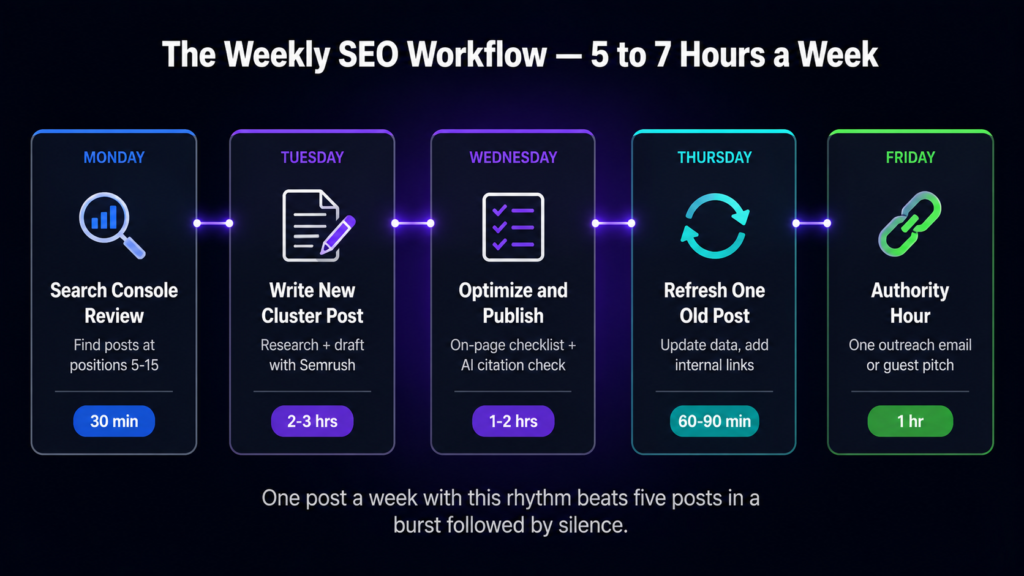
Monday: Search Console review (30 minutes). Open Google Search Console and check positions for your tracked keywords. Note every post sitting in positions 5 to 15. These are your refresh candidates, and they are the fastest wins available: a post at position 8 needs a small push to reach page-one visibility, while a post at position 40 needs months. Prioritize accordingly.
Tuesday and Wednesday: produce one new cluster post. Research with Semrush or Ahrefs through GFXToolz, follow the on-page checklist from Step 3, run the AI citation checklist from Step 2, and publish. One genuinely good post per week. Not three rushed ones.
Thursday: refresh one older post. Update the data and statistics. Change year references where relevant. Add internal links pointing to posts published since this one went live. Resubmit the URL for indexing in Search Console. A refresh takes 60 to 90 minutes and frequently moves a position 5-15 post onto page one within two to three weeks.
Friday: authority hour. One guest post pitch, one partnership email, or one resource page outreach. Just one. Fifty-two outreach actions a year produces more quality links than a frantic burst of a hundred emails in launch month followed by nothing.
Track everything in a simple sheet: keyword, current position, last updated date. Nothing fancier is needed. The sheet exists so that Monday’s review takes 30 minutes instead of starting from scratch.
Most bloggers fail at ranking not because they lack knowledge but because they lack a rhythm. One post a week with this workflow beats five posts in a burst followed by a month of silence. Iteration beats intensity in 2026 SEO, and Google’s freshness and consistency signals are effectively measuring exactly that.
How Long Does It Take to Rank on Google in 2026? (The Honest Timeline)
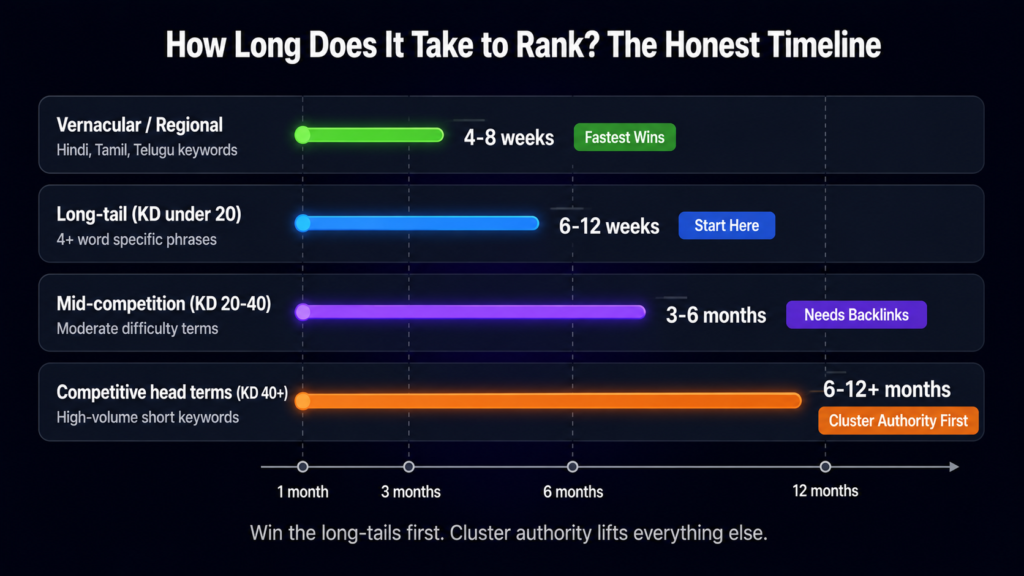
Anyone selling guaranteed rankings is selling a story. Here is what realistic timelines look like by keyword type:
| Keyword Type | Realistic Timeline | What to Do While Waiting |
|---|---|---|
| Long-tail, low competition (KD under 20) | 6–12 weeks | Build 3–4 supporting cluster posts; add internal links |
| Mid-competition (KD 20–40) | 3–6 months | Run the refresh cycle + earn 2–3 quality backlinks; grow the cluster |
| Competitive head terms (KD 40+) | 6–12+ months | Win the long-tails first; head terms follow cluster authority |
| Vernacular/regional keywords | 4–8 weeks | Lowest competition in Indian SEO; the fastest wins available |
The pattern to internalize: long-tails rank first and fund the patience required for harder terms. As your cluster fills out and internal links accumulate, the mid-competition keywords start moving without additional direct effort, because cluster authority lifts everything inside the cluster.
No one can guarantee position 1, including this guide. What you control are the conditions that make ranking probable: keyword selection, content quality, structural correctness, technical health, and consistency. Control those and the probability compounds in your favour every week.
The Affordable Tool Stack for How to Rank on Google 2026
Here is the barrier nobody addresses honestly: the professional SEO stack at retail prices locks most Indian bloggers out entirely. Semrush costs Rs 11,600 per month. Ahrefs costs Rs 8,300. Surfer SEO costs another Rs 8,300. That is Rs 28,000+ per month before you have written a word, which is more than most Indian bloggers earn from their blogs in a year of starting out.
The fix is group-buy access. GFXToolz from Rs 423 per month includes Semrush, Ahrefs, and 100+ other SEO tools. The Premium plan at Rs 846 per month adds Surfer SEO, Canva Pro, Grammarly, and the AI Studio with Nano Banana Pro and Flux 2 for generating unique post images, which feeds directly back into the AI citation checklist from Step 2.
On top of the paid layer, the free layer covers monitoring: Google Search Console, PageSpeed Insights, and Google Trends cost nothing and handle position tracking, technical testing, and trend research respectively.
One honest scope note: tools do not rank pages. They remove guesswork. Semrush tells you which keywords are winnable; it does not write the post. The weekly workflow above is what ranks pages. The tools just make every step of it faster and better-informed.
FAQ
How do I rank on Google in 2026 as a complete beginner?
Start with low-competition long-tail keywords (difficulty under 30), write content that answers the query within the first 200 words and includes first-hand experience markers, follow the on-page checklist (keyword in title, slug, H2s, first paragraph, meta description), fix your Core Web Vitals, and publish on a consistent weekly rhythm. Expect your first rankings in 6 to 12 weeks for long-tail terms.
What are the most important Google ranking factors in 2026?
The highest-weight cluster in 2026: search intent match, E-E-A-T with demonstrated first-hand experience, behavioral signals like dwell time and engagement, topical authority across a content cluster, Core Web Vitals, and quality backlinks from relevant sites. Keyword stuffing and thin content published at scale are actively penalised rather than merely ignored.
How does Google AI Overviews affect how to rank on Google 2026?
AI Overviews appear in roughly 60% of searches and answer queries above the organic results. Being a cited source inside the Overview now matters as much as your ranking position below it. To get cited: answer the exact query within the first 200 words, add FAQ schema, structure content with clean headings and comparison tables, and include original data or examples that AI systems cannot find on other pages.
How long does it take to rank on Google’s first page in 2026?
Long-tail keywords: 6 to 12 weeks. Mid-competition keywords: 3 to 6 months. Competitive head terms: 6 to 12 months or longer. Vernacular and regional-language keywords in India often rank within 4 to 8 weeks because competition is dramatically lower. New sites should win long-tails first and let accumulated cluster authority lift the harder terms over time.
Which SEO tools do I need to rank on Google in 2026?
The minimum stack: Google Search Console (free) for monitoring, a keyword research tool like Semrush or Ahrefs for finding winnable keywords, and an on-page optimiser (Rank Math’s free version works). At retail, the paid tools cost Rs 20,000+ per month. Through GFXToolz the same tools start at Rs 423 per month, which is the practical access path for Indian bloggers.
The Rules Changed. The Discipline Did Not.
How to rank on Google 2026 comes down to five things working together: winnable keywords, citable content, clean on-page execution, technical hygiene, and a weekly rhythm that never stops. Every step in this guide exists to serve one of those five.
Pick one long-tail keyword this week. Write the post using the checklists above. Repeat weekly for 90 days and then check your Search Console. That is the entire secret, and the reason it works is that almost nobody actually does it consistently.
The tool barrier is solved: Rs 28,000 per month of SEO software costs Rs 423 per month on GFXToolz. The remaining variable is your consistency.
Leave a Comment