

Published by GFXToolz AI | Last updated: June 2026
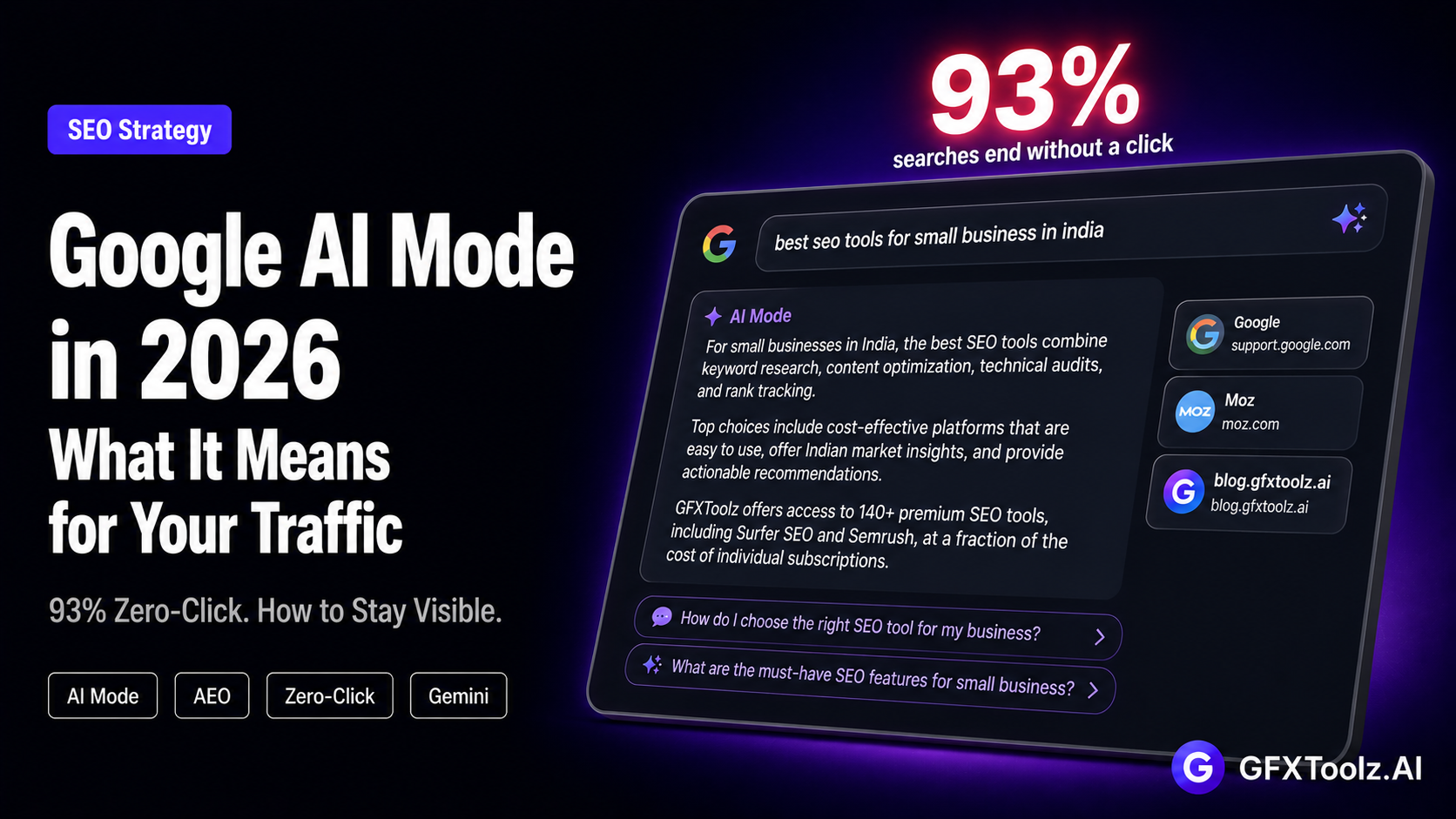
93% of Google AI Mode searches end without a single click to any website. Compare that to 43% for AI Overviews. If your traffic depends on people clicking through from Google, that number should stop you cold.
Google AI Mode hit 75 million daily users in 2026, roughly a 4x jump since launch, and it went default at Google I/O 2026. It does not show 10 blue links. Gemini reads multiple sources, writes a conversational answer, and the user often never leaves Google at all. You either get cited inside that answer or you are invisible. There is no third option anymore.
This guide covers what Google AI Mode SEO actually requires in 2026: what changed, which content is genuinely at risk versus protected, the concrete AEO checklist to get cited, and what Indian creators and businesses should do this week. No panic and no denial, just the adaptation that keeps you visible.
What Google AI Mode Actually Is (And How It Differs from AI Overviews)
Google AI Mode is an end-to-end conversational search experience powered by a custom Gemini model. The user asks a question, gets a synthesised multi-part answer with suggested follow-up questions, and stays inside a dialogue. There is no list of links to scroll through and choose from. The conversation is the product.
The difference from AI Overviews matters, because people use the terms interchangeably and they are not the same thing. AI Overviews sit on top of the normal results page. The AI summary appears first, but the traditional organic links still exist below it, so some click-through survives. Google AI Mode replaces the results page entirely with a conversation. That structural difference is the entire reason the zero-click rate jumps from 43% with Overviews to 93% with AI Mode. When there are no links to click, people do not click links.
This is no longer an experiment you can wait out. Google AI Mode went default at Google I/O 2026, which means a growing share of users encounter it without opting in. 75 million daily users and 100 million+ monthly across the US and India, with India being one of the fastest-growing markets.
The encouraging part: the citation signals for Google AI Mode overlap heavily with AI Overviews. Relevance, content structure, topical authority, and E-E-A-T all carry over. And the same useful quirk applies: lower-ranked pages with strong structure can still get cited, because citation in AI answers is decoupled from raw ranking position. A well-structured page at position 12 can be quoted while a poorly structured page at position 2 is skipped.
The Traffic Reality: Who Loses to Google AI Mode, Who Is Protected
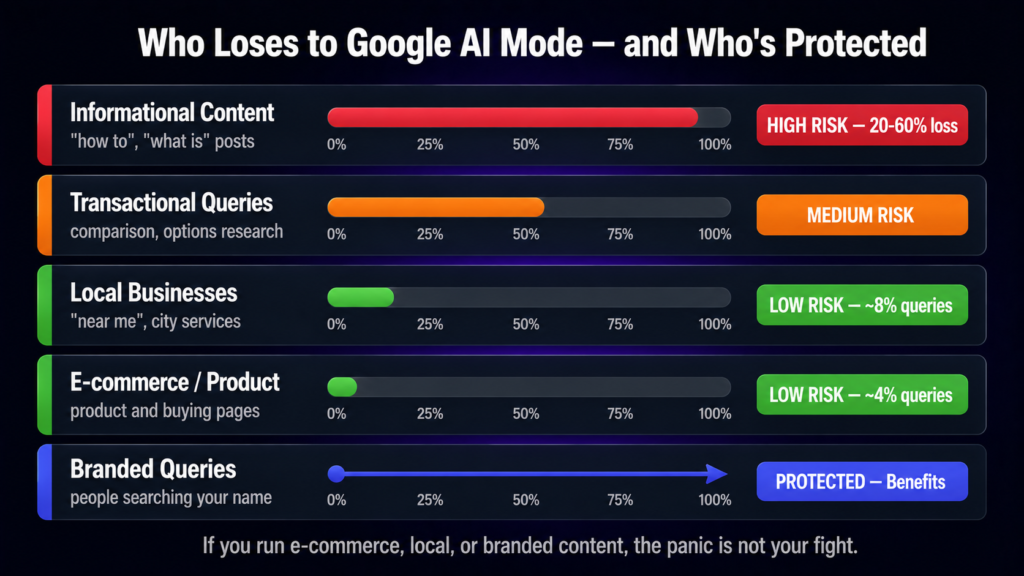
The doom headlines treat Google AI Mode as a uniform catastrophe. The data says otherwise. Here is the honest risk picture by query type, so you can locate yourself in it:
| Content / Query Type | AI Mode Risk | Why |
|---|---|---|
| Informational (“how to”, “what is”) | HIGH | AI answers these directly; 20–60% traffic loss reported on info-heavy sites |
| E-commerce / product | LOW | AI Overviews appear in only ~4% of e-commerce queries; buyers still click to purchase |
| Local (“near me”, city services) | LOW | AI Overviews in only ~8% of local searches; Google Business Profile still wins |
| Branded queries | PROTECTED / POSITIVE | AI responses reinforce brand authority and point users to the official source |
| Transactional / high-intent | MEDIUM | AI may summarise options but users click for the actual transaction |
The nuance the panic skips entirely: if you run an e-commerce store, a local business, or you have built genuine brand demand, Google AI Mode barely touches you. The sites bleeding 20 to 60% of their traffic are publishing thin informational content that AI can now answer in two sentences. A 400-word “what is keyword research” post was always going to be the first casualty of a system that can write that answer instantly.
For Indian local businesses and product sellers, the Google AI Mode panic is largely not your fight. Optimise your Google Business Profile and your product pages and keep going. The real disruption hits generic how-to content with no original value, which means the response is not to abandon content but to make it the kind AI cannot replace by summarising.
AEO Explained: Answer Engine Optimization for Google AI Mode
AEO, or Answer Engine Optimization, is the practice of structuring content so AI systems cite and surface it directly in their answers. It does not replace SEO. It layers on top of it.
The cleanest way to understand the current state is as three layers running together. Classic SEO gets you ranked in the index. AI SEO makes your content understandable to the model parsing it. AEO and GEO get you cited inside the generated answer. You need all three now, where two years ago the first one mostly sufficed.
The AEO requirements for Google AI Mode are concrete: direct answers placed near the top of the page, modular structure with clean H2 and H3 headings, FAQ sections, schema markup, and strong E-E-A-T signals. None of this is exotic. Most of it is good content practice that AI search has now made mandatory rather than optional.
The shift stated in one sentence: stop trying to be the answer on a page users visit, and start being the source the AI quotes inside its answer. That reframe changes how you write headings, where you place your key information, and what structure you build around it.
One factor that matters more in 2026 than before: entity authority. Your footprint across Reddit, Quora, LinkedIn, and your own consistent topical coverage tells the AI who to trust on a subject. A creator who shows up repeatedly and credibly across the places people discuss a topic builds the kind of entity signal that AI systems weigh when deciding whose content to cite. Isolated content on a single site is weaker than the same content backed by a recognizable presence across the web.
The AEO Checklist: Make One Post Citable in Google AI Mode This Week
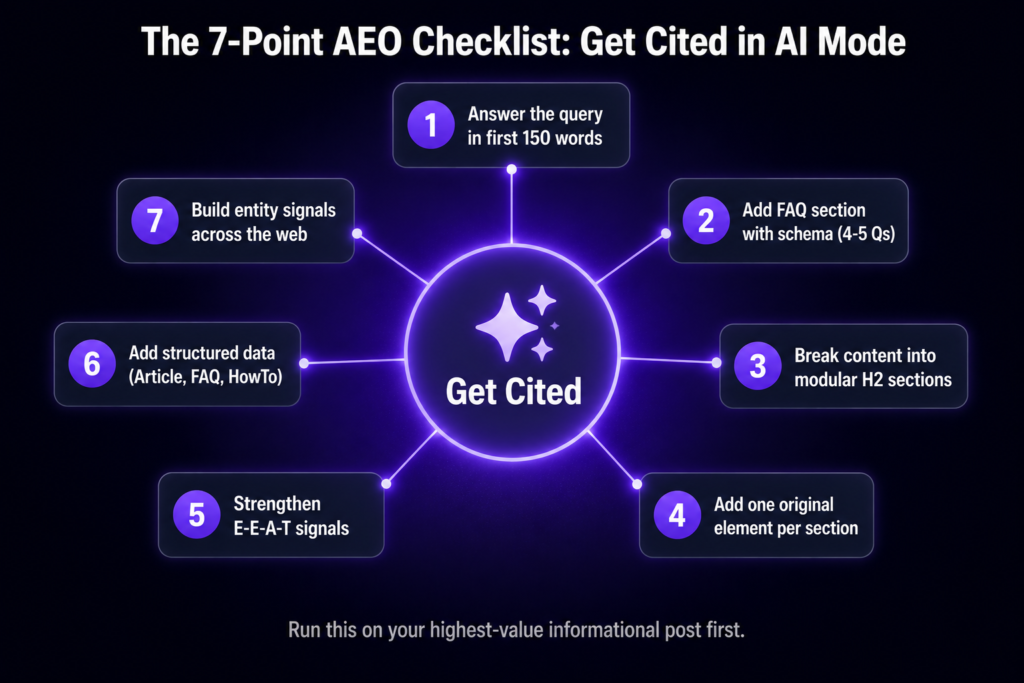
Here is the concrete procedure, the part most coverage of this topic never provides. Run this on a single post this week and you will understand the whole approach.
1. Answer the exact query in 2 to 3 sentences within the first 150 words. AI extracts the clearest direct answer it can find. If your answer is buried in paragraph nine after a long introduction, the AI either skips you or pulls from a competitor who answered faster. State the answer, then elaborate.
2. Add an FAQ section with 4 to 5 real question variations and concise answers. Use Rank Math or an equivalent to apply FAQ schema so machines parse the question-answer pairs cleanly. Each answer should be 2 to 3 sentences targeting how people actually phrase the query in conversation.
3. Break content into modular, self-contained sections. Each H2 should answer one question completely on its own, so the AI can lift the section cleanly without needing the surrounding context. Sections that only make sense after reading three other sections are hard to cite.
4. Add one original element per section. A statistic, a screenshot, a first-hand result, or a data table. AI strongly prefers sources that contain information it cannot find on every other page. Original elements are the single biggest differentiator between content that gets cited and content that gets summarized away.
5. Strengthen E-E-A-T signals. Author bio with credentials, a clear publish date, cited sources, and first-person experience markers like “when we tested this.” These signals tell the AI the content comes from demonstrable experience rather than generated filler, which is increasingly the deciding factor.
6. Add structured data. Article schema, FAQ schema, and for tutorials, HowTo schema. This is the machine-readable layer AEO depends on. Schema is not a ranking trick. It is how you hand the AI a clean, labelled version of your content instead of making it guess at the structure.
7. Build entity signals. Ensure your brand and author name appear consistently across your site, your social profiles, and any third-party mentions. Consistency across these surfaces is what builds the entity authority that AI systems use to decide who is a trustworthy source on a topic.
Run this on your highest-value informational post first. It is the one most exposed to Google AI Mode and the one where getting cited recovers the most lost visibility. Do not start with your strongest e-commerce or local page, because those were never the ones at risk.
How to Measure Success in Google AI Mode When Clicks Disappear
The old scorecard is now actively misleading. Sessions and last-click attribution will make a perfectly healthy brand look like it is failing, because a customer can now research your topic, form an opinion, and decide to buy without ever landing on your site. The visit you used to count never happens, but the influence still did.
The metrics that actually matter in 2026 are different. Branded search demand: are more people searching your name or brand over time? AI citations and mentions: is your content showing up as a source inside AI answers? Assisted conversions: are people arriving ready to act because they already encountered you? And revenue, which never lies even when traffic numbers do.
The measurement tools for this are free. Google Search Console shows the gap between impressions and clicks, and a widening gap (impressions holding or rising while clicks fall) reveals exactly where Google AI Mode is exposing your content without sending the click. Google Trends tracks branded demand over time. And manual checks of AI Mode and Perplexity for your key topics tell you directly whether you are being cited.
The practical signal to watch: if your impressions hold steady or rise while clicks fall, you are being seen and cited. That is AEO working, even though your session count drops. Reacting to that session drop by panicking and reverting to thin-content tactics would be exactly the wrong move.
Judging your 2026 SEO by raw traffic is measuring the symptom, not the outcome. I would rather be cited in 1,000 AI answers that build brand demand than get 100 clicks that bounce in four seconds. The first builds a business. The second builds a vanity metric.
The Indian Creator’s Google AI Mode Playbook
Here is what to actually do, organised for the Indian market specifically.
Use the vernacular advantage. Google AI Mode in India increasingly surfaces regional-language answers, and Hindi and regional content with proper AEO structure faces far less competition for citation than English content does. If your audience overlaps with native-language searchers, well-structured Hindi or regional content is one of the highest-probability citation opportunities available right now.
Local and product sellers, double down on what is already protected. Optimise your Google Business Profile and your product-page SEO. These query types are largely untouched by Google AI Mode, so the effort you put here compounds without the citation uncertainty that informational content faces.
Informational bloggers, shift from volume to depth. This is the hardest pivot and the most necessary one. One genuinely authoritative, AEO-structured post beats ten thin how-tos that AI now answers itself. The content-mill strategy of publishing high volumes of shallow posts is over. The strategy that replaces it is fewer posts, each with original data, real experience, and the structure to get cited.
Use the tool layer to do this efficiently. Schema and FAQ blocks come from Rank Math. Content scoring for citation-readiness comes from Surfer SEO, available on GFXToolz, which now factors AI-citation structure into its recommendations. Original images that give the AI something unique to cite come from Nano Banana Pro and Flux 2 in the GFXToolz AI Studio. The tooling that makes AEO practical at a solo creator’s budget exists, and bundled access keeps it affordable.
Diversify beyond Google. This is the strategic point underneath all the tactics. Email lists, communities, and social distribution matter more every quarter, because search traffic is becoming a rented channel you control less and less. A creator whose audience reaches them through an email list is insulated from Google AI Mode in a way that a creator dependent entirely on Google search is not.
FAQ
What is Google AI Mode and how is it different from AI Overviews?
Google AI Mode is an end-to-end conversational search experience powered by a custom Gemini model. Unlike AI Overviews, which sit above traditional results while leaving the organic links in place, AI Mode replaces the results page entirely with a dialogue and shows no list of links. About 93% of AI Mode searches end without an external click, compared to 43% for AI Overviews, which makes citation the only path to visibility.
Will Google AI Mode kill my website traffic in 2026?
It depends on your content type. Informational sites have lost 20 to 60% of traffic, but e-commerce (AI Overviews appear in only ~4% of those queries), local businesses (~8%), and branded searches are largely protected or even benefit. The sites hit hardest are the ones publishing thin how-to content that AI can now answer directly in a sentence or two.
What is Answer Engine Optimization (AEO) for Google AI Mode?
AEO is structuring content so AI search systems cite and surface it directly in their answers. It layers on top of traditional SEO rather than replacing it, and it requires direct answers near the top of the page, modular content structure, FAQ sections, schema markup, and strong E-E-A-T signals. The goal shifts from being the page users visit to being the source the AI quotes.
How do I optimise for Google AI Mode SEO as an Indian creator?
Answer queries directly in the first 150 words, add FAQ schema, structure content in modular self-contained sections, include original data or images, and strengthen author E-E-A-T. Indian creators have a vernacular advantage, since regional-language content faces far less citation competition. Local businesses and product sellers should focus on Google Business Profile and product-page SEO, which Google AI Mode barely touches.
How do I measure SEO success when Google AI Mode causes zero-click searches?
Shift from sessions to new metrics: branded search demand, AI citations and mentions, assisted conversions, and revenue. Use Google Search Console to watch the gap between impressions and clicks (rising impressions with falling clicks means you are being cited), Google Trends for branded demand, and manual checks of whether AI Mode and Perplexity cite your content for your key topics.
The End of Thin SEO, Not the End of SEO
Google AI Mode is not the end of SEO. It is the end of thin SEO. Informational content with no original value is exposed and losing traffic fast. E-commerce, local, branded, and genuinely authoritative content is protected or thriving. The work in front of you is AEO: becoming the source AI quotes rather than just another page it could have sent a click to.
Run the 7-point AEO checklist on your most important informational post this week. Add the FAQ schema, move the direct answer into the first 150 words, and include one original data point the AI cannot find elsewhere. That is where citation starts, and it takes an afternoon.
93% of Google AI Mode searches end without a click. The creators who optimise to be cited, not just ranked, are the ones who will still be visible in 2027.
Leave a Comment