

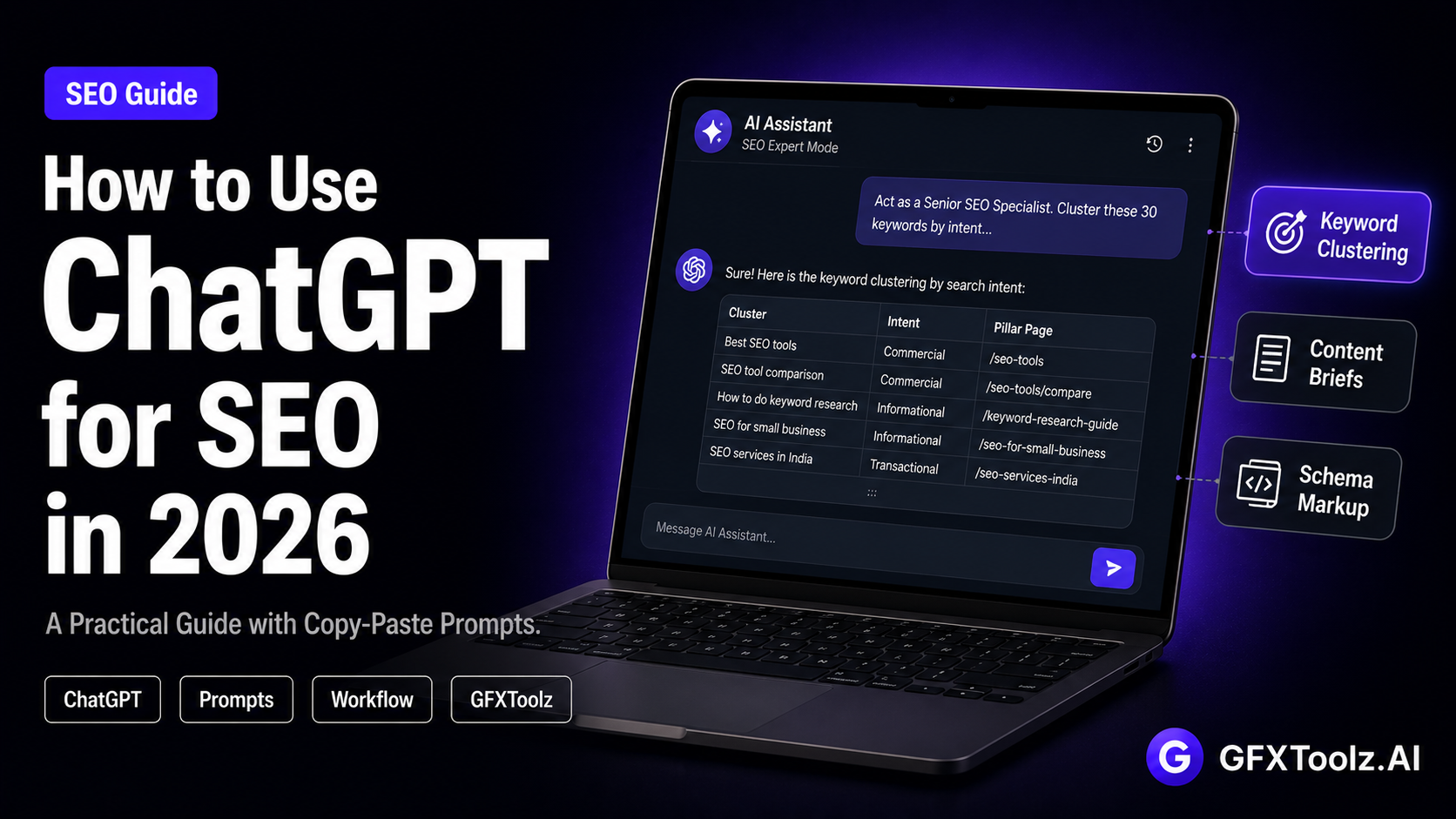

Published by GFXToolz AI | Last updated: June 2026
Most people use ChatGPT for SEO in the worst possible way. They type “write me an article about X”, paste the output straight into WordPress, and then wonder why it does not rank. In 2026, search engines are flooded with exactly that kind of generic AI text, and Google suppresses it on sight.
Here is the reframe that fixes everything. ChatGPT for SEO is not a writer you outsource your rankings to. It is an operations manager you direct. Used well, it handles keyword clustering, content briefs, internal-link mapping, and schema generation in minutes that would have taken you hours. Used badly, it produces thin pages that drag your whole site down. The entire difference is in how you prompt it and what you pair it with.
This guide shows exactly how to use ChatGPT for SEO in 2026, with a connected workflow and copy-paste prompts you can save and reuse. You will also learn the one thing ChatGPT genuinely cannot do, and the affordable tool that fills that gap without an agency budget.
A quick word on why this matters more in 2026 than it did even a year ago. Google’s systems are now trained to detect and suppress mass-produced generic content, and AI Mode and AI Overviews increasingly decide which sources to cite based on originality and demonstrated experience. The people who treated ChatGPT as a shortcut to skip the work are watching their traffic disappear. The people who treat it as an operations layer that makes the real work faster are pulling ahead. Same tool, both outcomes. The instructions below are how you end up on the right side of that split.
The Right Way to Think About ChatGPT for SEO
The mental model that separates people who get value from ChatGPT from people who get penalised: ChatGPT for SEO is an operations manager, not a content writer. It does logic, structure, and clustering brilliantly. It writes generic, forgettable prose poorly. Once you internalise that split, everything else follows.
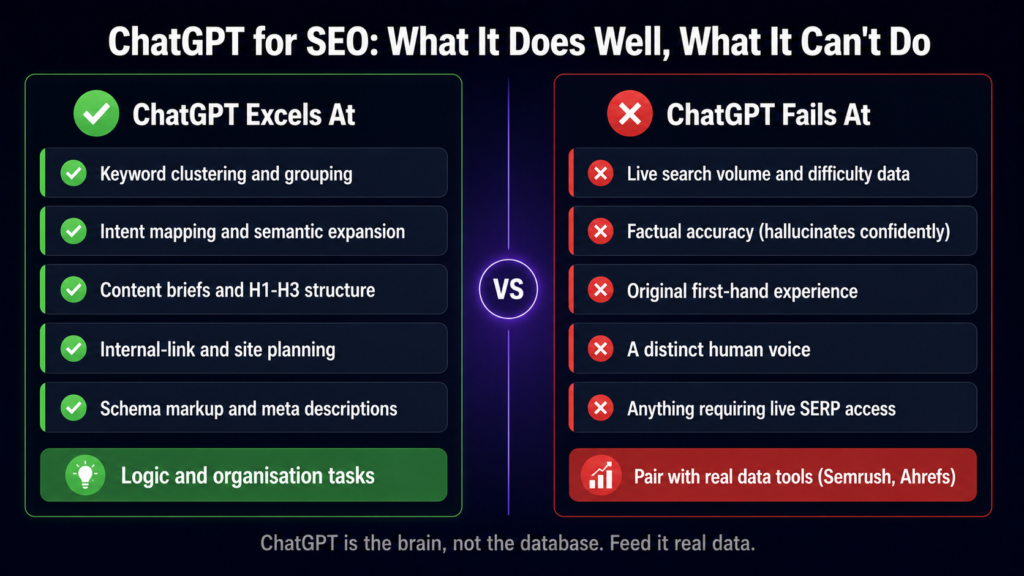
Here is what ChatGPT is genuinely great at: keyword clustering, semantic expansion, intent mapping, content briefs, silo and site structure, internal-link planning, schema drafting, and writing meta descriptions at scale. These are logic and organisation tasks, and the model is excellent at them. It can take a messy list of 50 keywords and group them into clean topic clusters faster than any human, and it does not get bored doing it.
Here is what ChatGPT is bad at, and where trusting it will hurt you: live search data, factual accuracy (it hallucinates confidently), original first-hand experience, and a distinct human voice. It does not know your real search volumes. It will invent a statistic that looks completely plausible. It has never actually used the product you are reviewing. These parts stay human or come from real data tools, every time, no exceptions.
The 2026 rule that ties it together: use ChatGPT for the skeleton and the busywork, then add human experience, original data, and editing for the parts that actually make content rank. The skeleton is fast and free. The experience and data are what get you cited and ranked. Confusing the two is the mistake that fills the web with content nobody reads.
The single biggest upgrade most Indian marketers can make is to stop asking ChatGPT to write and start asking it to think. The quality difference is night and day. A prompt that says “write an article about local SEO” gets you slop. A prompt that says “cluster these 30 keywords by intent and map them to a pillar-and-spoke structure” gets you a genuinely useful asset you could not have built as fast yourself.
Consider the contrast directly. A freelancer who asks ChatGPT to “write a 1,500-word post on keyword research” receives a competent-looking article that says exactly what 10,000 other competent-looking articles already say. No original data, no first-hand example, no distinct angle. It will sit on page 4 forever.
A freelancer who instead asks ChatGPT to “build a content brief for keyword research targeting Indian beginners, list the subtopics competitors miss, and mark where I should add a screenshot from my own Semrush account” receives a scaffold that, once filled with real screenshots and real experience, becomes a post that can actually compete.
Same tool, same five minutes of prompting, completely different outcome. The second freelancer treated ChatGPT as a thinking partner. The first treated it as a vending machine.
How to Write ChatGPT for SEO Prompts That Actually Work
A weak prompt produces weak output no matter how good the model is. Strong ChatGPT for SEO prompts follow a three-part formula: Clarity, Context, and Constraints.
Clarity means being specific about what you want. “Write about SEO” is not a task. “Give me 15 long-tail keyword ideas for a Pune-based dental clinic, grouped by funnel stage” is a task. The model can only be as precise as your request.
Context means telling it who you are, who your audience is, what your brand voice sounds like, and what your goal is. The same keyword request produces very different output for a budget freelancer in Indore versus a premium agency in Mumbai. Give it the context and it tailors accordingly.
Constraints means specifying word count, format, target keywords, and tone up front. “Format as a table.” “Keep each answer under three sentences.” “Do not use the word leverage.” Constraints are how you stop the model from defaulting to its generic patterns.
Use role prompting. Start your prompt with “Act as a Senior SEO Specialist” or “Act as an Information Architect.” This single technique sharpens output dramatically, because it tells the model which body of knowledge and which style to draw from. The difference between a generic answer and a specialist-framed answer is often just this one line.
Keep the conversation going. The first answer is always a draft, not a deliverable. Follow up, refine, push back. “Make cluster three more commercial.” “These titles are too generic, rewrite them with specific benefits.” The best output usually comes on the third prompt, not the first. People who give up after one response are leaving most of the value on the table.
Give it your real data. This is the highest-leverage habit. Paste your Semrush keyword export or your Search Console search terms directly into the prompt so the model works from actual demand instead of guessing. ChatGPT reasoning over real data is powerful. ChatGPT inventing data is dangerous.
Here is a master ChatGPT for SEO prompt you can copy, paste, and adapt:
Act as a Senior SEO Specialist. I run a [type of business] targeting [audience] in [city/India]. My brand voice is [helpful and casual]. My seed keyword is “[seed keyword]”. Give me 15 long-tail keyword ideas grouped into 3 topic clusters, with the likely search intent and funnel stage for each. Format as a table.
Fill in the brackets with your real details and you have a usable keyword map in seconds. Save this prompt. You will use it constantly.
The Connected ChatGPT for SEO Workflow (Seed Keyword to Published Post)
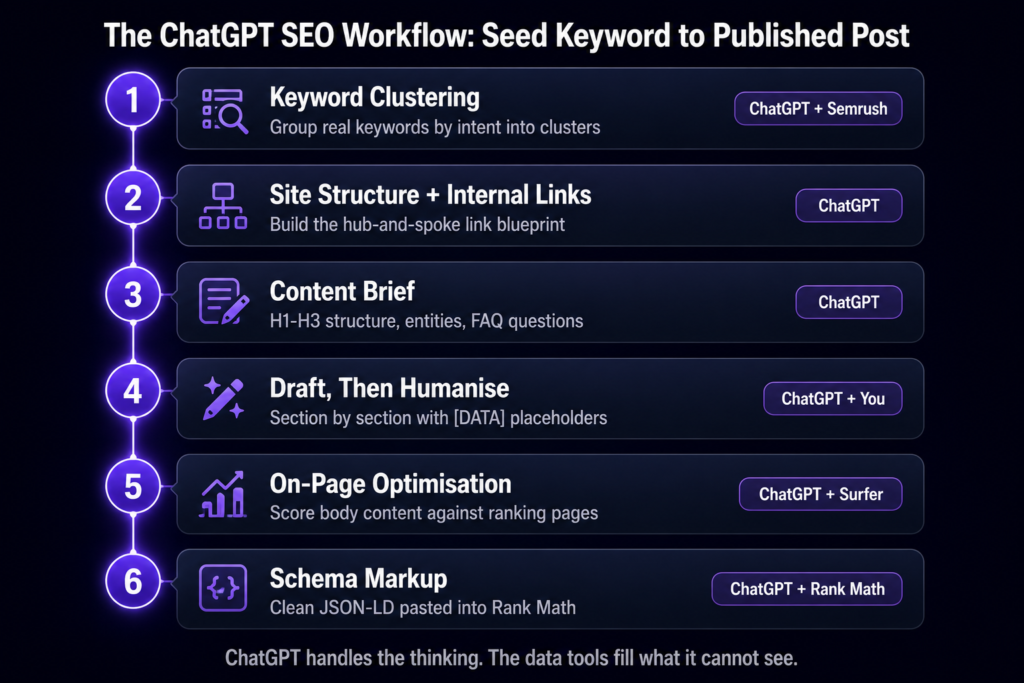
Most guides list individual ChatGPT tricks and stop. Here is the full chain, from a seed keyword to a published, optimised post. Each step has a copy-paste prompt and names the tool that fills the gap ChatGPT cannot.
Step 1: Keyword Clustering (ChatGPT + Semrush Data)
Pull real keyword data from Semrush or Ahrefs (both on GFXToolz), then let ChatGPT do the clustering it excels at.
Here is a list of keywords with their search volumes: [paste Semrush export]. Group them into topic clusters by search intent. For each cluster, suggest one pillar page and 3-5 supporting article titles. Format as a table with columns: Cluster, Intent, Pillar Page, Supporting Articles.
The output is a content plan grounded in real demand. The keywords come from Semrush; the organisation comes from ChatGPT. Neither tool could produce this alone.
Step 2: Site Structure and Internal Links
Act as an Information Architect. Create a site structure for a website about [niche]. Define 5 pillar pages (hubs). For each, suggest 5 supporting articles (spokes) and a URL hierarchy. For each spoke, give a specific instruction on how to link back to its hub and one related spoke.
This produces your internal-linking blueprint, one of the most undervalued ranking levers and one of the most tedious to plan by hand. ChatGPT builds the full hub-and-spoke map in one response.
Step 3: Content Brief That Forces Quality
Write a detailed SEO content brief for the topic “[primary keyword]”. Create a logical H1-H3 header structure that fully covers the search intent. List the entities and subtopics the article must include to be comprehensive. Suggest 5 FAQ questions. Note where original data or a first-hand example should be added.
A good brief is what prevents thin content. This prompt forces comprehensiveness by listing the entities and subtopics you must cover, and it explicitly marks where your human input goes.
Step 4: Draft, Then Humanise (ChatGPT + Your Voice)
Draft section by section, never all at once, then add your own examples, opinions, and Indian context.
Using the brief above, write the section under the H2 “[heading]”. Keep paragraphs short. Use simple, direct language. Do not use the words delve, landscape, leverage, tapestry, or realm. Leave a [DATA] placeholder where a statistic should go and an [EXAMPLE] placeholder where a first-hand example should go.
The placeholder technique is the key move here. ChatGPT writes the connective structure and explicitly flags where only you can add value, which keeps you from accidentally publishing a draft that has no original input. Never publish the raw output. The placeholders are instructions to yourself.
Step 5: On-Page Optimisation (ChatGPT + Surfer)
ChatGPT drafts the metadata; Surfer SEO (on GFXToolz) scores the actual content against the pages currently ranking.
Write 5 meta description options (under 155 characters each) for a post titled “[title]”. Make them action-oriented and include the keyword “[keyword]” naturally. Then write 3 SEO title options under 60 characters.
ChatGPT is fast and reliable at this structured, repetitive task. Surfer then tells you whether the body content itself matches what is ranking, which is something ChatGPT cannot see because it has no access to live SERPs.
Step 6: Schema Markup (ChatGPT Generates, You Paste)
Generate FAQ schema markup in JSON-LD format for these 5 questions and answers: [paste your FAQs]. Then generate Article schema for a post titled “[title]” by [author], published [date].
Schema is machine-readable structure that helps both traditional ranking and AI citation. ChatGPT produces clean JSON-LD you paste straight into Rank Math. This is one of its single most reliable SEO uses because it is pure structured generation with no room for the vague phrasing that hurts prose.
The One Thing ChatGPT for SEO Can’t Do (And How to Fix It Affordably)
Here is the hard limit you must respect: ChatGPT cannot give you live search volume, keyword difficulty, or competitor backlink data. It does not have access to that data, so when you ask, it guesses, and it often hallucinates numbers that look completely real. Never trust a search volume that ChatGPT produced on its own. This is the mistake that quietly ruins otherwise good SEO work, because a fabricated “2,400 monthly searches” looks identical to a real one.
What ChatGPT can do with keywords, once you feed it real data: clustering, intent classification, semantic expansion, and gap-finding. The pattern is consistent. Real data goes in, smart organisation comes out. The model is the brain, not the database.
The fix is simple: pair free ChatGPT with a real data tool. Semrush and Ahrefs are the standards, and at retail they cost Rs 11,600 and Rs 8,300 per month respectively. Through GFXToolz, both start at Rs 423 per month, which is what makes the full ChatGPT for SEO workflow affordable for an Indian freelancer or small business rather than just an agency.
The honest combo for Indian marketers on a budget: free ChatGPT as the brain, GFXToolz Semrush and Ahrefs as the data, Surfer as the content scoring, and Grammarly as the final polish. Everything except ChatGPT sits in one GFXToolz plan, which keeps the whole serious-SEO setup to a single affordable subscription plus a free chatbot account.
Every ChatGPT for SEO guide tells you to also use Ahrefs and then quietly leaves you to figure out the Rs 8,300 per month bill on your own. That gap is exactly why group buy access exists. Free brain, affordable data. The two halves of the workflow finally cost what an individual can actually pay.
For the full plan breakdown, see the GFXToolz pricing guide (Post #28).
Who Does What: The ChatGPT for SEO + Tools Handoff
To make the division of labour concrete, here is which tool owns which job and why:
| Job | Best Tool | Why |
|---|---|---|
| Live keyword data | Semrush / Ahrefs (GFXToolz) | ChatGPT cannot access real volume or difficulty; it hallucinates numbers |
| Keyword clustering + intent | ChatGPT (free) | Excellent at grouping and semantic expansion once fed real data |
| Content briefs + structure | ChatGPT (free) | Builds H1-H3 skeletons and internal-link plans fast |
| On-page content scoring | Surfer SEO (GFXToolz) | Scores against live top-ranking pages; ChatGPT cannot see SERPs |
| Schema markup | ChatGPT (free) | Generates clean JSON-LD you paste into Rank Math |
| Grammar + final polish | Grammarly (GFXToolz) | Catches errors and tone issues in the human-edited draft |
The takeaway is the whole point of this guide: ChatGPT for SEO is one tool in a pipeline, not the entire pipeline. It handles thinking and structure for free. GFXToolz covers the data and scoring layer that ChatGPT physically cannot touch, from Rs 423 per month. Used together, they cover the full workflow at a fraction of the retail cost of the data tools alone.
How to Fact-Check ChatGPT for SEO Output (The Verification Routine)
Treat everything ChatGPT produces as a confident draft from a smart assistant who sometimes makes things up. Run this verification routine before anything goes live.
Verify every statistic. If ChatGPT gives you a number, find the original source for it. If you cannot find the source, delete the number. Most fabricated stats look entirely plausible, which is exactly why they are dangerous. A wrong statistic in a published post damages your credibility and can get the content flagged as unreliable.
Cross-check all keyword data against Semrush or Ahrefs. Never use a search volume or difficulty figure that ChatGPT generated on its own. This is the single most common ChatGPT for SEO error, and it leads people to target keywords that either have no real search demand or are far too competitive to win.
Read for generic phrasing. If a paragraph could appear on any website in any niche with a few words swapped, it is filler. Rewrite it with your specifics, your numbers, and your experience. Generic phrasing is what Google’s systems are trained to suppress in 2026.
Add what AI cannot. A first-hand result, an Indian example, a genuine opinion, a screenshot of something you actually did. This is the experience signal that Google rewards and that AI search engines cite. It is also the part no competitor using raw ChatGPT output will have, which is your entire advantage.
Run a final human edit out loud. Read the post aloud before publishing. If it does not sound like a person talking, it will not connect with readers and it will not get cited by AI search systems that increasingly favour natural, authoritative content. Your ear catches what your eye skims past.
To see how much this matters, picture a real failure case. A marketer asks ChatGPT for “the average conversion rate for Indian e-commerce stores” and gets back a confident “the average conversion rate for Indian e-commerce stores is 1.8%.” It sounds right. It looks citable. But ChatGPT has no live access to that figure, and when the marketer searches for the source, none exists that says exactly that.
Published as-is, that single fabricated number undermines the credibility of the entire post the moment a knowledgeable reader checks it. Caught during verification, it costs nothing. The whole routine exists to catch confident-sounding fabrications before they reach a reader, because the model will never tell you which of its statements are invented and which are real. That judgement stays yours.
FAQ
Can ChatGPT for SEO do keyword research on its own?
Not fully. ChatGPT is excellent at keyword clustering, intent classification, and semantic expansion, but it cannot access live search volume or keyword difficulty, and it often hallucinates numbers. The reliable method is to pull real data from Semrush or Ahrefs (available on GFXToolz from Rs 423 per month) and then let ChatGPT organise, cluster, and expand that real data.
Will Google penalise content written with ChatGPT?
Google does not penalise AI-assisted content. It penalises unhelpful content. The danger is publishing generic, unedited ChatGPT output, which is thin and gets suppressed regardless of how it was made. Use ChatGPT for structure and drafting, then add first-hand experience, original data, and human editing. Quality content ranks regardless of the tool used to produce it.
What are the best ChatGPT for SEO prompts in 2026?
The highest-value prompts use role framing and clear constraints: “Act as a Senior SEO Specialist” for keyword clustering, “Act as an Information Architect” for site structure and internal links, and detailed content-brief prompts that specify H1-H3 structure, required entities, and FAQ questions. Always feed ChatGPT real keyword data rather than asking it to invent search volumes.
How do I use ChatGPT for SEO without paying for expensive tools?
ChatGPT’s free tier handles clustering, briefs, schema, and meta descriptions at no cost. The one thing it cannot do is provide live keyword data, which requires Semrush or Ahrefs. Instead of paying Rs 11,600 per month retail for Semrush, a group buy platform like GFXToolz provides it from Rs 423 per month, giving you the full free-brain plus affordable-data workflow.
Can ChatGPT write meta descriptions and schema markup?
Yes, and these are two of its best SEO uses. ChatGPT generates multiple meta description options within character limits and produces clean JSON-LD schema markup (FAQ, Article, HowTo) that you paste directly into Rank Math or your site. Always review the output, but for these structured, repetitive tasks ChatGPT is both fast and reliable.
Direct the Manager, Do Not Outsource the Writer
Use ChatGPT for SEO as an operations manager, not as a writer you hand your rankings to. Direct it with role prompts and clear constraints. Chain the workflow from keyword clustering through to schema. Feed it real data instead of letting it guess. Verify everything it produces. And add the human experience that is the actual reason content ranks and gets cited in 2026.
Save the copy-paste prompts above. Run one keyword through the full six-step workflow this week, from clustering to published post. Pair free ChatGPT with Semrush on GFXToolz for the live data it cannot give you, and you have a complete SEO production line.
ChatGPT is free and brilliant at thinking. The data layer it cannot touch costs Rs 423 per month on GFXToolz instead of Rs 11,600 at retail. That combination is the cheapest serious SEO setup available in India right now.
Leave a Comment